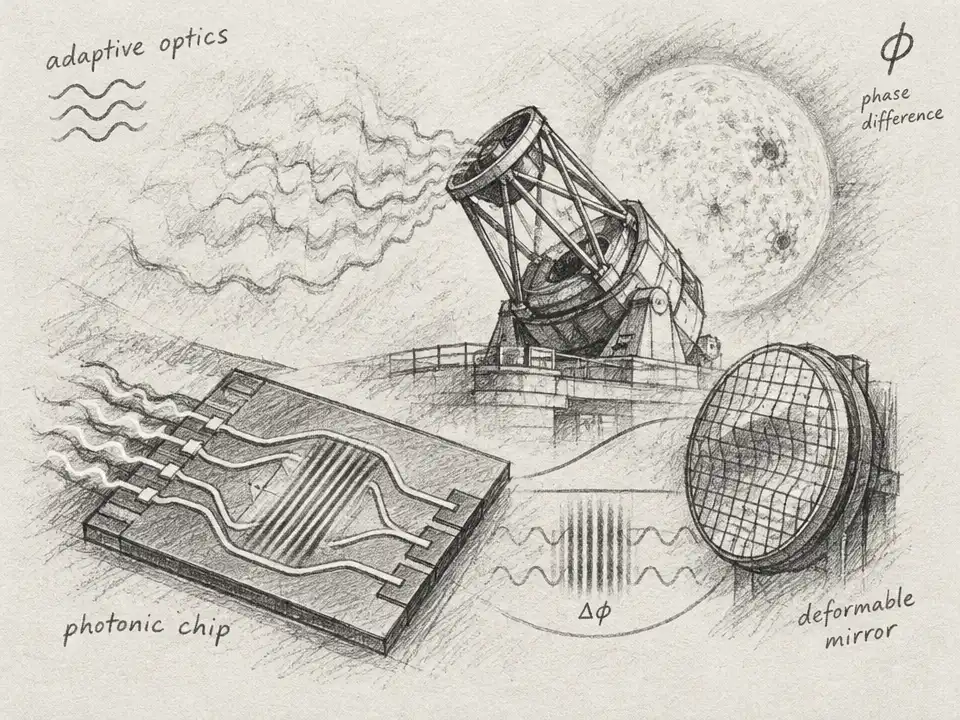
A telescope gathers faint light from the sky. Then the instrument behind it has to sort that light into useful clues: which colors are present, how the light’s waves line up, and what those details might reveal about a distant world. Traditionally, that work can take a lot of carefully aligned optics. In space, every extra kilogram, cubic inch, and watt competes with mirrors, power systems, and everything else the mission needs.
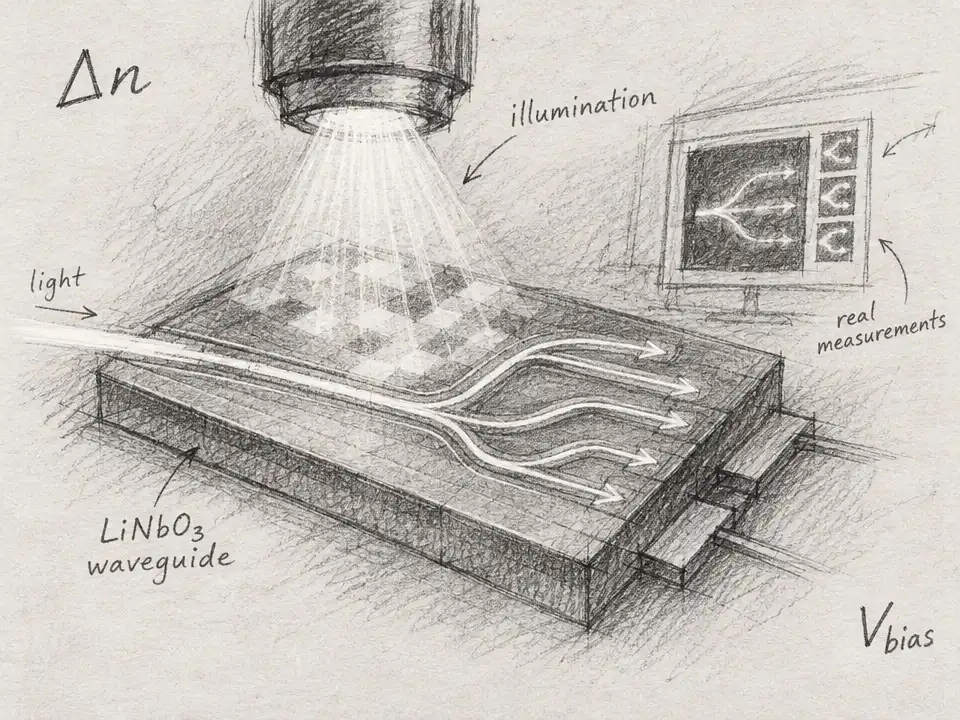
A different approach puts some of that optical work onto a photonic integrated circuit: a chip that guides light through tiny pathways. One component can separate wavelengths; another can split a beam into channels or bring several beams together. A photonic lantern, for instance, takes incoming light traveling in many patterns and feeds it into multiple narrower channels. Instead of building an optical bench from separate parts, engineers can route light through a compact, fabricated circuit.
The payoff could be unusually large. A review posted on arXiv on August 1, 2026, says photonic circuits could reduce the size, weight, and power demands of space optical subsystems by one to two orders of magnitude. Smaller instruments would not merely be tidier. They could make room for other equipment, reduce demands on spacecraft power, or help a large telescope carry sophisticated instruments without letting the optics grow along with its mirror. Chip-based beam combiners might also help future observatories make extremely precise measurements of starlight.
That is the possibility. The price is proving that a delicate optical circuit can survive a rocket launch and then work reliably in space. The new review does not report a fresh chip surviving a launch simulation. Instead, it tackles a less cinematic obstacle: space agencies have detailed qualification rules for many components, but no dedicated standard for astrophotonic circuits. Projects have had to adapt requirements written for other kinds of electronics, optoelectronics, and optical fiber.
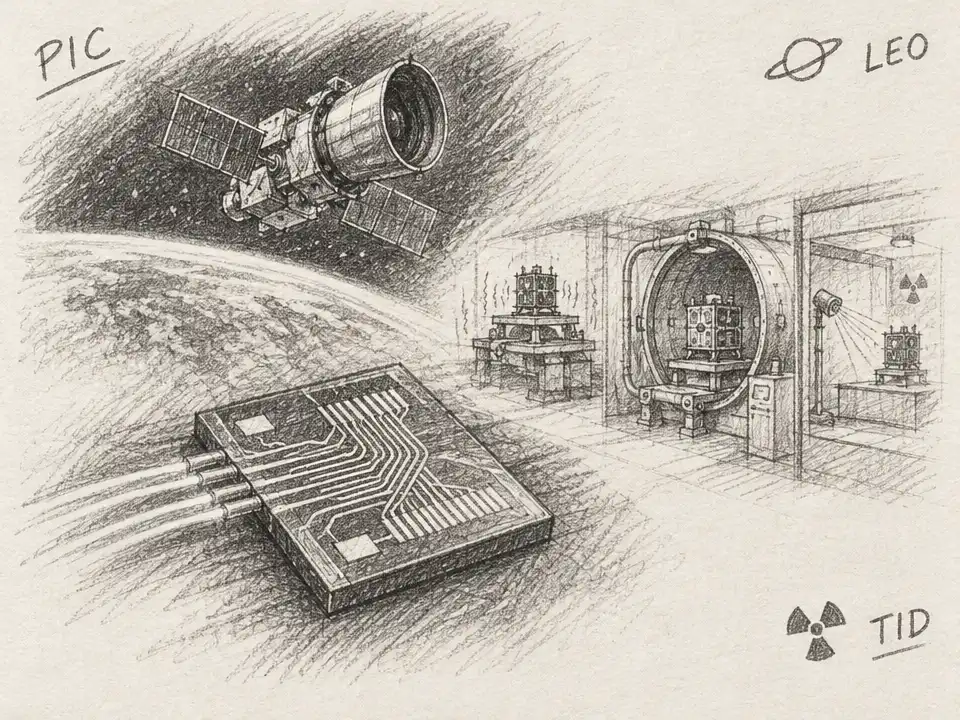
The authors’ proposed response is a seven-phase qualification template, built from a 19-step menu of tests. It starts with close inspection and measurements of how well the chip transmits light. Then come checks for packaging leaks and loose particles, followed by the ordeals familiar from spacecraft engineering: vibration, mechanical shock, hot-and-cold cycling, vacuum, and radiation. The purpose is to catch failures that a chip’s neat performance on a laboratory table cannot reveal.
Some of those checks sound almost mundane until the mission context comes into focus. A temperature-vacuum test asks whether the circuit still performs while it cycles between mission-specific temperatures in near-vacuum. The review lists at least four cycles as a typical qualification target, with eight recommended for new technology. Active components—parts such as lasers and photodetectors—face a proposed operating-life test lasting 2,000 hours, typically around 85 °C. A component that shifts slightly in a lab could become a serious problem when no one can reach it to realign or replace it.
One revealing twist is that the chip’s passive and active parts do not share the same main weakness. Passive pathways made from materials such as silica, silicon nitride, or laser-written glass can be highly resistant to radiation. The review summarizes prior tests reporting no measurable optical-loss change up to 1 Mrad of total ionizing dose and 1011 protons per square centimeter. But active devices—including some lasers, modulators, and photodiodes—are more likely to set the radiation limit. In other words, the light’s route through the chip may be sturdy while the parts that create, control, or detect it need much more scrutiny.
The same test menu can be adjusted to the mission. A small satellite demonstration in low Earth orbit and a flagship observatory near the Sun-Earth L2 point face different consequences if something fails. The proposed flow keeps a common structure but varies how many devices are inspected, how much margin is required, and how deeply every step is documented. A small mission could provide a comparatively affordable early flight test; a flagship would demand stronger evidence and tighter performance checks.
For astronomy, precision is not a bonus feature. A circuit that separates light correctly but drifts as it warms and cools may fail to deliver the stability a faint-signal instrument needs. Infrared systems may also have to operate at 80 K or below, adding cryogenic testing. Other hard problems sit at the interfaces: adhesives that attach fibers to chips must not release contaminants in vacuum, and packaging must protect the optical pathways without undermining their performance. The review identifies packaging, cryogenic qualification, radiation testing for some ultraviolet platforms, hybrid integration, and space-grade design tools as important gaps.
That makes the paper’s contribution a roadmap, not a launch-ready guarantee. Its authors assemble existing agency and industry procedures into a framework they propose for future projects; the framework itself still needs use, refinement, and, ultimately, flight experience. The paper argues that passive circuits are already approaching space readiness, while other pieces and specialized wavelength ranges need more work. A template can tell engineers what evidence to collect, but it cannot substitute for the evidence.
The frontier, then, is not simply making telescope instruments smaller. It is learning how to trust those instruments far from a repair bench. If photonic circuits pass that test, future spacecraft could carry capable optical systems that once demanded far more room and power. Before that future arrives, the chip has to prove itself in the shaker, the thermal-vacuum chamber, and the radiation beam—one demanding phase at a time.