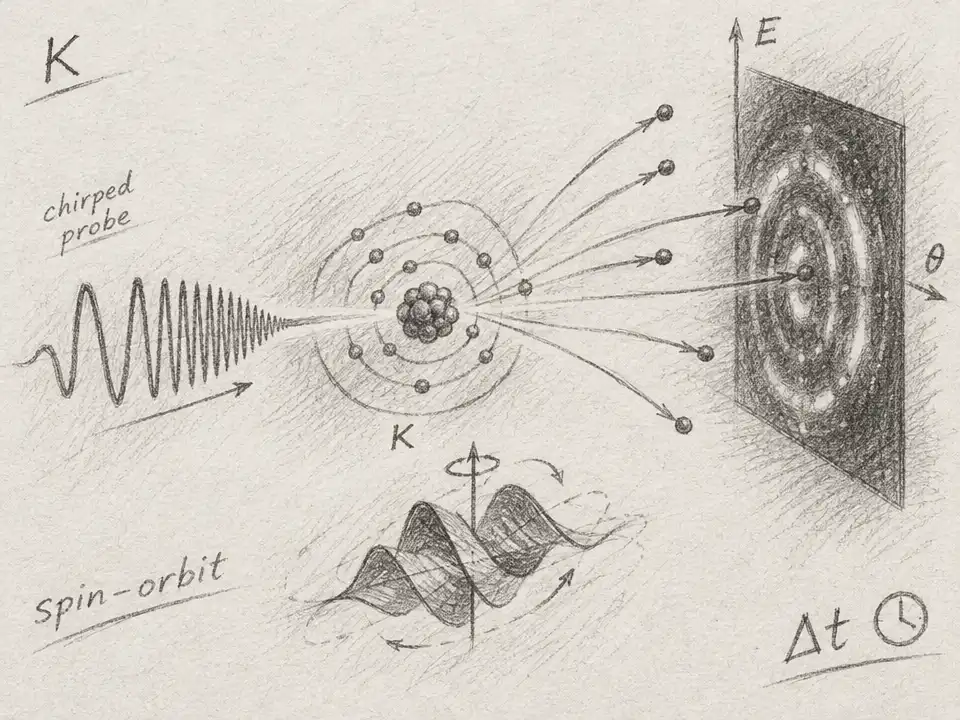
A powerful laser pulse hits helium, and the atoms answer with flashes of extreme-ultraviolet light. The familiar explanation is a quick three-step journey: an electron slips out of its atom, is swung around by the laser’s electric field, then crashes back and releases energy as light. But a recent experiment picked up a second, stranger signal—one that points to an electron that did not quite get away, and to atomic states usually considered too dark to shine.
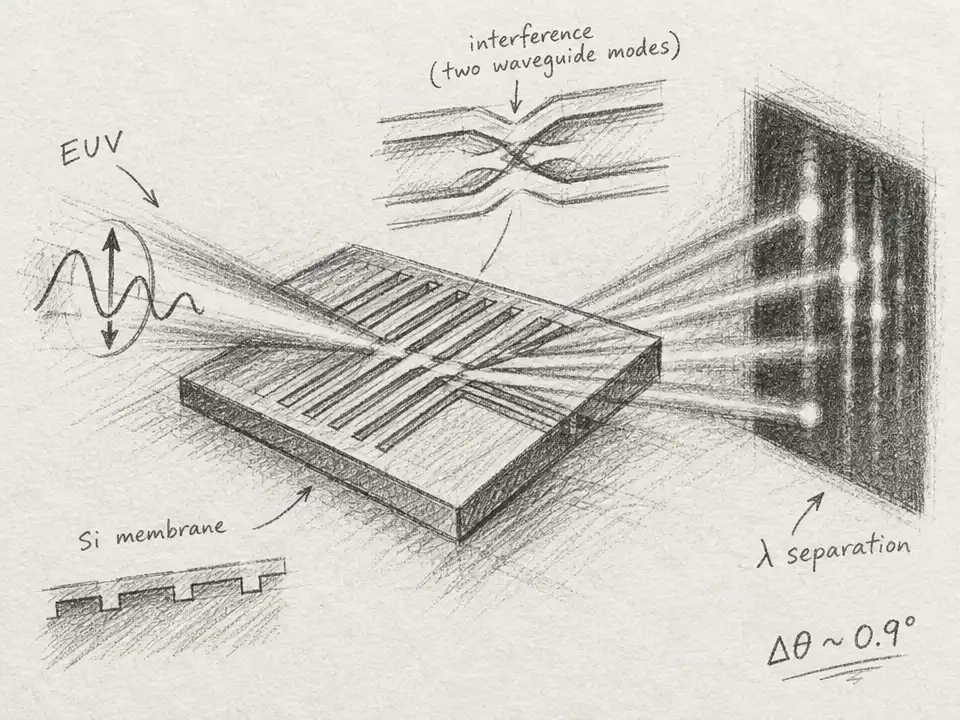
The researchers sent intense, few-cycle visible-light pulses through helium gas and measured the ultraviolet light that emerged. Their pulse reached a peak intensity of 3.9 × 10¹⁴ W/cm2. In the spectrum, familiar emissions appeared alongside narrow sidebands near 22.5 and 25.6 eV. The sidebands spread across a wider range of angles than the ordinary high-harmonic signal, which was confined to about ±0.5 mrad. Their energies did not line up with helium’s usual bright transitions. Something else in the atom-and-laser encounter seemed to be making them.
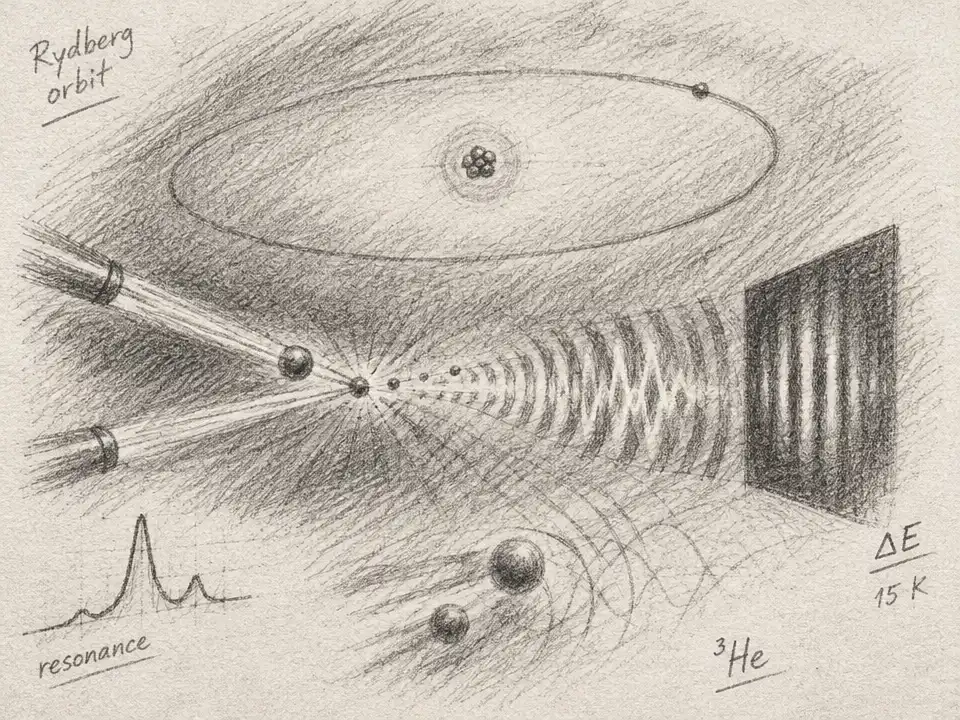
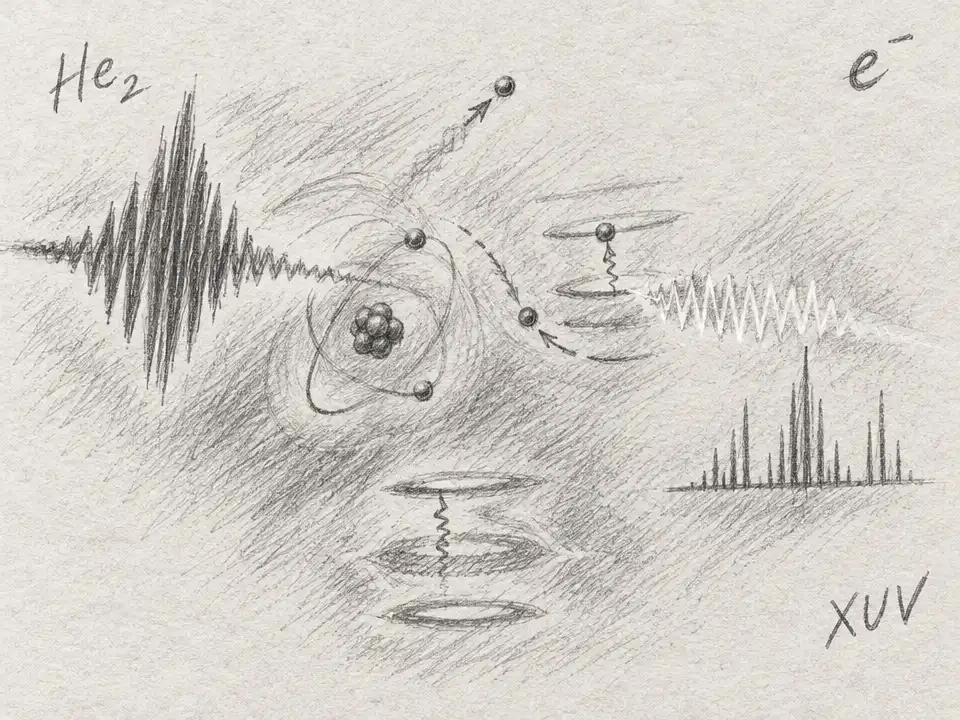
To see what might be happening, zoom in from the whole beam to one electron’s near-escape. In strong fields, an electron can tunnel through the barrier that normally confines it to the atom. Some electrons then travel away and return with enough energy to produce high-harmonic light. Others follow a less decisive route: the laser’s changing field turns them around before they escape for good. The atom survives, but the electron can be left in an excited state. Physicists call this frustrated tunneling ionization. “Frustrated” is apt: the electron has started to leave, but never completes the escape.
That return can leave helium in a peculiar condition. Some of the excited states that receive the recaptured electrons are “dark”: a basic quantum selection rule forbids them from absorbing or emitting a single photon directly to or from the atom’s ground state. Dark does not mean empty or inert. It means that one particular optical doorway is closed. In helium, the calculations identify populated states of the 1sns and 1snd families among these normally forbidden destinations.
The surprise is that the laser pulse does not vanish when its brightest moment passes. A faint tail continues after the main burst. While that residual field is present, it can dress an excited dark state—changing the available energy pathways, rather like adding a temporary rung to a ladder. The authors describe the resulting states as Floquet-like light-induced states. With this extra dressing, a transition that was forbidden in the field-free atom can become possible: the dark-state population can contribute to extreme-ultraviolet emission, producing sidebands rather than only the usual bright-state lines.
The experiment recorded those sidebands, but it did not film individual electrons being recaptured. To test their interpretation, the team also calculated how a helium atom responds to a laser pulse, using a time-dependent Schrödinger-equation model. With an idealized pulse that ended cleanly, the calculation produced sharp emissions associated with bright states. When the researchers included a longer, more realistic pulse tail, extra features appeared between those bright lines and above the ionization threshold, in the same spectral regions as the measured sidebands. Increasing the modeled tail’s strength enhanced the emission near 22 eV.
The simulations also reveal why this signal belongs to a longer story than ordinary high-harmonic generation. The researchers examined the calculated emission at two time scales: a 434-attosecond window that resolves the ultrafast harmonic bursts, and a 21.7-femtosecond window that can distinguish narrower spectral features. The dark-state-related structures appear in the longer-window analysis and require a nonzero residual field. That supports the proposed delayed pathway, but it is a theoretical time-frequency analysis, not a direct experimental recording of the atom’s evolution frame by frame.
There is another clue in the shape of the light. The unusual emissions fan out more broadly than the ordinary harmonic beam. The paper connects that divergence to the longer electron trajectories associated with frustrated tunneling ionization: a longer trip accumulates more phase and becomes more sensitive to the details of the driving pulse. Meanwhile, the bright-state emissions can persist through the atom’s polarization after the pulse, whereas the light-induced sidebands are active only while the dressing field remains. The pulse’s fading end is not just an afterthought; it is part of the mechanism.
This gives laser physicists a new control knob to explore. Instead of treating the pulse tail as unwanted residue, researchers could tune its intensity or color to steer which light-induced states become accessible, and potentially strengthen XUV emission at selected energies. The paper presents that as a possibility, not a finished source. The work also points to a practical reason to care: nonlinear techniques used to compress laser pulses can leave weak residual pedestals, and those faint leftovers may influence experiments designed to study ultrafast matter.
In the standard picture, the important action happens during the laser’s peak: an electron departs, returns, and flashes. This experiment opens a smaller window onto what follows. A failed escape can leave an atom excited; a weak field, lingering after the main burst, can briefly make a forbidden route visible. In helium, the light that reveals this hidden passage is not the brightest part of the pulse, but its quiet, fading tail.