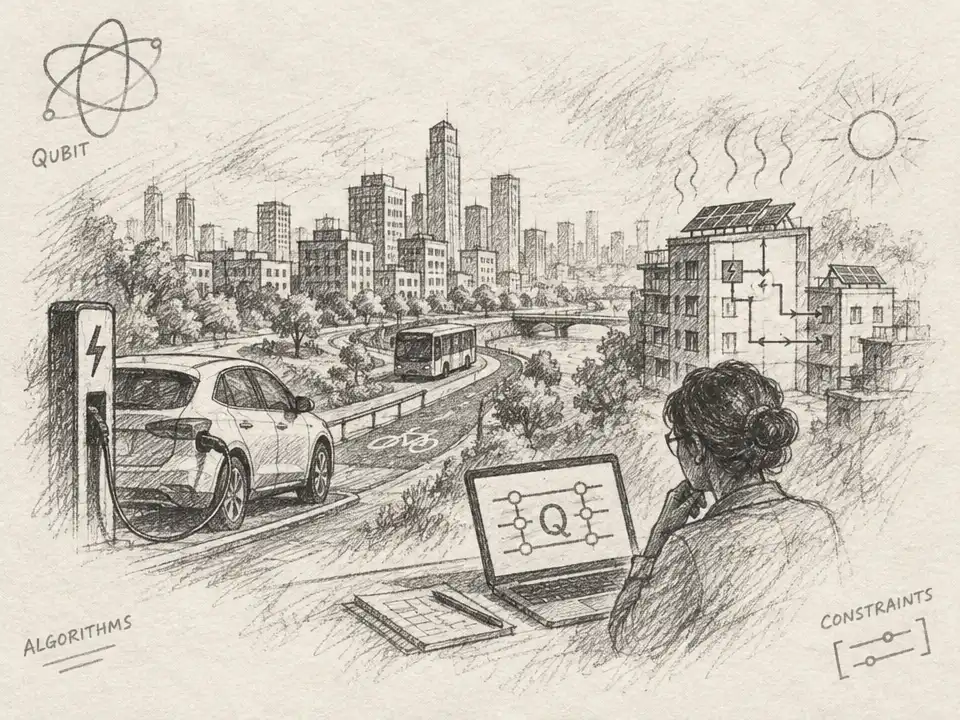
Imagine a heat wave settling over a city just as electricity demand climbs. Building managers want air-conditioning; drivers need chargers; transit planners need routes that still work if a road or power link fails. Each decision affects the others. The tempting challenge is to find the best plan for the whole city at once. But a new meeting between quantum computing and urban planning points to a more modest—and potentially more useful—question: can a quantum machine help planners sort through one small, stubborn tangle of choices?
The tangle is real, even if this scene is hypothetical. A city’s energy and transport systems are coupled networks, not separate checklists. Where chargers go influences travel and power demand. When buildings run their cooling equipment can affect the grid. A blocked link may change which neighborhoods can reach a shelter. Add constraints such as cost, capacity, timing, and comfort, and the number of possible arrangements can grow quickly.
This is where ideas from quantum information science meet a different discipline: combinatorial optimization, the search for good arrangements among many discrete options. A planner might represent a choice as on or off: install a charger at a site or don’t; include a road in a disruption scenario or leave it open. A quantum algorithm can encode those choices in a physical system and use quantum effects to influence which candidate answers are more likely to be measured. That is not the same as reading every possible answer at once, nor does it guarantee the best one.
Two recent papers sketch possible roles for this technology in city systems. One considers buildings, energy management, and urban microclimates; the other takes a critical look at transport planning. Together, they suggest that the most plausible near-term task is not to replace a city’s planning software. It is to help screen a limited set of difficult, discrete choices—perhaps combinations of vulnerable transport links or possible locations for charging stations—before conventional tools do the heavier work.
That distinction matters. Transport planning is already served by mature classical methods, including optimization approaches that can handle large networks, detailed constraints, and policy questions. A quantum version may require planners to translate a practical problem into a new mathematical form. Continuous quantities, like traffic flow, may need to be simplified into discrete choices; constraints may need extra variables to fit the model. In doing so, a problem can swell rather than shrink. The transport review concludes that reliable, repeatable quantum advantages on realistic city-scale problems have not yet been established.
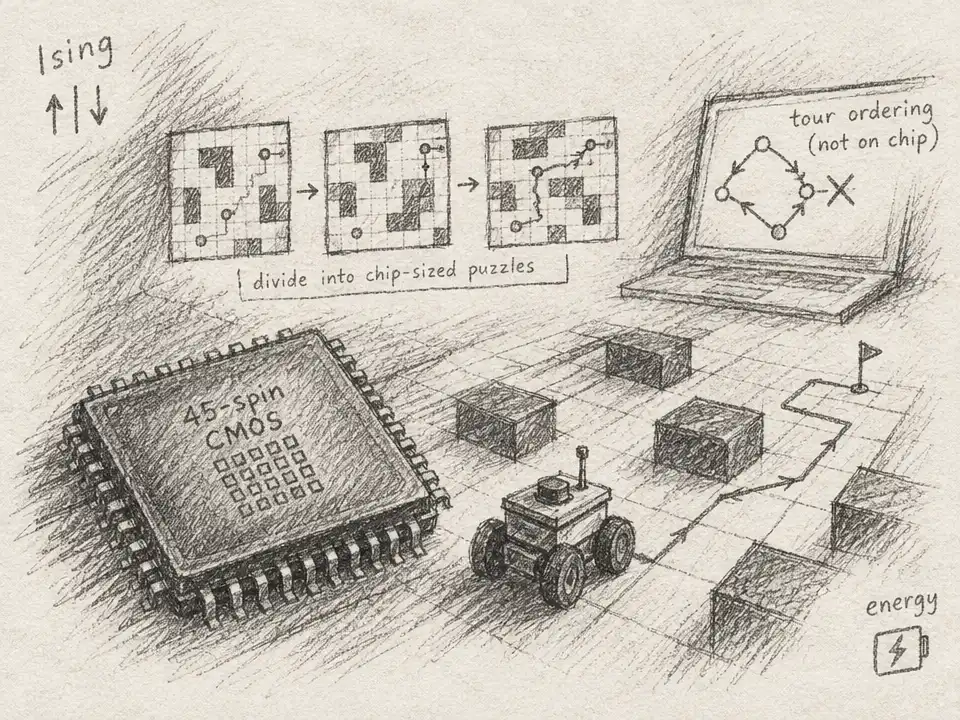
So where might a quantum method fit? The transport paper points to exploratory tasks: checking combinations of failed links, screening extreme congestion scenarios, or comparing a bounded set of shelter or charger locations. These are not complete plans. They are smaller searches inside a larger planning process. A conventional model could still assess traffic behavior, costs, and system-wide consequences, while planners decide which trade-offs are acceptable.
A separate proposal for built-environment research offers a useful filter called BITE: Big search, Input-light, Tiny computation, Evaluation polish. The idea is to find a search space with many possible combinations, but keep the information each candidate requires and the calculation used to score it manageable. Then let established, classical methods check and refine promising results. For urban climate research, the authors describe possibilities such as coordinating building energy decisions or exploring neighborhood designs that balance energy use, comfort, and outdoor temperature. These are proposed applications, not proof that quantum hardware has already delivered better city plans.
The “evaluation polish” step may be the most revealing. A planner cannot judge a proposal by how futuristic the computer is or how many candidate solutions it produces. The question is whether it finds feasible, useful options faster or better than strong classical alternatives—after accounting for the time spent encoding the problem, loading information, and checking results. If a standard method already solves the task well, adding quantum machinery may only add complexity.
Current quantum hardware makes that caution essential. Noise, limited connections between qubits, and restrictions on the size or depth of computations can undermine a promising formulation. A problem that looks compact on paper may become unwieldy when translated for a real device. And many practical urban decisions involve uncertainty and competing goals, such as keeping a network efficient while maintaining fair service across neighborhoods. Simplifying those goals can discard precisely the details planners need.
The crossover, then, is not simply physics offering cities a faster calculator. It is a meeting between two ways of describing a problem: quantum computing’s search among encoded possibilities, and urban planning’s insistence that a solution work within messy systems of people, infrastructure, and policy. The transport researchers argue for hybrid workflows, where classical methods preserve system-wide logic and quantum methods explore a tightly bounded discrete subproblem. The building-and-climate authors likewise emphasize careful problem selection and classical refinement.
For now, the most interesting quantum city may be one that does not hand its decisions to a quantum computer. It uses the technology as a research instrument: to test whether a particular search is a good fit, compare it honestly with existing methods, and perhaps uncover candidate options worth examining. The practical breakthrough, if one comes, may begin not with a grand plan for the entire city, but with a sharper question about which small decision is hardest to make—and whether quantum physics can help ask it.