Imagine a city-sized scatter of points and a huge collection of possible regions drawn around them. You want to pick a small handful of points so that every region covering a substantial share of the city contains at least one point you picked. It sounds like a sampling problem: choose representatives, and make sure none of the important regions slips through untouched.
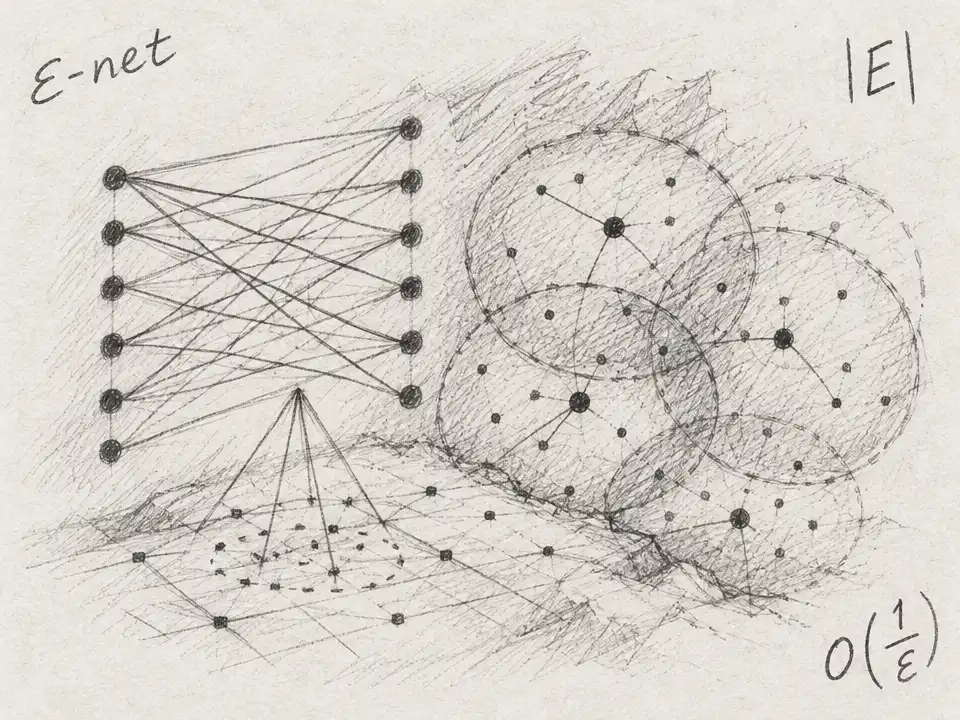
Mathematicians call such a representative set an epsilon-net. The “epsilon” is the fraction that makes a region important. If a region contains at least that fraction of all points, the net must hit it. These nets show up in geometric algorithms and in problems about selecting a small set of locations that can reach or “pierce” many overlapping objects.
The catch is that the smallest net can depend on the structure of the possible regions. A broad theorem says that when the patterns made by those regions are suitably limited—a property called bounded VC dimension—a net of a certain size is guaranteed. But the general guarantee carries an extra logarithmic factor. It is not just a clumsy estimate: researchers have constructed low-complexity examples where that extra factor really is needed.
So the puzzle is not simply how to sample. It is how to recognize when a particular family of ranges has enough hidden structure to do better. In a recent mathematical study, Chaya Keller and Shakhar Smorodinsky found an unexpected answer: sometimes the clue is not a familiar geometric drawing at all. It is a limit on how many connections a certain bipartite graph can contain.
To build that graph, put points on one side and candidate ranges on the other. Draw a link whenever a point belongs to a range. Each range is now represented by its neighborhood: the collection of points linked to it. The key restriction concerns a simple kind of crowding. Two ranges should not share an arbitrarily large set of common points while the whole graph still stays sparse.
In graph theory, this kind of question belongs to the Zarankiewicz tradition: how many links can a bipartite graph contain if it is forbidden from holding a complete two-sided pattern? Here the relevant forbidden pattern amounts to two range-nodes sharing many of the same point-nodes. Keller and Smorodinsky show that if a whole class of these graphs—including every graph you get by taking smaller subsets of its vertices—obeys a suitable linear edge bound when such patterns are absent, then its neighborhood sets admit nets whose size grows in proportion to one over the threshold. The bounded-VC-dimension condition is part of the theorem too.
Why should a rule about shared neighbors help choose representatives? The proof begins by considering ranges of roughly the same size. Among them, it selects a maximal group whose point sets overlap only modestly. “Maximal” matters: any other range in that size band must overlap one of the selected ranges substantially, or it could have been added to the group.
Now the graph condition starts doing its work. If there were too many selected ranges, each would contribute many links to points, but their limited pairwise overlap would prevent the forbidden shared-neighbor pattern. The assumed edge bound then says the graph cannot support that many of them. The number of selected ranges is therefore limited by the reciprocal of the threshold, up to constants determined by the class of graphs.
That still leaves the unselected ranges. Since each overlaps one selected range by a substantial fraction of its points, the researchers use a bounded-VC-dimension guarantee to place a small local net inside each selected range. That local net catches every range overlapping it enough. Put these small local nets together, and the result hits all ranges in the chosen size band without paying for every possible range individually.
Ranges can be much larger than the threshold, so one band is not enough. The proof repeats the process for bands that roughly double in size. The costs shrink as the ranges get larger, and the sum stays on the same linear scale as the first band. That is how a graph’s edge count leads to a compact net across all the important ranges.
The surprise is not that every geometric problem now has a cheap net. The theorem is conditional: the relevant class of bipartite graphs must have bounded VC dimension and must satisfy the hereditary edge bound. But it gives researchers a route to prove compact nets without first showing that a more familiar geometric certificate applies. In the paper, the authors note that an established example is the crossing graph between horizontal and vertical line segments, where a link records a crossing.
The same study also connects structural limits to a different geometric task: piercing families of non-piercing regions in the plane. For families satisfying the paper’s overlap condition, the authors derive a hitting-set guarantee that grows linearly with the packing parameter, improving on a previous bound that grew as its ninth power. It is a reminder that a carefully chosen graph can organize problems that, at first glance, seem to be about shapes and points rather than networks.
There is still a question hanging over the result. The authors ask whether their graph condition always implies another, more familiar measure of local complexity that has explained many earlier linear-size net theorems. They do not resolve it. If the answer is no, the graph route may reveal a genuinely new mechanism: not simply another way to describe geometric simplicity, but a separate reason that a small set of representatives can cover every large case.