A plant’s inner life is usually hard to watch in real time. To inspect the chemicals moving through its tissues, researchers often have to take a sample and analyze it in a lab—a little like understanding a city’s traffic by collecting a few cars and taking them apart. A new experiment tries a different route: shine invisible light at a living plant, then listen to the tiny pressure changes that follow.
The method brings tools from optical sensing into plant physiology. Mid-infrared spectroscopy has been developed in part around the challenge of monitoring human physiology, including glucose, without taking a tissue sample. The researchers adapted that kind of light-based sensing to a plant’s petiole—the slender stalk connecting a leaf to its stem—and asked whether it could follow changes over several days.
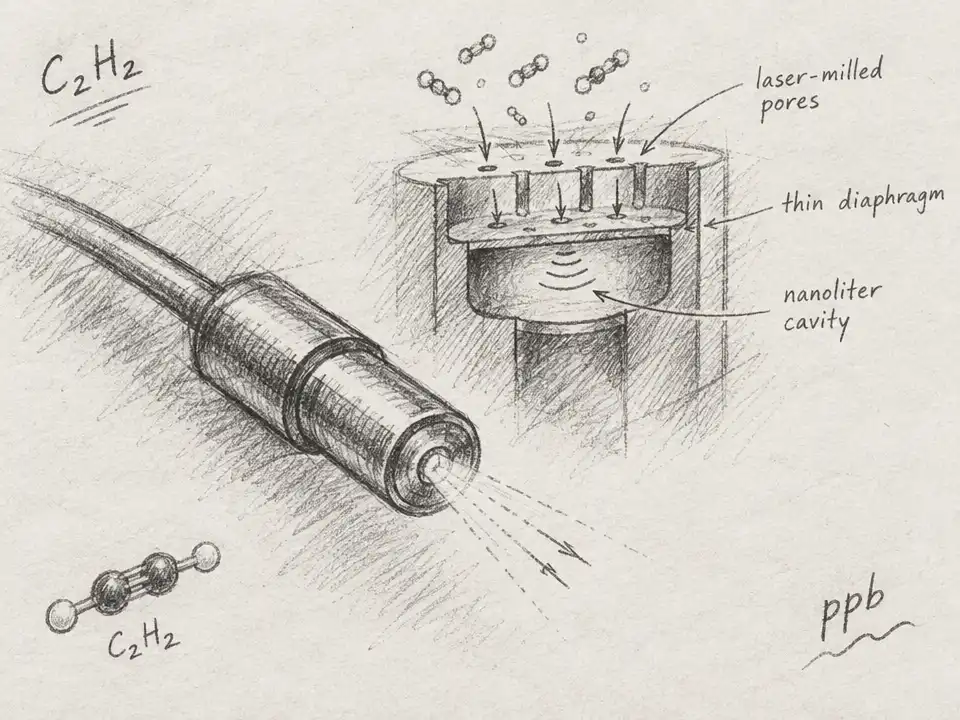
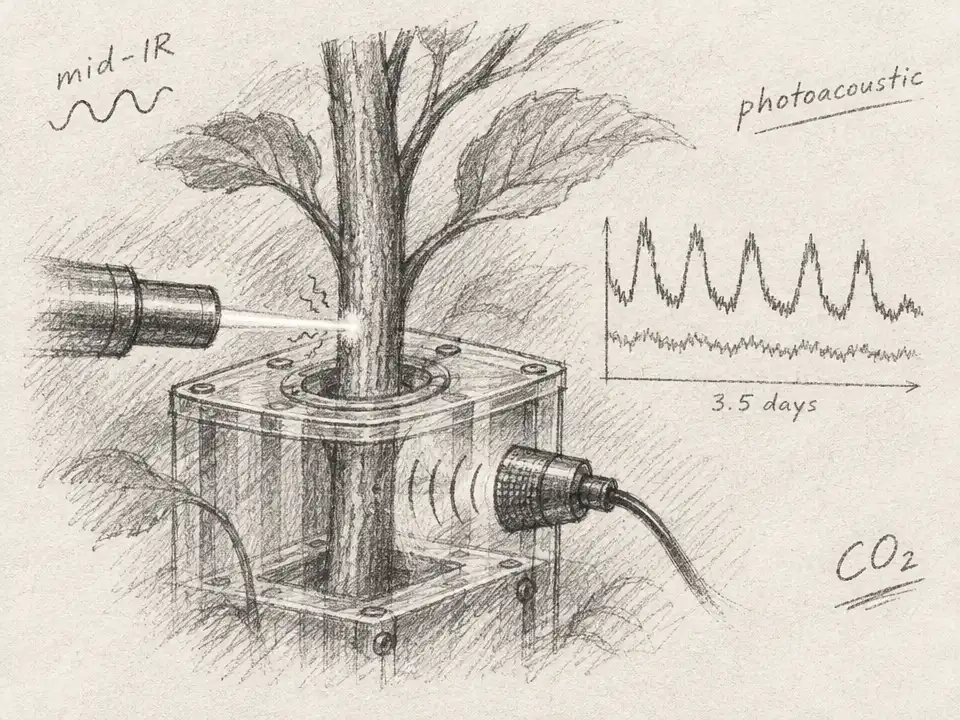
The key is that the plant does not need to send light back to the instrument. When molecules absorb mid-infrared light, some of that energy becomes heat. The researchers used a laser whose intensity rose and fell in a regular rhythm. As the plant tissue warmed and cooled, it nudged the air in a small sealed cavity around the petiole. A miniature microphone recorded the resulting pressure signal.
That signal is a kind of indirect chemical fingerprint. Molecules absorb light differently, and the way heat spreads through tissue depends on what is there and how it is arranged. Changing the rate at which the laser’s intensity rises and falls can also change how heat travels before reaching the surface. The researchers measured at three modulation frequencies—157, 282, and 507 Hz—so the instrument could sample the plant’s response under different thermal conditions.
The test subject was Oxalis triangularis, chosen partly because its petioles are thin, about 1.5 mm across, and contain vascular bundles near the surface. Those bundles include the phloem, a transport network that carries sap and its dissolved contents through a plant. The laser wavelength was 9.65 µm, near a major glucose absorption peak. A custom-fitted cavity held the petiole, while a microphone and sensors tracked the signal and surrounding conditions.
The team recorded measurements every 45 seconds for three and a half days. They also ran a 17-hour control measurement with no plant in the cavity, to see how much the apparatus itself might drift as temperature and pressure changed. The plant’s signal was not a clean readout of a single substance. It was a shifting trace, combining the optical response of tissue with the way heat and sound moved through the setup.
Still, a pattern emerged. In the plant measurement, the signal changed with the day: it was generally stronger during daylight and weaker at night. The researchers identified three daytime peaks, each lasting roughly 4 to 6 hours, and a slower decline overnight. The pattern recurred across the measurement period and appeared at all three laser modulation frequencies, though with small differences. The signal’s typical fluctuations were about 3%.
Could the pattern have come from the room, or from a leaky seal? Those possibilities matter in a measurement where tiny changes in air pressure and temperature can alter the microphone’s reading. In the empty-cavity control, environmental changes did affect the signal, and the authors found that their simple model did not explain every drift. But the plant’s signal was larger in some respects, differed from the control, and did not track the measured environmental changes closely enough to be explained by them alone. The authors also estimate that ordinary stem expansion would account for only a small part of the observed variation.
That makes the recurring pattern evidence of a signal associated with plant activity—not a molecular diagnosis. The laser was fixed at one wavelength. Although it sits near glucose’s main absorption peak, water is so abundant in biological tissue that it still dominates absorption. A change in the microphone trace therefore cannot be labeled “more glucose,” or confidently assigned to any particular molecule. Tissue structure and water content may also affect how the heat travels. The researchers suggest that measurements at several wavelengths, alongside more detailed biological analysis, could help separate those contributions.
That uncertainty is part of what makes the crossover interesting. A sensor designed to turn absorbed light into a measurable physical signal has been fitted around a living plant, where the signal may carry information about daily changes in its tissues. The experiment does not yet tell us exactly what the plant is doing. It shows that researchers can follow a repeatable rhythm without cutting into the petiole—and gives them a new way to ask what that rhythm means.
For now, the instrument is a listening post, not a translator. But if future versions can distinguish chemical signals from changes in tissue structure and water, they could help researchers watch how plants respond over time to their surroundings. Instead of taking isolated snapshots, they may be able to follow the living system as it changes—one faint pressure pulse at a time.