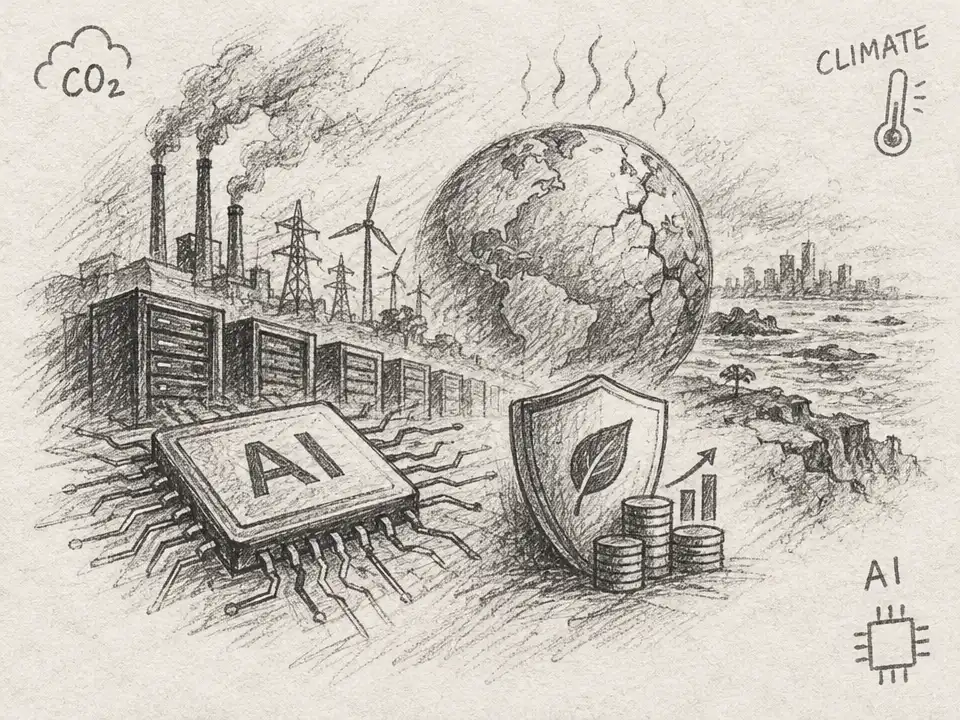
To estimate AI’s climate footprint, it is tempting to start with the electricity used by data centers. But what if AI also changes how fast the whole economy grows—and how much energy that growth uses? A 2026 study takes on that wider question by building a climate-economy model that treats AI not just as a power-hungry technology, but as an industry that could reshape production, emissions, adaptation and climate policy.
The researchers call their expanded model DICE-AI. It builds on DICE, a framework that links economic activity to greenhouse-gas emissions, warming and the damages climate change can cause. The key change is to add AI as an intermediate production sector: AI infrastructure uses capital and labor, and its emissions intensity differs from that of the rest of the economy. That gives the model a place to track AI’s costs and benefits alongside the forces already shaping the climate.
Those forces run in several directions at once. Building and operating AI infrastructure adds emissions. AI applications might help cut emissions elsewhere by lowering the economy’s carbon intensity. And AI could boost productivity or automate more work, expanding economic output—and, with it, demand for energy-using equipment and production. The model also allows AI to improve society’s ability to adapt to climate impacts, reducing some of the damage from warming. The challenge is to account for all these channels together rather than treating any one of them as the whole story.
Because nobody knows how transformative AI will be, the authors compare two possible paths. Their “ICT-like” case assumes AI’s long-run effect resembles earlier information and communication technologies. Their more ambitious “Industrial Revolution-like” case assumes AI has a much larger effect on economic growth. These are scenarios calibrated using published research, not predictions that either future is certain. In the model, annual per-capita GDP growth reaches about 2.1% in the ICT-like pathway, while the Industrial Revolution-like pathway reaches 4.1% in 2100. Without AI, the comparison model’s growth rate gradually declines to 1.8% by that year.
Under a low-abatement climate-policy scenario, the model’s less transformative AI pathway still raises emissions. Projected annual emissions in 2100 rise from 61.8 to 76.2 GtCO2, with an additional 0.1°C of warming. The accounting reveals why data-center power alone misses part of the picture: in that scenario, the model attributes an increase of 12.8 GtCO2 to economy-wide effects, comparable to the 9.9 GtCO2 increase attributed to computing-related effects.
The more striking contrast comes from the Industrial Revolution-like scenario. If low abatement persists, the model puts 2100 emissions at 111.1 GtCO2 and warming at 4.2°C. AI infrastructure is still a major part of the emissions increase, but the wider economy matters too. By 2100, the model attributes an additional 40.4 GtCO2 a year to computing-related effects and 21.2 GtCO2 to economy-wide effects. In other words, even a technology that can improve efficiency may be part of a system that grows enough to use more energy overall.
That is the study’s central shift in perspective: the climate question is not simply how much power AI consumes, but how AI changes the economy that consumes power. An application that makes one process more efficient does not automatically cancel emissions from new infrastructure or a larger volume of economic activity. The authors’ model puts those competing effects on one ledger, while also allowing for potential emissions cuts from AI applications and climate benefits from better adaptation.
The model produces another counterintuitive result: stronger climate policy can support AI investment. Under the ICT-like scenario, modeled AI investment in 2100 is 3.25% of final output under the low-abatement pathway, compared with 3.66% under a 2°C warming constraint. The reason is that unchecked warming damages the future economy, weakening the returns on investment—including investment in AI. Cutting climate damage can therefore protect the conditions that make future AI investment worthwhile.
The authors also estimate how climate-related costs compare with AI’s economic gains. Under low abatement, those costs offset about one-fifth of the modeled gains in the ICT-like scenario and about one-quarter in the Industrial Revolution-like scenario. The balance improves under climate policy. In the model, combining emissions cuts with AI-powered adaptation reduces climate-related consumption losses more than either measure alone. That is a conditional result, not evidence that AI adaptation already delivers those benefits in the real world.
That distinction matters. DICE-AI is a simplified model for exploring linked effects, not a measurement of AI’s current total emissions or a forecast of the planet’s future. Its results depend on uncertain assumptions about how much AI will boost growth, how its carbon intensity changes, whether applications reduce emissions, and how useful AI may be for adaptation. The authors ran 2,000 simulations to test uncertainty in several AI-related parameters. They also note what the model leaves out, including detailed AI production processes, market spillovers and income distribution.
The new approach does not settle whether AI will be a climate burden or a climate tool. Instead, it shows why the answer cannot be read from a data-center power bill alone. AI’s effects may travel through the entire economy, feeding back into emissions, climate damage and the value of future investment. By bringing those links into the same model, the researchers make a sprawling question easier to examine—and reveal a possibility worth testing: policies that protect the climate may also help protect the economic future AI depends on.