A gamma-ray photon can cross thousands of light-years without announcing what it has tested along the way. But when photons from the flaring binary system Cygnus X-3 arrived with energies reaching 3.7 petaelectronvolts, their survival became a test of one of physics’ most basic assumptions: that the laws of nature work the same way everywhere and at every speed. A new analysis of those photons finds no sign of the abrupt disappearance that some proposed departures from that principle predict.
The assumption is called Lorentz invariance. It sits at the foundation of special relativity: the measured laws of physics should not depend on an observer’s motion or orientation. Some ideas about physics beyond today’s theories suggest that this symmetry might fail at extraordinarily high energies. The effects, if they exist, would be too tiny to notice in ordinary experiments. So researchers look for nature to provide a much longer test track: particles born in violent cosmic environments, then traveling vast distances before reaching Earth.
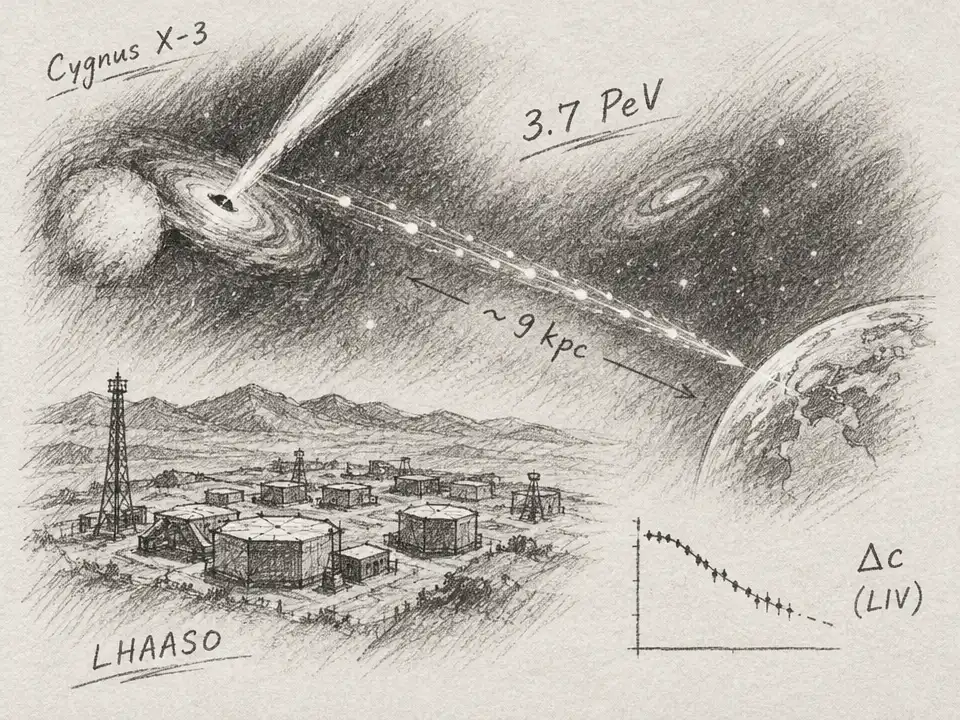
Cygnus X-3 offers an especially useful track. It lies about 8.95 kiloparsecs away, deep in the Milky Way, and the observations used in the study caught it during several flaring episodes. In the system’s relativistic jet, protons may be accelerated to tens of petaelectronvolts. The research team’s model has some of those protons interacting with ultraviolet light from the companion star, producing gamma rays that can carry energies into the petaelectronvolt range. One petaelectronvolt is a million billion electronvolts: a scale far beyond the energies of particles used in everyday laboratory experiments.
To catch such faint messengers, the Large High Altitude Air Shower Observatory, or LHAASO, watches for the cascades they create in Earth’s atmosphere. The facility sits 4,410 meters above sea level in Sichuan, China. Its kilometer-scale detector array records the showers’ particles and timing, allowing researchers to estimate where a gamma ray came from and how much energy it carried. In the data set examined here, observations from four flares between December 26, 2019, and July 31, 2024, added up to 692.8 days of flare-period data.
The test is not simply whether a gamma ray reaches us. Ordinary processes can absorb some of the light on the way. The team accounts for interactions with the interstellar radiation field and the cosmic microwave background, the faint afterglow of the early universe. Those backgrounds naturally dim gamma rays at different energies. Researchers must model that expected dimming before asking whether a second, more fundamental effect has carved an extra edge into the spectrum.
In some “superluminal” Lorentz-invariance-violation scenarios, very energetic photons would become unstable. They could decay into an electron and its antimatter partner, or split into three lower-energy photons. Either process would drain the highest-energy end of the source’s spectrum, producing a sharp cutoff. The team compared the LHAASO data with models that included such a cutoff and with models without one. The observed spectrum showed no evidence for the predicted break.
The most energetic reconstructed photon had an energy of 3.735 ± 0.411 PeV. Using the full spectrum, the researchers set a 95-percent-confidence lower limit of 3.05 PeV on where a cutoff could begin in their baseline analysis. That result is not a claim that relativity has been proved, or that a new law has been discovered. It says that, given the data and the assumed source spectrum, a cutoff below that threshold is inconsistent with the observations at the stated confidence level.
From the cutoff limit, the team translated the result into bounds on the energy scale associated with possible violations. For the second-order case, photon splitting gives a lower bound of 1.73 × 1026 electronvolts—more than one hundredth of the Planck energy scale, where quantum-gravity effects are often expected to become important. The study says this improves earlier limits in that channel by nearly an order of magnitude. That enormous number is not the energy of a single photon: it is a constraint on the scale at which a particular kind of departure from Lorentz invariance could appear.
There are important limits to what the result can say. The strongest uncertainty comes not from the background, which is nearly negligible above petaelectronvolt energies, but from how the source’s intrinsic spectrum is modeled. Comparing two plausible spectral descriptions changes the inferred cutoff limit by about 9.5 percent; the team reports a total systematic uncertainty of about 9.6 percent. An independent analysis that keeps individual events rather than grouping them into bins gives a consistent cutoff limit of 3.057 PeV, a useful check on the method, not a substitute for the assumptions behind the source model.
The perspective shift is the striking part. A distant binary’s flare becomes a probe of rules usually tested in laboratories, while the Galaxy itself supplies the distance and the extreme energies. The photons do not reveal what quantum gravity is, and this analysis does not test every possible way relativity could fail. Instead, they show how the universe can narrow the room available to new physics: a sharp cutoff was expected in some scenarios, and these particular messengers kept coming through.