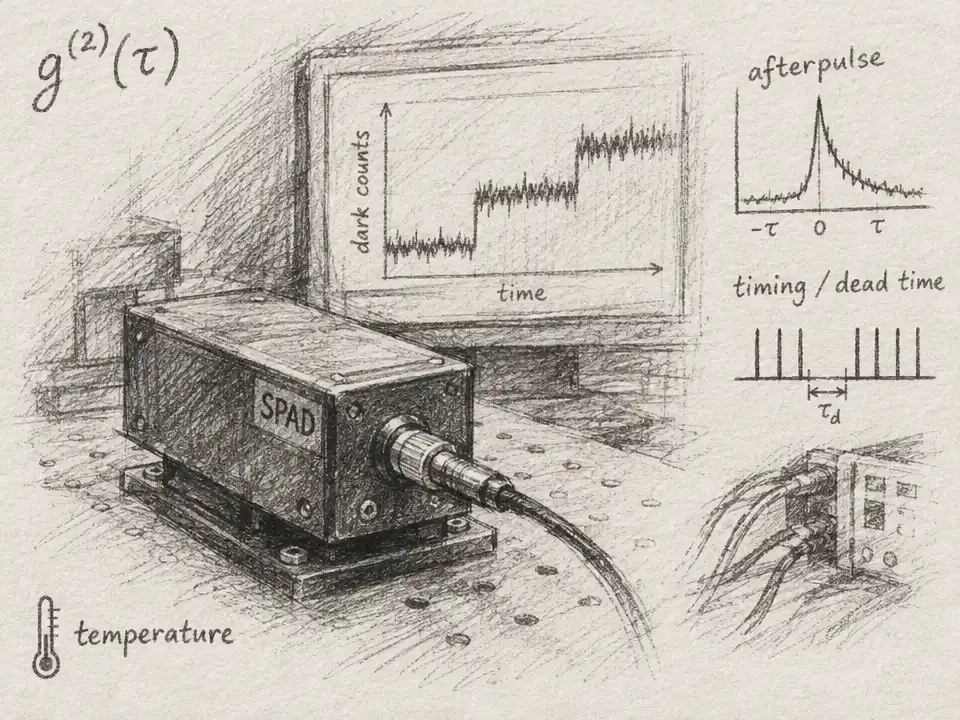
A single-photon detector sits in darkness, waiting for light that never comes. Then its count rate jumps—suddenly, and by a repeatable amount. Has something changed inside the detector, or is the instrument being fooled by a loose cable, a temperature shift, or light leaking into the room?
That is not a cosmetic distinction. A single-photon avalanche diode, or SPAD, registers faint flashes of light as electrical pulses. Even without incoming photons, it sometimes fires on its own, producing a dark count. Those false detections can muddy the signals used in quantum communication. If the detector itself is switching between behaviors, it may need recalibration or replacement. If the cause is outside it, the fix belongs elsewhere.
The puzzle is that several different causes can draw nearly the same picture: two count-rate levels, with an abrupt step between them. Looking at the rate alone does not reveal which culprit is responsible. Yu Luo, Lina Pu, Yaroslav Koshka, Chun-Hung Liu, and Junming Diao set out to find more discriminating clues in the detector’s own time-stamped records.
Their investigation followed four commercial SPAD modules in darkness for more than 920 hours. Three showed distinct rate changes: 44.59%, 19.33%, and 2.77%. The researchers also saw an initially persuasive clue: switching between levels seemed abrupt. But abruptness is not a fingerprint. A light turning on can make a detector’s count rate jump just as sharply.
The team instead examined what happened after each count. A SPAD avalanche can leave charge carriers temporarily trapped in the device. When some are released later, they can trigger another avalanche: an afterpulse. The probability of an afterpulse gives each detector a kind of statistical echo. The researchers asked whether that echo changed when the dark-count rate switched.
They compared the afterpulse yield per recorded event in the low-rate state with the yield in the high-rate state. They called this comparison R. If the detector produces more or fewer genuine avalanches, the afterpulse events should rise or fall along with them, leaving the yield per event roughly unchanged. But if the readout simply loses a fraction of events, an afterpulse and its triggering event can each be lost, changing the yield. Add unrelated electrical counts, and the total count rises without a matching increase in afterpulses.
For all three switching modules, the measured comparison stayed close to one: 0.9996 ± 0.0027, 1.0050 ± 0.0023, and 1.0027 ± 0.0043. Those results were consistent with an unchanged afterpulse yield across the two rate states, even though the count rates differed. That was an important clue in favor of a change in the detector’s avalanche population rather than simple, independent losses or random added counts.
But the first clue did not solve the case. The team deliberately created rival explanations and watched how they behaved. In one test, they moved the electronics’ threshold close to the tops of the detector’s output pulses. A small temperature-driven change in pulse height could then make the electronics miss some pulses—or count a single pulse twice. The detector’s underlying behavior could stay in one state while the recorded rate appeared to switch.
That mimic left a different afterpulse signature. At two tested thresholds, the afterpulse comparison fell between the values expected for fully unchanged detection and for independent pulse loss. The afterpulse and its triggering pulse were related, but not identical: their amplitudes were similar, not perfectly matched. As temperature shifted the pulses, the two did not always cross the threshold together. The apparent switch was therefore neither a clean detector change nor simple independent loss.
Another suspect was stray light. When laboratory illumination reached the modules, all four count rates changed at once. On one detector’s record, the step could look convincingly like intrinsic switching. Its afterpulse yield could also remain unchanged: leaked photons create real avalanches, and those avalanches can produce afterpulses just like dark counts do. Here the decisive clues were outside the afterpulse statistic. The channels changed together, and the apparent rate levels varied with the background light and the temperature of the lamps.
Then came the cable. Twisting a detector’s output connection produced bursts and dropouts, not the stable, repeatable rate levels seen in the suspected intrinsic switching. Some intervals between recorded events were shorter than the detector’s own recovery time allows. That is a physical constraint: after an avalanche, the SPAD needs time before it can register another. An event inside that forbidden interval suggests that at least some pulses came from the readout path, not from a genuine detector avalanche.
The researchers pushed the test further by injecting artificial electrical pulses designed to imitate the detector’s afterpulse behavior. This was a tougher decoy than random electronic noise: its afterpulse comparison was 1.002 ± 0.020, with pair-survival behavior also resembling the intrinsic case. Yet timing betrayed it. The real detector showed no events below its 48-nanosecond dead-time floor across more than 30 million measured intervals. The injected stream produced 40 events below that limit, with one as short as 28 nanoseconds.
So the answer was not a single magic number. A near-one afterpulse comparison helps reject some explanations, but light leakage and carefully matched electrical injection can imitate it. The stronger diagnosis combines clues: Are the two rate levels reproducible? Does only one detector channel switch? Do the transitions track temperature, illumination, or other disturbances? Do event times respect the SPAD’s recovery limit? The paper’s tests support detector-local switching when these clues line up, but they do not identify the microscopic defect responsible for it.
That layered approach is the useful discovery. A detector’s unexplained jump can be treated not as a verdict, but as the start of an investigation. The afterpulse echo narrows the suspects; shared motion across channels, unstable rate levels, and impossible event timing help expose the impostors. In a system built to notice single photons, the quiet intervals between counts may turn out to be just as revealing as the counts themselves.