One photon leaves a semiconductor dot. Then another, and another, each carrying a quantum connection to a tiny spin left behind in the device. But that spin does not sit still: it precesses, like a turning compass needle. If its phase wanders between emissions, the photons’ shared quantum state can fray. Researchers have found a way to make two opposing spin motions cancel their average drift—not with an extra control pulse, but by carefully timing the light that creates each photon.
The result is a new kind of solid-state source for multiphoton entanglement. In a paper posted to arXiv on October 8, 2026, the team reports a semiconductor quantum dot that emits photons at a rate above 1 gigahertz and uses what the researchers call a “natural spin echo” to extend the distance over which their entanglement remains robust. Their measurements point to a characteristic entanglement length of about 13 photons. That is a promising scale, but it is important to be precise: the team did not directly measure a complete 13-photon GHZ state.
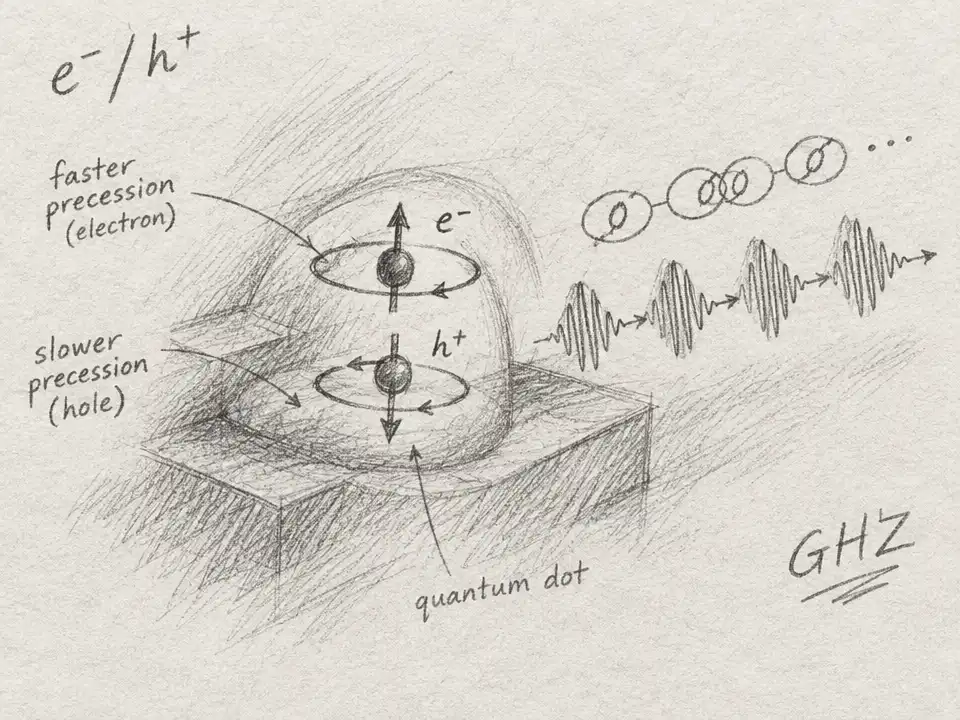
To see why the approach matters, picture the dot as a tiny machine with a memory. A laser pulse prepares a short-lived state called a trion; when it decays, it emits one photon and leaves the dot’s resident hole spin carrying part of the quantum information. The photon’s polarization becomes linked to that spin. Repeat the process, and the same spin can help link a sequence of photons into a larger entangled state.
In a Greenberger-Horne-Zeilinger, or GHZ, state, the whole group shares a stark kind of connection: the photons act as if they belong to one of two coordinated polarization patterns, rather than each carrying an independent answer. Such states are useful building blocks proposed for quantum communication and measurement-based computing. The challenge is not just to produce more photons, but to keep their relationships intact as the sequence grows.
Here, the memory itself creates a timing problem. Between laser pulses, the hole spin precesses. During the brief trion stage, an electron spin also precesses. Those rotations add phase to the quantum state, and a phase mismatch between successive emissions can weaken the correlations. The researchers’ key observation was that the relevant electron and hole spins precess in opposite directions because their in-plane magnetic response has opposite signs.
That opposition makes a quiet kind of compensation possible. The team adjusted the interval between laser pulses so that the phase gathered by the hole after one emission offsets, on average, the phase gathered by the electron during the next trion’s lifetime. The system does not need a separate pulse that flips the spin midway through its motion, as in a conventional spin-echo technique. Instead, the emitter’s own two-stage cycle supplies the opposing rotations; timing brings them into balance.
The experiment used an indium arsenide quantum dot embedded in a gallium arsenide microcavity and held at 4 kelvin. Resonant laser pulses, each 12 picoseconds long, repeatedly excited the dot. At the chosen operating point, the pulse repetition rate was 1.46 gigahertz and the applied magnetic field was 0.05 tesla. The timing condition that cancels the average phase does not depend on the magnetic-field strength, a feature that could make the method less sensitive to changes in that field.
The team tested the source in several ways. A tomographic measurement of the spin-photon operation—the repeated step that links the dot’s spin to an emitted photon—gave a fidelity of 0.93 ± 0.01 compared with an ideal operation. They also measured polarization correlations for states involving one and two photons. The two-photon measurements showed the expected stronger response to an added optical phase, a signature of GHZ-type correlations.
Those direct measurements had a practical ceiling: the collection and detection setup allowed the researchers to study up to four sequential photon events at a reasonable rate. Their two-photon GHZ characterization required four such events, including photons used to prepare and read out the spin. To estimate how entanglement would hold up in longer strings, they combined the measured correlations with a reconstructed process map of the emitter. The resulting characteristic decay length was about 13 photons, with estimates from different analyses agreeing within their uncertainties.
That distinction matters. “Thirteen” is not a claim that the apparatus directly captured and fully verified a 13-photon GHZ state. It describes the scale over which the inferred entanglement remains robust as the process is repeated. The paper also identifies the current bottleneck: the electron spin loses coherence during the trion’s radiative lifetime, largely because it interacts with fluctuating nuclear spins in the surrounding dot.
The researchers model a possible next step: putting the emitter in a cavity that speeds up photon emission through the Purcell effect. With a feasible fivefold increase in radiative rate, their calculations suggest an operating rate near 4 gigahertz and a characteristic entanglement length above 100 photons. Those figures are projections, not results of the present experiment. Faster emission could help because the electron would spend less time exposed to the fluctuations that blur its phase.
The broader idea is elegant: instead of fighting every source of phase drift with additional control hardware, let two parts of the emitter’s own dynamics oppose one another, then tune the clock that links them. The present source still faces limits in photon collection, spin coherence, and direct verification of very large states. But it offers a new route toward producing longer strings of entangled light from a compact, semiconductor-based device—one carefully timed photon at a time.