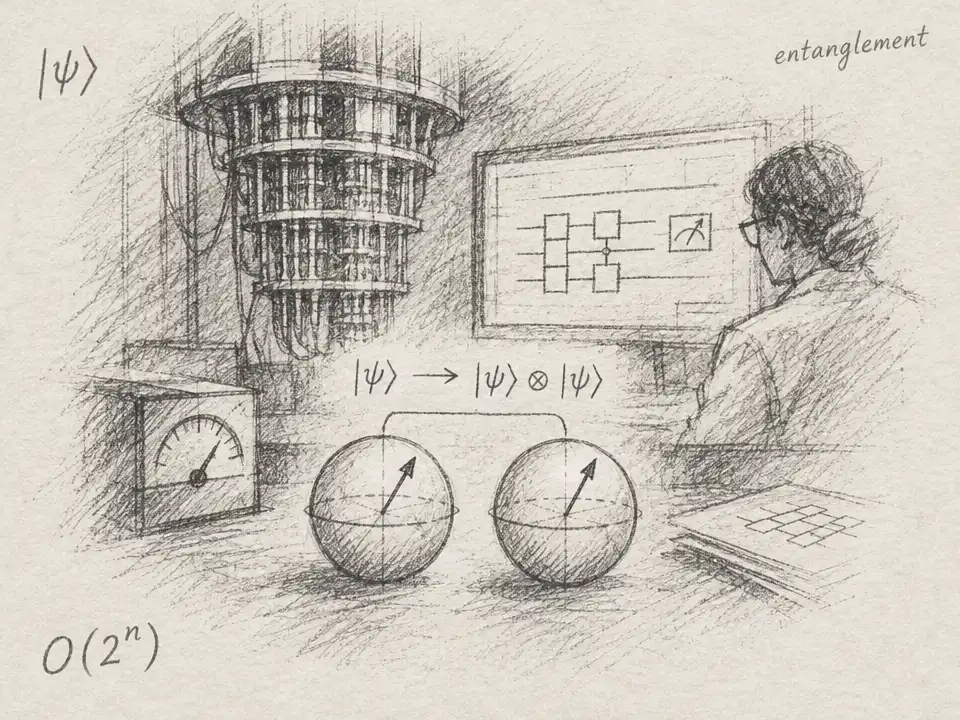
Imagine searching a band of frequencies for one faint signal. A conventional sensor checks candidate frequencies in sequence, like turning a dial one stop at a time. The more possibilities there are, the more checks the search may require. A new experiment points to a stranger strategy: let a quantum computer help the sensor decide which frequency deserves attention.
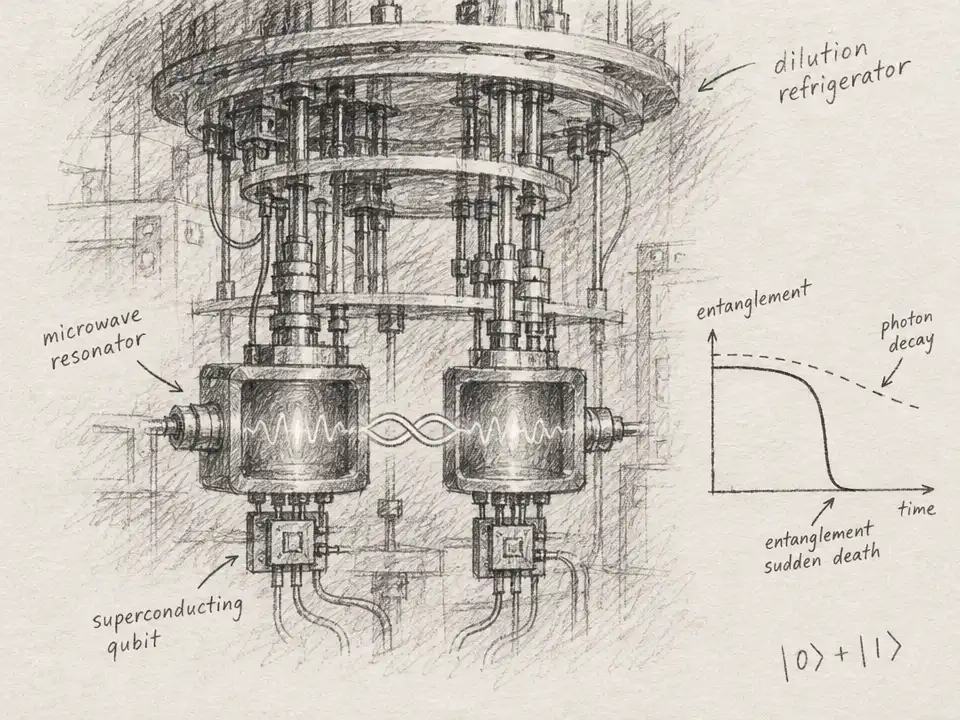
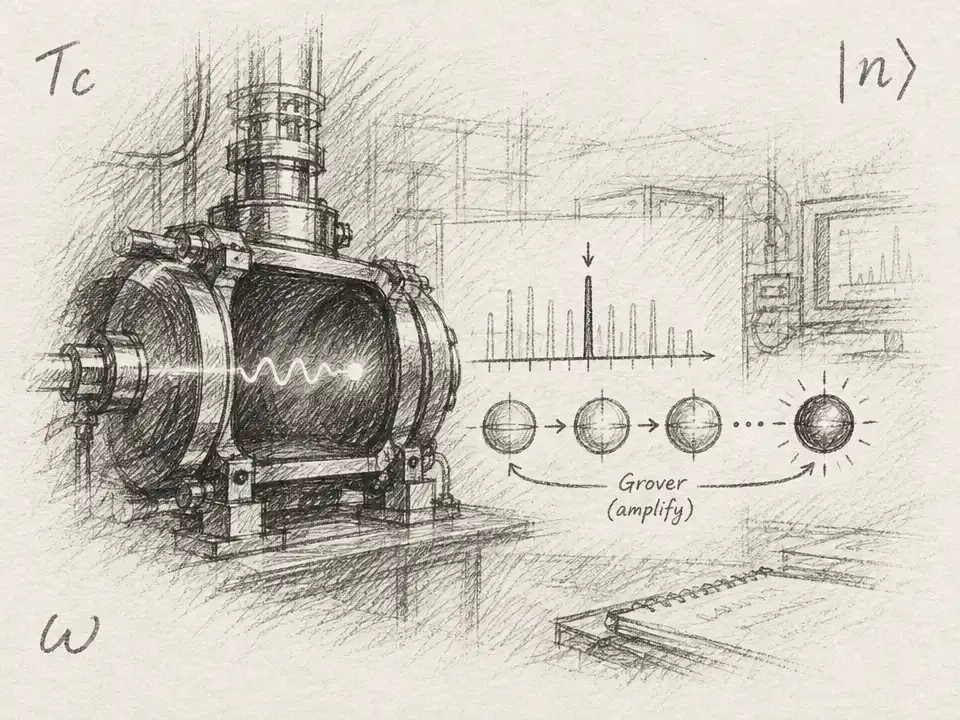
The team built its demonstration around a superconducting cavity and a tiny circuit element called a qubit. The cavity can hold microwave photons in distinct number states. Each state shifts the frequency at which the coupled qubit responds, creating a link between a possible signal frequency and a particular photon-number state. The cavity acts as a quantum register; the qubit acts as the sensor.
Here is the crucial twist: the unknown signal is not simply measured and passed along to a computer. Instead, it interacts with the qubit in a way that depends on the cavity’s state. If the signal matches one candidate frequency, it drives the qubit through a carefully calibrated motion. The qubit returns to its starting condition, but the matching cavity state acquires a phase change. In the language of quantum computing, the signal has marked the matching answer.
That mark alone is not enough. The protocol then applies a second operation that redistributes probability among the cavity’s possible states. Alternating the signal-driven mark with this redistribution makes the marked possibility more prominent, so a final measurement is more likely to reveal it. This is the central trick of Grover’s search algorithm, repurposed as part of a sensor rather than run after a sensor has finished its work.
The idea sounds like a quantum search through every possible frequency at once, but that shorthand can mislead. The experiment still needs carefully prepared quantum states, controlled operations, and a defined set of candidate frequencies. Its advance is more specific: with each interaction, the signal itself helps carry out the quantum algorithm’s marking step. In principle, Grover search needs fewer interrogations than sequential testing as the list of possibilities grows.
The researchers first tested whether their cavity could perform the necessary amplification. For a target state with 16 photons, two rounds of the algorithm raised its measured population to 85.4%. They also observed amplification when extending the cavity’s photon-number range to 128 photons. That is not a machine with 128 qubits: it is one cavity whose possible photon-number states provide a large set of quantum possibilities.
Then came the sensing test. The team supplied signals from a set of candidate frequencies and measured the cavity afterward. With two signal interrogations, the quantum protocol resolved 11 candidates, compared with three for a classical strategy that tested candidates sequentially. The measured information about which frequency was present rose from 1.58 bits for the sequential search to 2.40 bits for the quantum method.
Those numbers make the result tangible, but they also define its scale. Eleven candidates are a small search space, and the result is a laboratory demonstration—not a field-ready instrument sweeping a broad, unknown spectrum. The researchers calibrated the signal amplitude and interrogation time so the signal would produce the required phase change. The unknown was its frequency. Real searches may have to estimate several signal properties at once, contend with noise, or cover frequencies that do not fit neatly into a preselected grid.
The hardware itself sets another limit. The cavity must respond strongly enough to photon number for the qubit to distinguish candidate frequencies. At the same time, the cavity’s own nonlinearity must stay weak. If it grows too influential, photons shift the cavity’s behavior and distort the operations that amplify the target. The experiment’s performance began to degrade around 32 to 64 photons, which the team attributed in part to this self-Kerr nonlinearity. Dissipation and accumulated control errors also make repeated operations harder to trust.
So the next frontier is not simply to add more candidate frequencies. It is to build a sensor that preserves the useful signal-dependent interaction while keeping unwanted distortions, losses, and calibration demands under control. The researchers suggest that stronger nonlinear elements could help suppress some effects at higher photon numbers. Another proposed direction is to combine the search protocol with methods for estimating signal amplitude, so a future system might determine both frequency and strength. That combined capability remains a goal, not a result of this experiment.
If those engineering problems can be solved, quantum search could matter wherever scientists spend substantial effort looking for a narrow, faint signal among many possibilities. Dark-matter experiments are one possible long-term motivation, but this study did not search for dark matter. It tested a controlled signal in a carefully prepared device. Its larger lesson is more basic: a sensor need not merely report what it detects. In some circumstances, the signal itself might steer the computation that helps the sensor find it—at the price of building a quantum system precise enough to make that steering work.