The puzzle starts with a quantum chip that is, by one familiar measure, impressively precise. Its two-qubit gates—the operations that link pairs of quantum bits—had a median fidelity of about 99.7%. Yet a small number of troublesome components could still drag down the chip’s ability to protect information. So what should a quantum computer do when a few of its parts keep misbehaving: get better at spotting their errors, or stop asking them to work?
That question matters because quantum information is unusually fragile. A tiny disturbance can scramble a calculation, and simply checking a qubit too directly can destroy the state the computer is trying to preserve. Error correction offers a workaround: spread one logical, or encoded, qubit across many physical qubits, then repeatedly measure patterns that reveal whether errors have occurred without directly reading out the encoded information.
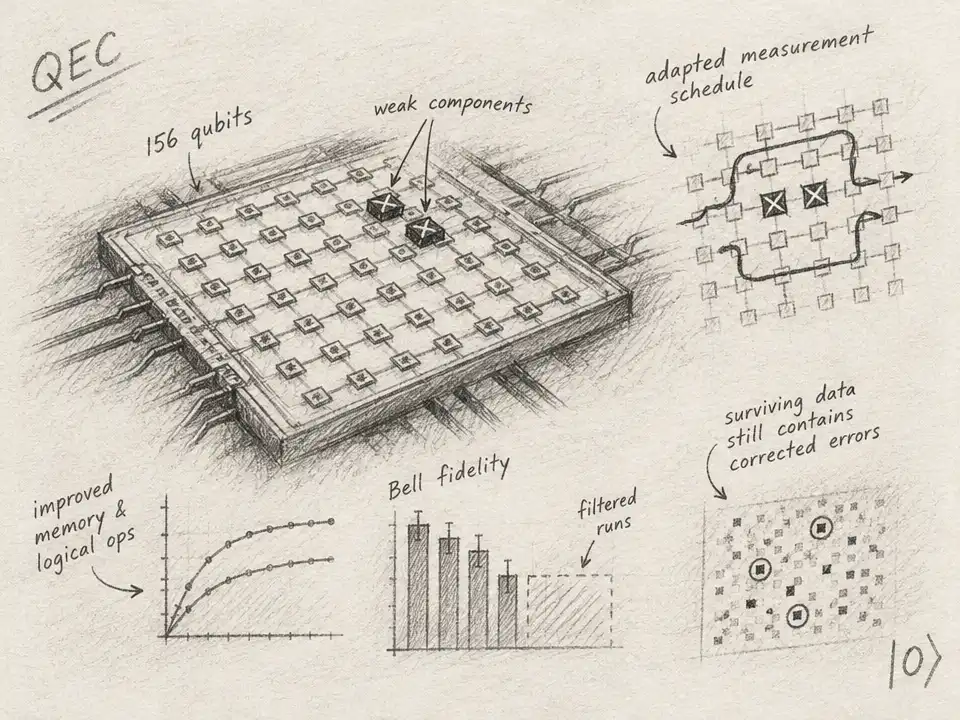
But that plan has a catch. It assumes the physical parts doing the checking are dependable enough. In the 156-qubit processor studied by Campbell McLauchlan and colleagues, underperforming components clustered around qubits at sites 46 and 85, along with nearby connections. The team could feed a decoder—software that interprets error-check results—a more accurate picture of the chip’s noise. Perhaps the decoder simply needed better clues.
That was the first explanation to test. The researchers used noise measurements tailored to the circuits they were running, rather than relying only on general device statistics. They also tried decoding strategies that could make more detailed use of measurement information. Better noise information helped, but it did not erase the problem. Even a better-informed decoder could not fully compensate for the same weak spots. The clue pointed away from a purely software fix: perhaps some errors were being generated too often, in places the decoder could not reliably work around after the fact.
The alternative was more structural. Instead of using the troublesome qubits and their neighboring couplers, the team redesigned the sequence of error checks around them. Their code, called a dynamic compass code, changes which checks are measured over a repeating four-step cycle. That flexibility let the researchers reroute the checks into larger groupings that avoided the weak components, while keeping the checks manageable. They did not repair or remove the hardware. They changed how the code used it.
To see whether the detour helped, the researchers first tested the chip as a quantum memory. They encoded a state across a seven-by-seven patch of the processor, repeatedly checked for errors, and then tested whether the encoded information survived. With noise-informed decoding, defect avoidance, and filtering for runs likely to have avoided leakage—when a qubit slips outside its intended operating states—the measured logical error probability per round was 4.11% for one kind of encoded memory and 2.56% for the other. Those represented improvements of 32.3% and 35.2%, respectively, compared with the baseline.
A more telling comparison came from code size. Bigger codes can offer stronger protection, but they also involve more hardware, and therefore more chances to encounter a bad component. Here, the seven-by-seven memory patch with defect avoidance met or exceeded the average performance of smaller five-by-five patches. The result suggests the code’s ability to route around weak spots helped make the larger memory useful, rather than simply adding more qubits to the problem.
The researchers then asked whether the fix held up over time. In a separate stability experiment—a test of repeated measurements important for operations between encoded qubits—the version without defect avoidance began to flatten out in performance at around 12 rounds of error checks. With weak components excluded from the measurement schedule, error suppression continued through 30 rounds. At that point, the combined strategies reduced failure probability by 56%.
Then came a result that invites a rival explanation. The team joined encoded quantum regions using a technique called lattice surgery, which uses measurements to carry out logical operations. After filtering, they reported Bell fidelities above 97%. Was this evidence that the chip had successfully corrected errors—or had the researchers simply thrown away the difficult runs until only clean-looking data remained?
The distinction matters. The strongest result depended on selection: only a fraction of experimental attempts passed the filters. For one reported setting, the post-selection yield was 27%. That number is not a measure of how often an unfiltered attempt succeeded; it tells readers that the high fidelity belongs to an accepted subset, not to every run. But the filtering did not mean the accepted data contained no errors. At a key threshold, the average number of error-check violations per round fell from 1.16 to 0.91—not to zero. The researchers argued that the code was still correcting errors in the selected runs, rather than merely keeping runs where nothing had gone wrong.
That answer strengthens the result, but it does not close the case. Post-selection is a useful way to study performance and may be valuable in some future operations, but it comes with a cost in yield. And while the redesigned checks tolerated the defects tested here, the authors warn that larger numbers of defects could limit how large a code can grow. Better decoding and richer measurement data helped only so far; the hardware’s uneven performance remained a bottleneck.
So the chip’s weak spots were not solved by asking a smarter decoder to overlook them. The more surprising answer was to change the route the quantum information took through the processor. The experiment does not demonstrate a complete, general-purpose fault-tolerant quantum computer. It does show that error-correcting codes can sometimes adapt to imperfect hardware—and that, for quantum machines, resilience may depend not on making every component behave, but on knowing which ones to route around.