A quantum bit does not have to sit still. In a graphene device, researchers sent a carefully prepared electron excitation through a tiny interferometer, then steered its quantum state while it traveled. The achievement joins two steps that are usually hard to combine: launching a clean electron from a crowded sea of other electrons, and changing its state without erasing its wave-like behavior.
The crowd is the first challenge. In a metal or semiconductor, electrons fill a vast number of available energy states up to a boundary called the Fermi level. A voltage pulse can kick an electron into a higher-energy state, but it can also leave a vacancy behind and create extra electron-hole pairs. Those unwanted companions add noise and muddy the question researchers want to ask: what did the one intended electron do?
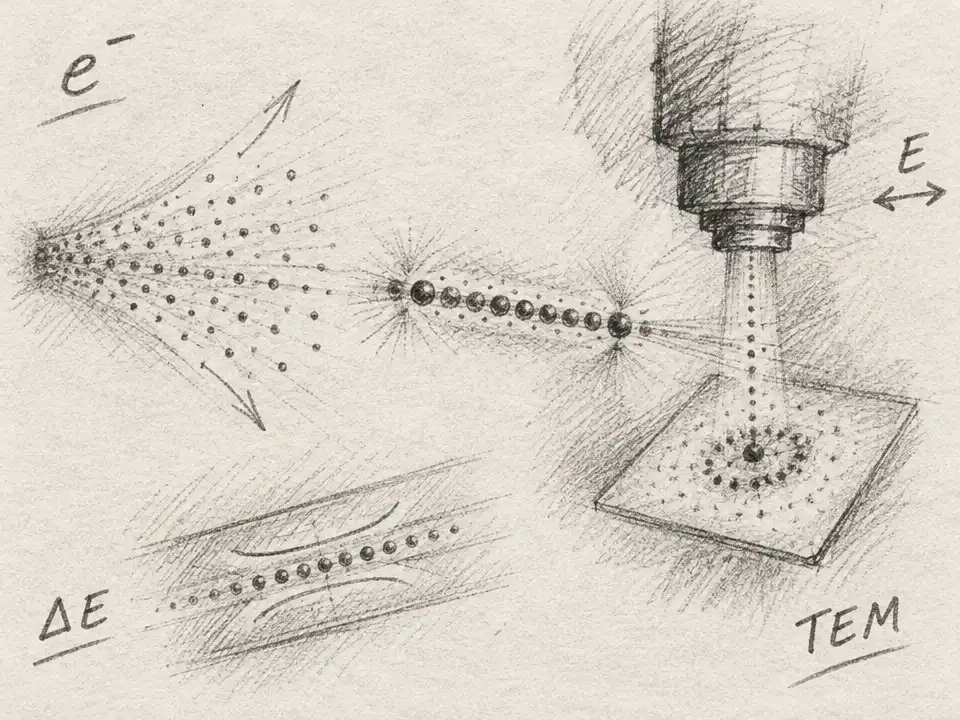
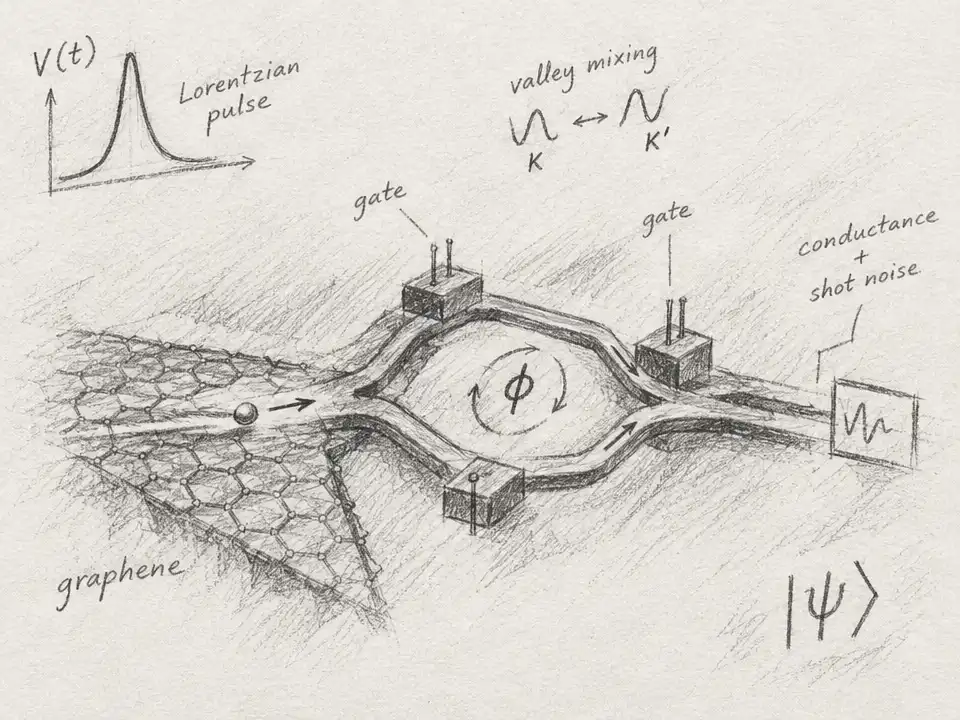
There is a clever exception. A pulse with a Lorentzian shape and just the right total area can lift an electron out of the Fermi sea without producing a messy spray of additional pairs in the traveling channel. The shape matters, not just the pulse’s strength. The idea was developed theoretically years before this graphene experiment; researchers call the clean excitation a Leviton. In a real device, heat still creates background noise, so “clean” means the pulse minimizes extra excitations, not that the entire experiment becomes noise-free.
Graphene offered a way to put that idea to work. Under a strong magnetic field, electrons travel along the material’s edges in narrow channels. By using gates to make one region electron-rich and another hole-rich, the team formed a junction where channels could meet and mix. Graphene’s band structure also supplies a useful two-way label called valley: it distinguishes electron states associated with different regions of the material’s momentum landscape. Here, valley is not the electron’s ordinary spin; it serves as the two-state basis for the traveling qubit.
The route through the device works much like a miniature interferometer for light. A gate-controlled junction acts as a beam splitter, dividing the electron’s quantum state between two valley-labeled channels. As the components travel, magnetic flux changes the phase between them. A second junction brings them together again. Adjusting the gates and flux changes the balance and relative phase of the two components—the operations that, in the language of quantum information, rotate a qubit’s state on a Bloch sphere.
Getting the source pulse right took more than dialing a waveform into a generator. High-frequency signals can change as they travel through the wiring into a cryogenic experiment. So the researchers calibrated the pulse at the device using electrical noise measurements, adjusting the strength and timing of its component frequencies. They combined several harmonics to build the Lorentzian shape, then used shot noise to check whether the pulse produced the expected pattern of electron and hole excitations.
The measurements showed that the device could launch one-electron excitations with a minimized number of unwanted electron-hole pairs. The team also tested pulses carrying two electron charges. After sending the excitations through the interferometer, conductance revealed how the output depended on the accumulated phase, while noise provided a separate check on the extra excitations. Together, the signals showed that the low-excitation character of the Leviton survived its trip and that its valley state could be coherently controlled. The experiment covered pulse frequencies from 3.5 to 14 GHz.
There is an important distinction between demonstrating a traveling qubit and having a practical quantum processor. The researchers did not read out each passing electron individually. They repeated the operation and inferred the quantum behavior from averages in conductance and noise. Nor did they demonstrate two-qubit gates—the operations needed to make qubits work together in a quantum computer. Those remain substantial hurdles.
Still, the route is significant. Graphene’s junctions can act as both a source and the components of an electron-optics circuit, while a shaped voltage pulse avoids the need for a conventional quantum-dot pump to launch the excitation. That gives researchers a way to study quantum information carried by electrons in motion, where interactions between electrons may eventually enable operations that are difficult with photons. For now, the result is a controlled journey, not a finished computing system: one carefully shaped pulse, one valley state, and a clear demonstration that an electron can be guided without losing its quantum coherence.