A quantum particle starts at one corner of a mathematical maze. The equations promise it will arrive at the opposite corner with perfect certainty, at exactly the right moment. Then researchers put the walk on a real quantum computer—and a much simpler route often did better. The puzzle is not whether the math works. It is what happens when a perfect journey has to pass through imperfect hardware.
In a continuous-time quantum walk, a single excitation can spread between neighboring sites, with the connections laid out like a graph. Carefully chosen connections can make the wave’s different paths line up so that, at a prescribed time, the excitation appears at a particular destination with certainty. This idealized effect, called perfect state transfer, has been studied mathematically for years. Priscilla Awuah and Krystal Guo set out to see what it looks like on a present-day processor, without error correction or error mitigation.
The first obstacle was the maze’s size. A hypercube with 20 dimensions has more than a million vertices. Representing every vertex directly would be an unwieldy way to test a walk on a chip. The researchers instead used a compact mathematical cousin: a weighted path whose 21 positions correspond to how many steps a vertex lies from the starting corner. The weights preserve the transfer behavior of the much larger hypercube. For the experiment, that meant using 21 qubits rather than trying to build a million-site device.
Compression solved the size problem, but not the next one: how to make a quantum processor perform a continuous-time evolution. The device does not simply let the ideal walk run. Its instructions must be compiled into a sequence of gates, and even a circuit that represents the correct evolution exactly can become enormous. The paper reports that an exact synthesis for one family of walks would require nearly half a million two-qubit gates by dimension nine—far beyond a practical run.
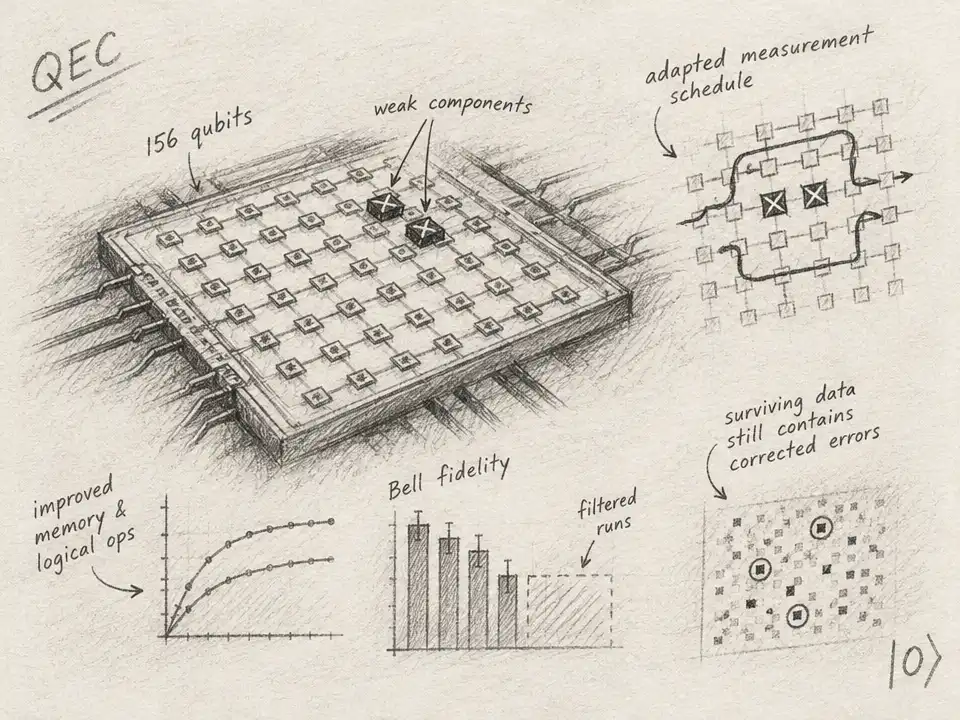
So the researchers used a shortcut: approximate the walk with repeated, shorter gate sequences. More repetitions make the approximation closer to the intended motion, but each repetition adds gates, creating more chances for hardware errors. Too few repetitions, and the simulated walk itself misses its target; too many, and noise takes over. The team chose the repetition count by balancing those competing losses, then ran the circuits on ibm_kingston, a 156-qubit IBM Heron processor. Each reported hardware job used 4,096 measurement shots.
There is an important limit to what those shots show. The experiment prepared one excitation—a single qubit in the “on” state among qubits in the “off” state—and measured where it ended up. It tested whether that particular state could be transported, not whether the processor could carry every possible, unknown qubit state intact. And the result was not a perfect transfer: errors sometimes left the excitation in the wrong place or produced bit patterns outside the one-excitation pattern expected from an ideal walk.
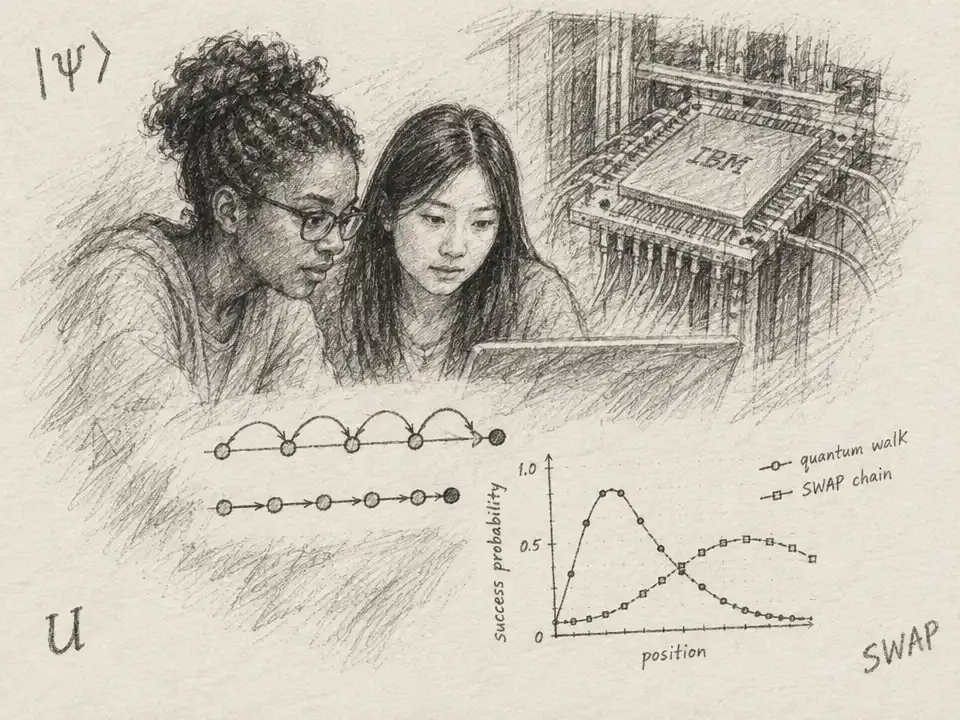
The comparisons offered a clue. At a transfer distance of three qubits, one weighted quantum walk reached its target in 91.6% of shots, compared with 83.6% for a chain of ordinary SWAP gates. But the walk used 14 two-qubit gates; the SWAP route used six. At distance four, a special set of fractional gates gave the walk a smaller edge—84.9% versus 81.5%. Beyond distance four, the SWAP chain had the higher target probability in the paper’s comparison.
That simple route is the rival explanation the experiment needed. A SWAP chain moves the excitation one neighbor at a time through explicit gate operations. It is less elegant than a walk that spreads across a network and reunites at a destination, but in these tests it generally required fewer two-qubit gates. Fewer operations meant fewer opportunities for trouble. The weighted walk’s mathematically exact destination did not make its compiled circuit shorter, nor did it shield the circuit from errors.
The gap became stark at long distances. For a transfer distance of 21, the SWAP chain placed the excitation at its target in 38.9% of shots. The weighted-walk result in the paper’s distance comparison was about 0.2%. The walk’s ideal mathematical counterpart still predicts perfect transfer; the measured circuit, however, has to pay both for approximating that evolution and for running hundreds of gates on noisy hardware. A basic estimate based only on two-qubit gate errors and readout errors also predicted better performance than the researchers observed, suggesting that other effects, including decoherence and differences among physical qubits, mattered too.
So the apparent contradiction has a practical resolution: “perfect” describes the mathematical walk, not the hardware implementation. The experiments do not show that quantum walks are a better way to route quantum information. In these comparisons, the straightforward SWAP chain usually won. Instead, the work makes the gap between a clean theorem and a noisy device measurable—and shows how graph compression, circuit compilation, gate choice, and hardware noise each leave fingerprints on the result. The next puzzle is not how to make the ideal walk perfect. It is how to make its real circuit worth taking.