A light pulse can look finished before the device making it has settled down. The voltage drops, the optical switch is supposed to close—and yet a faint afterglow can linger, like a door that seems shut while its latch is still moving. In integrated photonics, that lingering light is not just untidy. It can blur the boundary between a carefully timed signal and the next one.
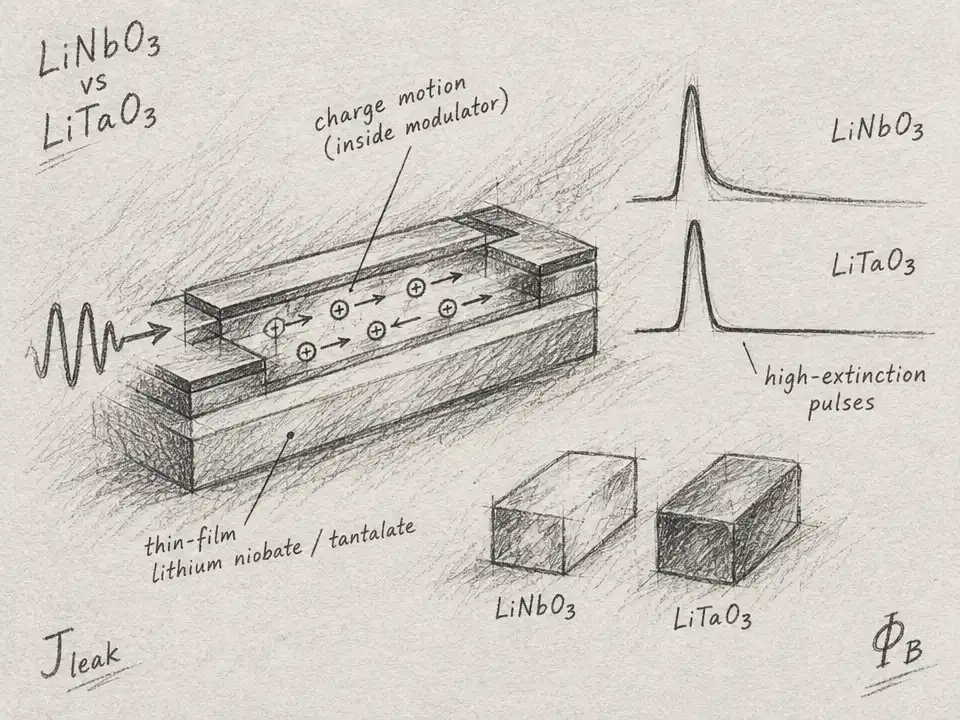
A recent experiment traced this hidden tail to something far smaller than the beam itself: mobile charges in the material of an optical modulator. The researchers compared two closely related crystals, thin-film lithium niobate and thin-film lithium tantalate. Both can use an electric field to steer light quickly. But in their tests, one material let tiny charges move and rearrange more readily—and that movement left a trace in the light.
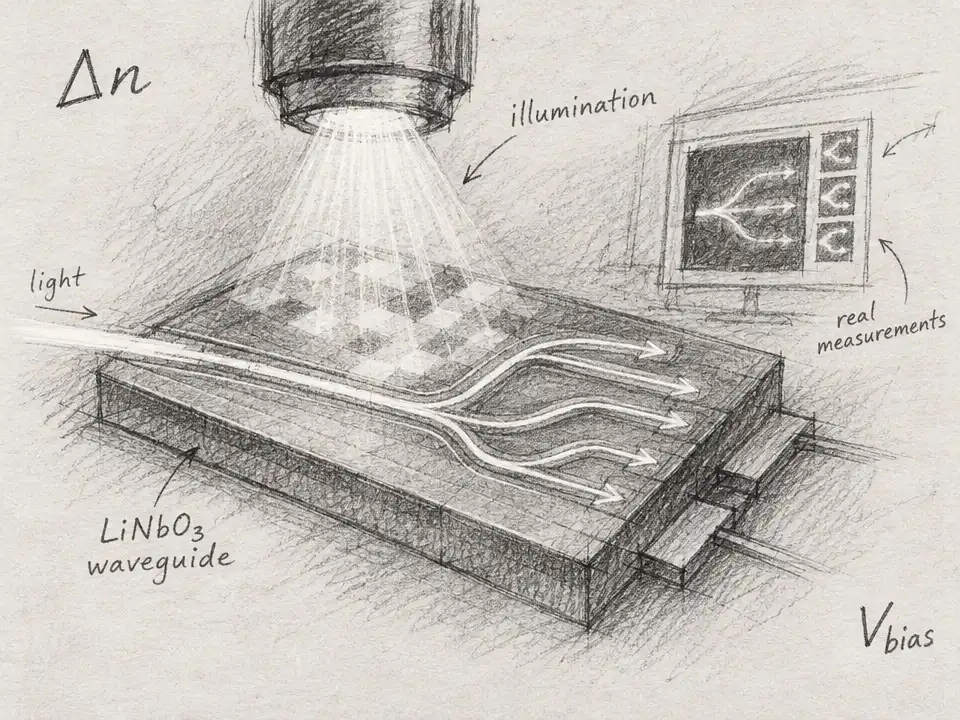
The devices at the center of the work are Mach–Zehnder modulators. Inside, a waveguide splits light into two paths, then brings the beams back together. The paths are tuned so their waves cancel at the output when the switch is off. Apply a voltage, change the phase of one beam, and the cancellation weakens: light emerges. It is a beautifully simple trick, but the dark state depends on precise balance. Even a small disturbance can let unwanted light leak through.
In a quantum photonic circuit, leakage is especially costly. A stray photon cannot simply be ignored or amplified away without consequences for the quantum state. A pulse with a long, low tail can also overlap with a later operation, muddying the timing. So the researchers asked a question that reaches below the switching speed of the device: after the voltage changes, what else inside the crystal is still moving?
They first tuned the lithium-tantalate modulators’ splitters to improve how completely the two light paths canceled. Then they sent voltage pulses through the device and examined the optical output using a second modulator and an electrical spectrum analyzer. This measurement arrangement let them look far below the bright part of a pulse, where the faintest leftover light would otherwise be lost in detector noise.
The lithium-tantalate device produced pulses with more than 35 dB of extinction across a broad range of pulse repetition frequencies, including frequencies as low as 10 Hz. The pulses showed no measurable long tails or waveform distortion in those tests. The paper also reports distortion-free pulses with widths up to 1 s. The measured extinction was limited mainly by scattered light and the measurement system—not necessarily by the modulator’s own ability to go darker.
For comparison, the team tested a thin-film lithium-niobate modulator. Its beam splitters were made differently, using a fixed multimode interferometer rather than the tunable splitters in the tantalate device, and its static extinction ratio was 18 dB. Even at that lower extinction, the niobate output showed pronounced relaxation tails after switching. The contrast suggested that simply balancing the optical paths would not explain the difference.
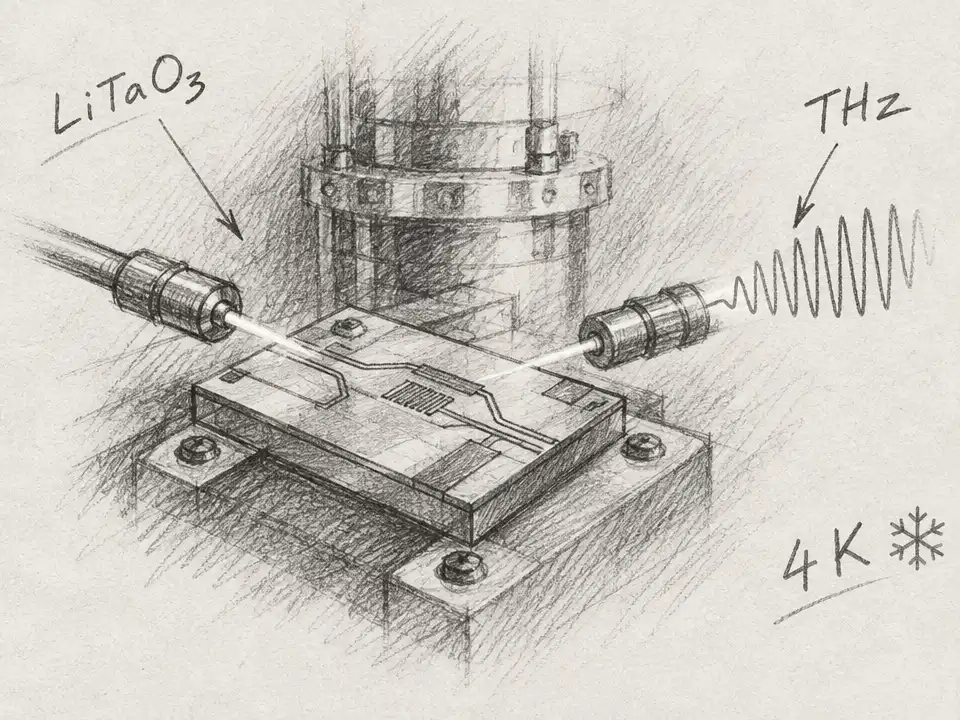
So the researchers looked for a less visible culprit: charge transport. They measured current through the devices while changing temperature and applying ultraviolet illumination. At room temperature, the niobate device carried nearly four orders of magnitude more current. Its measured sheet conductivity was 9.4 × 10⁻¹⁴ S/□, compared with 8.7 × 10⁻¹⁸ S/□ for tantalate. Under ultraviolet light, the current rose substantially in niobate, while tantalate remained far less conductive. The authors caution that this illumination test was qualitative, not a measurement of each material’s absolute photoconductivity.
Temperature measurements offered a clue to why. The team fitted the conductivity data to estimate the energy needed to activate defect-related charge carriers: 0.894 eV for thin-film lithium niobate and 1.306 eV for thin-film lithium tantalate. The similar fitted pre-exponential factors suggested that the difference was not mainly a matter of how many carriers could move once activated. Instead, the tantalate’s higher energy barrier makes it harder for those charges to get moving under the tested conditions.
That microscopic distinction can matter at the scale of a pulse. When charges shift or accumulate, they can alter the local electric conditions that control the modulator. The optical device then takes time to return to its intended dark state, leaving a tail behind the commanded pulse. In the tantalate device, the researchers argue, suppressed charge motion helps the light switch return cleanly. Their experiments support this explanation; they do not directly watch individual charges traveling through the crystal.
There is an important wrinkle in the speed story. The modulator itself has a reported electro-optic bandwidth of 60 GHz, but the experiment’s measured pulse rise and fall times were limited by a 30 MHz arbitrary waveform generator. The work therefore reveals a material advantage for clean pulse generation, not a demonstration of 60 GHz-shaped pulses. The careful distinction matters: a fast component and a complete fast system are not the same thing.
Nor did the researchers run a quantum processor with the device. The potential connection is more basic and perhaps more revealing: building reliable photonic circuits may depend on controlling the sluggish electrical life hidden inside materials chosen for their rapid optical response. In this experiment, a slightly more difficult route for charges appears to make the light behave more cleanly. The switch’s most useful feature may be something the beam never shows directly—a quiet interior, where fewer microscopic rearrangements keep echoing after the voltage is gone.