Light can be more than illumination or a signal moving through a fiber. In the right device, it becomes a ruler: a series of sharply spaced colors that can help measure other light with extraordinary precision. Make two such rulers with slightly different spacing, and their overlap produces a slower pattern of beats that can reveal information across a wide optical spectrum.
That is the promise of dual-comb technology, used in research for spectroscopy, ranging, and sensing. But making two useful frequency combs has often meant managing two separate resonators, their pumps, and the systems needed to keep their signals in step. A new experiment offers a striking shortcut: generate both combs inside one tiny ring, using one continuous-wave laser.
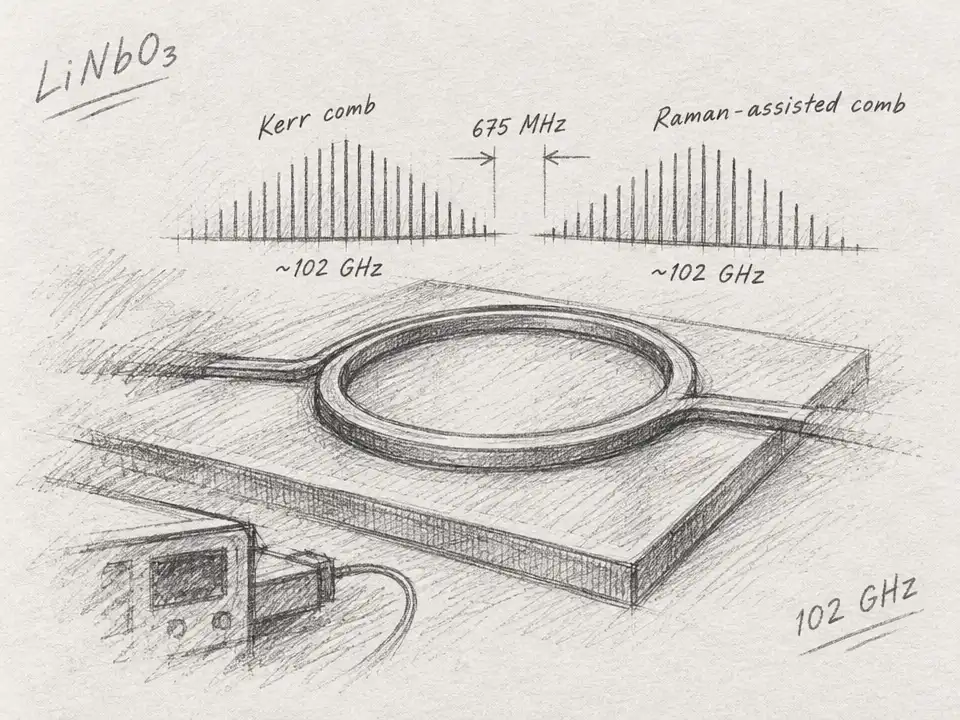
The ring is made from thin-film lithium niobate, a material prized in photonics for how strongly it interacts with light. It is 400 micrometers across, with a top width of 2 micrometers. Inside it, light circulates around and around, building up until the material’s nonlinear responses reshape the spectrum. The researchers measured a loaded quality factor of 5.1 million—a sign that light can circulate in the resonator with relatively little loss.
The key was not simply shrinking two devices into one. The ring supports different spatial patterns, or mode families, that light can occupy. The researchers engineered two of those families to have nearly matching spacings between their resonances, but with a deliberate offset. One family produces a comb through the Kerr effect, in which intense light changes the material’s optical response. In the other, stimulated Raman scattering first shifts light’s frequency through its interaction with vibrations in the material; that light then helps generate a second, Raman-assisted Kerr comb.
In other words, a process that might have been treated as a complication becomes the bridge between two combs. The experimenters tuned a laser to 1551.28 nanometers and pumped the ring at 320 milliwatts. They observed two distinct combs, each with a repetition rate around 102 gigahertz, but separated from one another by 675 megahertz. Their spectra stayed offset rather than collapsing into one set of lines.
The way the combs appeared makes the mechanism easier to picture. At about 55 milliwatts, Raman signals emerged. Above 75 milliwatts, additional spectral lines began to form around those signals and the pump light. As the pump power increased, those lines spread and developed into combs. At higher power, the Raman-related signals helped fill out a broad spectrum, while the separate Kerr comb grew around the original pump.
The researchers report an overall optical conversion efficiency of approximately 13.8 percent. The broadest spectrum extended from about 1300 to 1954 nanometers, spanning 654 nanometers. In the telecom band, the combs had relatively flat spectral profiles across more than 29 nanometers. A measured comb-line linewidth of 410.63 hertz indicated that the output retained high coherence.
Those are meaningful ingredients for a compact light source. In a dual-comb measurement, the two combs’ slightly different spacing turns optical-frequency differences into lower-frequency beats that can be detected and analyzed. That can make it possible to gather broad spectral information without scanning through every color one at a time. A single-ring source could eventually make such measurements easier to build into smaller instruments, with potential uses in identifying substances, measuring distance, or sensing subtle changes.
But the experiment is a component breakthrough, not a finished pocket spectrometer. The setup used a tunable laser, an erbium-doped fiber amplifier, filters, polarization control, and careful adjustment of the coupling into the ring. The device demonstrated the generation and characterization of the two combs; the paper did not demonstrate a portable instrument performing a field measurement. And one successful design does not, by itself, establish how easily the result can be reproduced, stabilized, or integrated into a practical system.
That is the price attached to the possibility: the elegant optical trick still has to survive the less elegant engineering of alignment, control, and packaging. The authors point to lithium niobate’s other useful properties, including its ability to support electro-optic modulation, as opportunities for further integration. For now, the achievement is more focused and more revealing: inside one carefully engineered ring, two distinct routes for shaping light can cooperate. If later work can make the source smaller and easier to control, the same ring that now sits in a laboratory setup could help bring precision measurements out of specialized optics labs and into more compact devices.