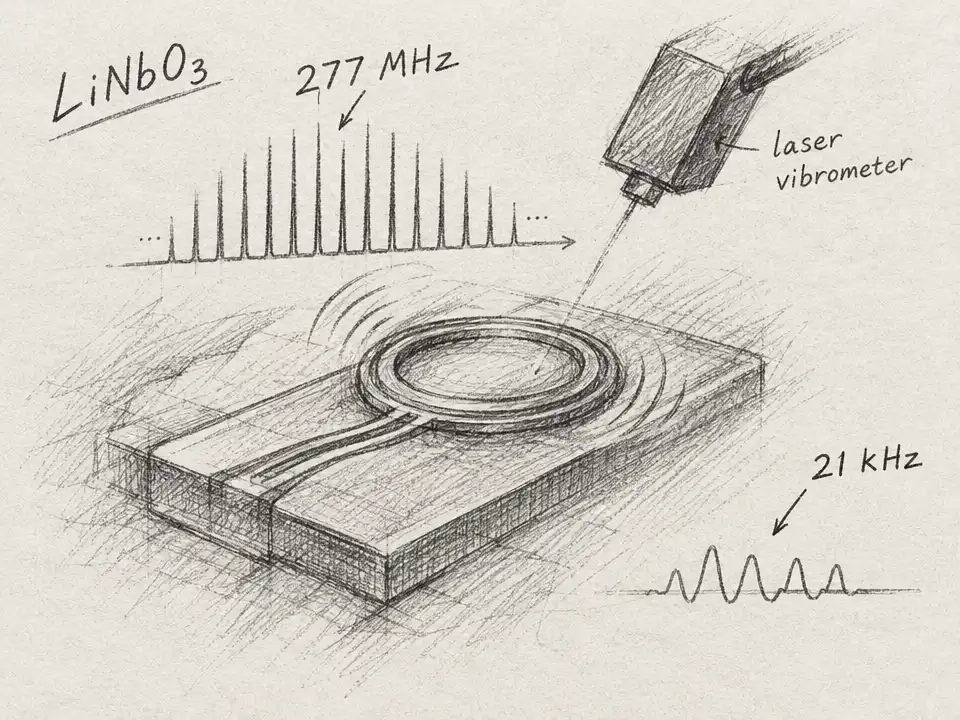
Imagine listening to a vibration so fast that it repeats hundreds of millions of times each second. Now imagine a small device producing a much slower mechanical note from that rapid motion—one you can detect with a laser. Researchers have demonstrated a way to connect those two scales inside a lithium-niobate acoustic resonator: drive it near 277 megahertz, and its nonlinear vibrations form a set of evenly spaced tones whose low-frequency spacing appears as motion at 21 kilohertz.
The idea borrows a trick from a very different kind of instrument. An optical frequency comb is a spectrum of light arranged like the teeth of a comb: many sharp, evenly spaced frequencies. A detector can turn the spacing between optical lines into a much lower-frequency electrical beat. The new work asks whether a mechanical resonator can do something analogous—not with light, but with vibrations traveling through a solid.
That is not as simple as scaling down an optical device. A mechanical resonator has many possible vibration patterns, or modes, and their frequencies do not naturally fall into a neat, evenly spaced ladder. At high drive power, however, the modes interact nonlinearly. In the process used here, energy first feeds two lower-frequency tones through a three-wave interaction. Further interactions create additional tones, or sidebands, around them. If those lines settle into a regular spacing, they form a mechanical frequency comb.
To give the vibrations room to interact, the team built a thin-film lithium-niobate device with an unusual layout. It combines a resonator, which traps acoustic waves, with acoustic pathways that carry waves across the chip. Two sets of electrodes are offset so they can couple to many vibration modes rather than just one. The researchers measured mechanical combs across a broad high-frequency range, from 250 to 900 megahertz, then focused on a mode near 277 megahertz for a closer look.
First came the electrical measurements. The device was driven at 276.046 megahertz and 3 dBm, with a signal analyzer reading the response at a separate port. At high drive, the spectrum showed comb lines spaced by 40.8 kilohertz. At low drive, where the resonator behaved more linearly, those extra tones did not appear. That contrast points to nonlinear interactions as the source of the comb rather than a collection of unrelated background signals.
But the sharper test was whether the comb’s low-frequency spacing could also be found as actual mechanical motion. For that, the researchers used a laser Doppler vibrometer, which reads movement by measuring shifts in light reflected from the device. They drove the resonator at 276.96 megahertz and 15 dBm. The vibrometer detected another comb, this time with lines 21 kilohertz apart. It also picked up out-of-plane mechanical motion at 21 kilohertz and at higher multiples, extending to 300 kilohertz.
The 21-kilohertz motion matched the spacing of the high-frequency comb. Relative to the roughly 277-megahertz drive, that is a frequency division of about 13,000. The researchers compare the mechanical motion to the low-frequency beat produced when a detector reads an optical comb: a widely spaced set of fast tones gives rise to an observable signal at its slower spacing. In this case, the low tone was measured optically, but it was the resonator itself moving—not an electrical output produced by an ordinary mixer.
There is a useful wrinkle in the results. The electrical and vibrometer measurements did not show the same comb spacing: one was 40.8 kilohertz, the other 21 kilohertz. The researchers suggest that wire-bonding inductance, along with changes in drive conditions, may have led the device into a different comb pattern. That is a reminder that nonlinear resonators can be sensitive to how they are wired and driven. Their behavior is not simply a fixed conversion ratio waiting to be switched on.
The demonstration is a first step, not a ready-made clock or sensor. The low-frequency tones were weaker than the high-frequency ones, and the team could not image the resonator’s vibration patterns while it was operating in the nonlinear regime. They therefore could not confirm whether the detected tones correspond to resonances in the way they hope. Further measurements will test that question and explore how drive frequency and power affect the low-frequency signal.
If those challenges can be worked through, a mechanical comb could offer a compact way to connect fast acoustic vibrations with signals that slower electronics can handle. The intriguing part is the route: instead of relying on a separate chain of components to translate between frequency scales, the resonator’s own nonlinear motion creates a slow mechanical beat. For now, that beat is a faint experimental result. But it gives researchers a new place to look for the bridge between the very fast and the readily measured.