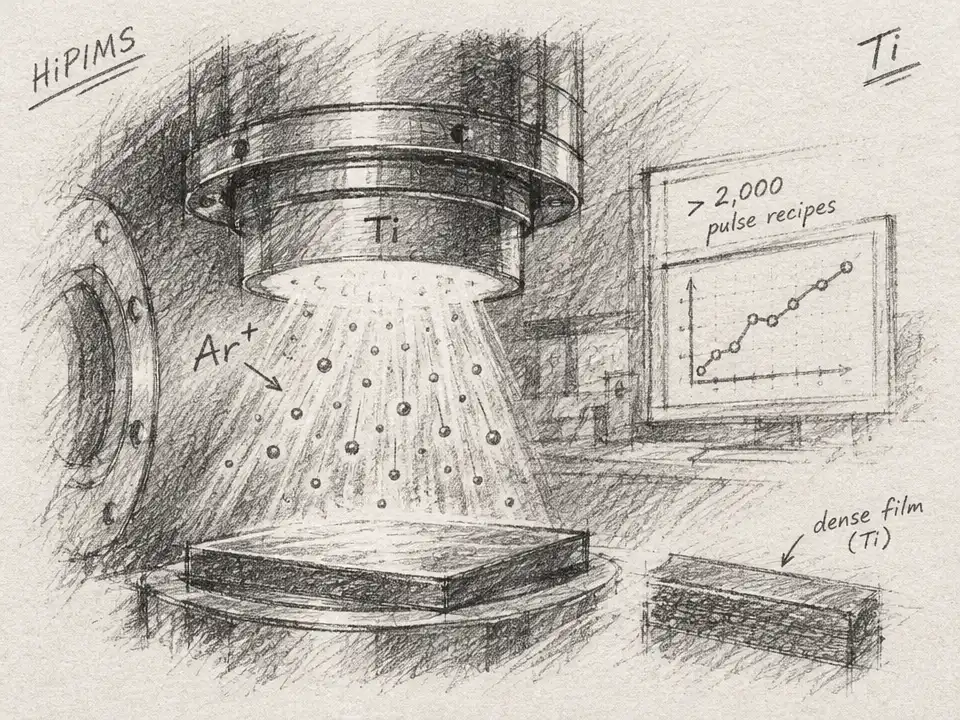
Inside a vacuum chamber, a stream of argon atoms is sent toward a titanium target. The impacts knock titanium atoms loose; some cross the chamber and settle on a surface as a thin film. It is a finely controlled way to make coatings and materials used in technologies from microelectronics to protective layers. But the power supply’s rhythm matters. Researchers have long expected that a particularly intense pulsed method would make films more slowly than a steady electrical current.
That expectation has a physical reason. High-power impulse magnetron sputtering, or HiPIMS, packs energy into brief bursts, creating a dense plasma in which many of the flying titanium atoms become charged ions. Those ions can help produce dense, well-adhered films, and their energy can be tuned. But the target is negatively charged, so it can pull some of the ions back before they reach the surface being coated. The useful, ion-rich process comes with a familiar cost: a slower deposition rate.
To see whether that trade-off was inevitable, Nathan Rodkey, Felix Thelen, Alfred Ludwig and Sebastian Siol searched a much wider range of pulse recipes than a person could efficiently test by hand. Their study, posted to arXiv on October 26, 2026, reports measurements of titanium deposition across more than 2,000 process recipes. The team varied pulse count, pulse width, the gap between pulses and how often the pulses repeated, while tracking both how fast material arrived and what fraction of the arriving flux was ionized.
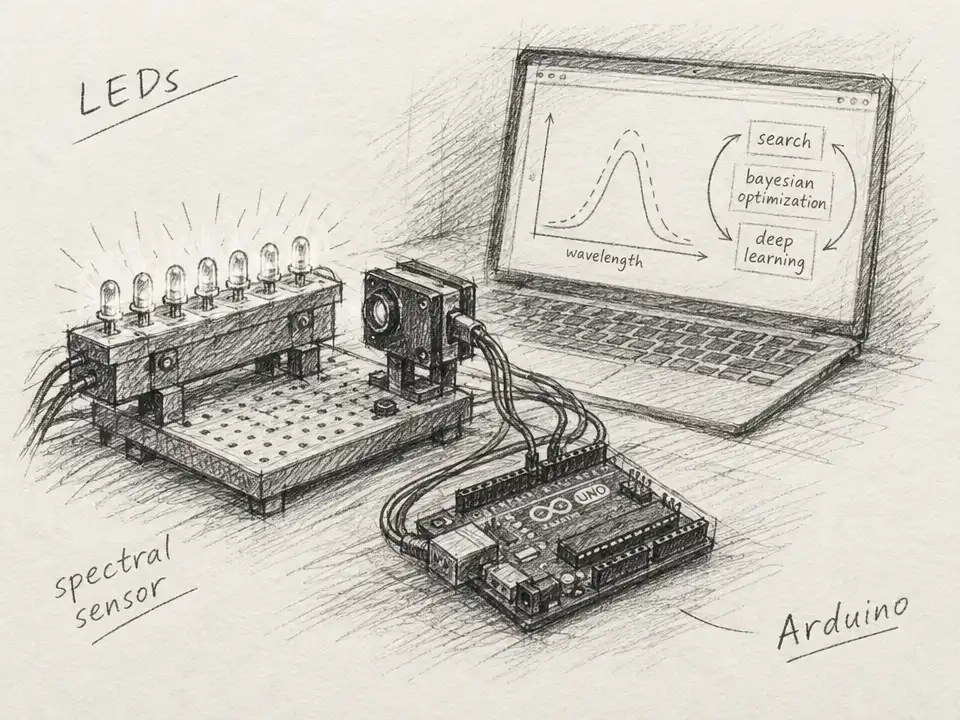
The search was designed to find not one “best” setting, but the boundary of the compromise: how much deposition speed could be retained at different ionization levels. The researchers used a Bayesian optimization system to choose what to test next, based on the results so far. In effect, each run helped the computer-guided search decide where the next run might reveal a better combination of speed and ionization.
The boundary held a surprise. In their titanium experiments, many optimized HiPIMS processes deposited material faster than direct-current reference processes. The best reported rates reached 1.5–2.2 times the DC rate, at duty cycles up to 10%. The strongest result did not mean that pulsing always wins. At a working pressure of 1.0 Pa, the team found that millisecond-scale operating conditions and moderate ionization flux fractions of 5–20% were especially promising. In the 2.2 W cm−2 campaign, the DC reference began to outperform HiPIMS above an ionization fraction of about 35%.
Even the shape of the useful pulse pattern ran against an appealing intuition. One strategy for reducing ion back-attraction is to chop a long burst into shorter pulses separated by gaps: when the voltage switches off, the target stops pulling ions back. The team compared single pulses with packets of pulses that had the same total on-time. In the moderate-ionization range, their measurements showed little difference in deposition rate or ionization. The gaps were not providing the expected advantage. For these conditions, the more effective recipe leaned toward a long single pulse, rather than a complicated packet.
The researchers’ explanation starts with the gas itself. A strong opening burst can push argon out of the region in front of the target, thinning the gas along the route to the surface. The team suspects that this “rarefied” channel lets later titanium atoms travel with fewer collisions—and lets more titanium ions form farther from the target, where they are less likely to be pulled back. The pulse traces support this picture: after the first burst, the current decayed with a fitted time constant of 131 μs. The researchers interpret that decay as evidence that the gas keeps thinning even after the initial ignition.
That changing environment could explain why dividing a pulse into pieces does not automatically help. The gaps tested were 10–100 μs, while the gas takes much longer to refill. So each later pulse may still be working in a channel opened by the first. In this picture, the first burst does the clearing; the lower-current tail of a longer pulse then keeps material moving through the thinned region. It is a plausible mechanism, not a direct measurement of gas density during each experiment, and the authors present it as a hypothesis.
The optimization also revealed that pulse packets may matter more when the goal shifts toward higher ionization. In their analysis, pulse count became more influential above 22% ionization, while pulse on-time was the stronger factor at lower ion fractions. That distinction matters: the result is not that one pulse pattern replaces all others, but that the right pattern depends on which balance of speed and ion content a process needs.
There are important limits to what the study establishes. The experiments used a titanium target in a custom sputtering system, with working pressures of 0.5, 1.0 and 2.0 Pa and power densities of 2.2 and 4.4 W cm−2. The team measured deposition and ionization rates; it did not demonstrate that finished films made with the faster recipes have identical or superior performance in every application. The authors expect the trends may extend to other materials, but that remains to be tested.
Still, the result shifts the question from “How do we make pulsed sputtering pay its speed penalty?” to “Which pulse regime avoids that penalty in the first place?” The answer, at least for this titanium system, was not simply to add more pulses. It was to let a first burst reshape the gas between the target and the surface—and then keep depositing through the path it opened.