Hubble’s Cosmic Origins Spectrograph has a problem that no software patch can make disappear: its far-ultraviolet detector is aging. As the detector’s sensitivity fades, it can stop registering some incoming photons. The obvious fix is to place new spectra on a healthier patch of detector. But the instrument’s onboard software was built with a hard limit on how many positions it could remember. Researchers found a way around that limit without changing Hubble’s flight software: reuse one of its existing table entries, updating it just before each exposure.
The spectrograph has been gathering ultraviolet light from thousands of astronomical targets since its installation in 2009. Its Far Ultraviolet channel is sensitive from below 900 Å to 2150 Å. With its medium-resolution gratings, it typically reaches a resolving power of about 15,000; with a low-resolution grating, about 3000. That makes the channel a valuable tool for examining the ultraviolet fingerprints of space. Keeping it useful means working with the delicate detector that records those fingerprints.
The detector counts individual photons using microchannel plates. Each incoming photon triggers an amplified signal, and the instrument records where the event landed, when it arrived, and the signal’s pulse height—a measure related to the detector’s gain. With use, gain declines. Calibration software can correct for some consequences, but if it falls too far, an event may no longer be processed at all. The photon is lost before it can contribute to the spectrum.
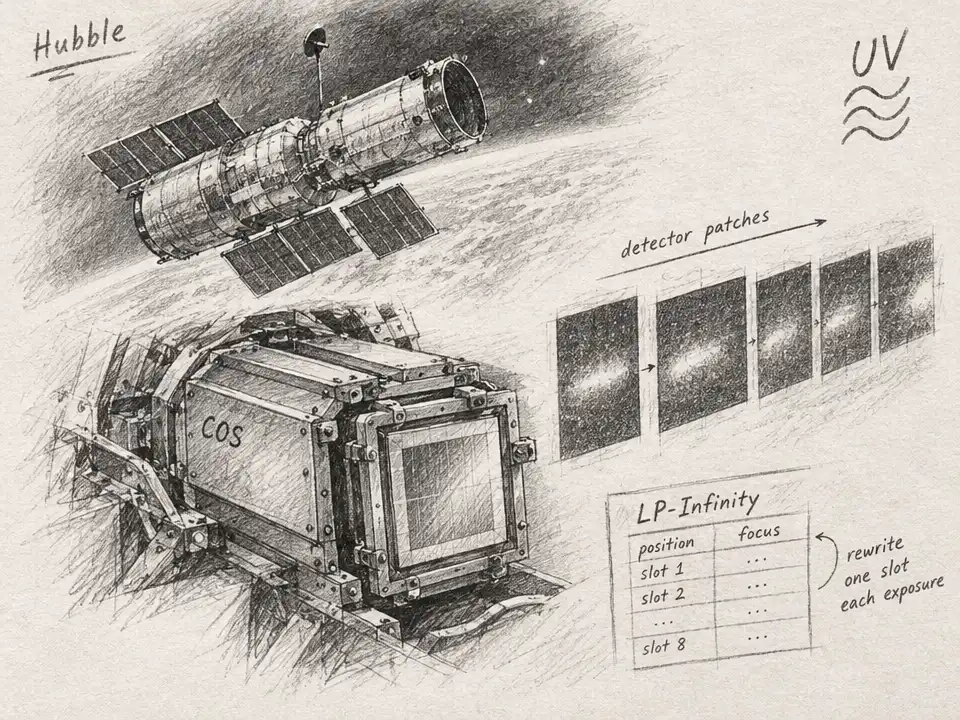
To slow that decline from undermining observations, the team shifts where spectra land. A Lifetime Position, or LP, is a particular placement of a target in Hubble’s focal plane. By changing the observatory’s pointing and the position of the spectrograph’s aperture, the instrument places a spectrum on a different detector region. It is not the detector being moved; the light is being directed to a new strip of it. As one strip loses gain, another can take over.
Choosing that fresh strip is more than finding an empty patch. The optics were designed around the original position, so resolving power generally falls as spectra are placed farther away. Researchers also have to avoid overlapping spectra, detector defects, troublesome light leaks, and edge regions where distortion and background counts increase. Each position needs its own instrument settings, including aperture placement and focus. A new LP is therefore a carefully chosen compromise between detector health and the quality of the measurement.
At first, adding positions seemed to require expanding the tables stored in the Cosmic Origins Spectrograph’s flight software. Those tables hold instrument settings for each LP, but they had room for only eight. Changing their size would require memory and software work, followed by extensive testing—an awkward prospect when the next position might be needed before that work could be completed. Reusing old entries was possible, but it would make their meanings depend on when an observation took place, complicating both planning and later data processing.
The alternative changes how the existing table is used, rather than how large it is. Before an exposure, the ground-based commanding system writes the needed settings for a new position into the table entry normally associated with LP8. Hubble then carries out the observation using those updated settings. Before a later exposure, the entry can be rewritten with a different position’s values. The slot becomes a temporary workspace, not a permanent address for one particular detector location.
That is the core of LP-Infinity. The name sounds boundless, but the method does not make the detector larger or create unlimited fresh locations. It removes the software table’s old ceiling. Previously defined LP1 through LP7 continue using their established settings. To distinguish the new, dynamically assigned positions, the team skipped LP8 and LP9 and began numbering them with two-digit names, starting at LP10.
The workaround also keeps the changes focused. It requires no modification to Hubble’s onboard flight software, no change to the pointing method, and no expansion of the tables. The ground commanding system and observation-planning tools did need updates, and patching adds a few seconds of overhead to each exposure. The researchers completed the implementation in time for Cycle 33, beginning in November 2025, about 20 months after the idea was first developed.
LP-Infinity gives the team more flexibility than simply extending the old list. Because focus settings can be adjusted for different positions and wavelength configurations, future placements can be tailored to preserve resolution where it matters most. But every choice still faces the same physical limits: usable detector area is finite, and each new location must be evaluated against gain, focus, overlap, and background. The method is a way to use the remaining space more strategically, not a way to stop the detector from aging.
Combined with other operational changes, the researchers say the approach could let the Cosmic Origins Spectrograph continue producing high-quality far-ultraviolet data well into the 2030s, with essentially the same performance. That is a plan, not a guarantee: future LP assignments may change as the detector’s gain evolves. Still, LP-Infinity turns a stubborn constraint into a manageable task. Instead of asking Hubble’s software to remember an ever-growing list, the team teaches one old slot to hold the right answer for the next observation—and then to make room for another.