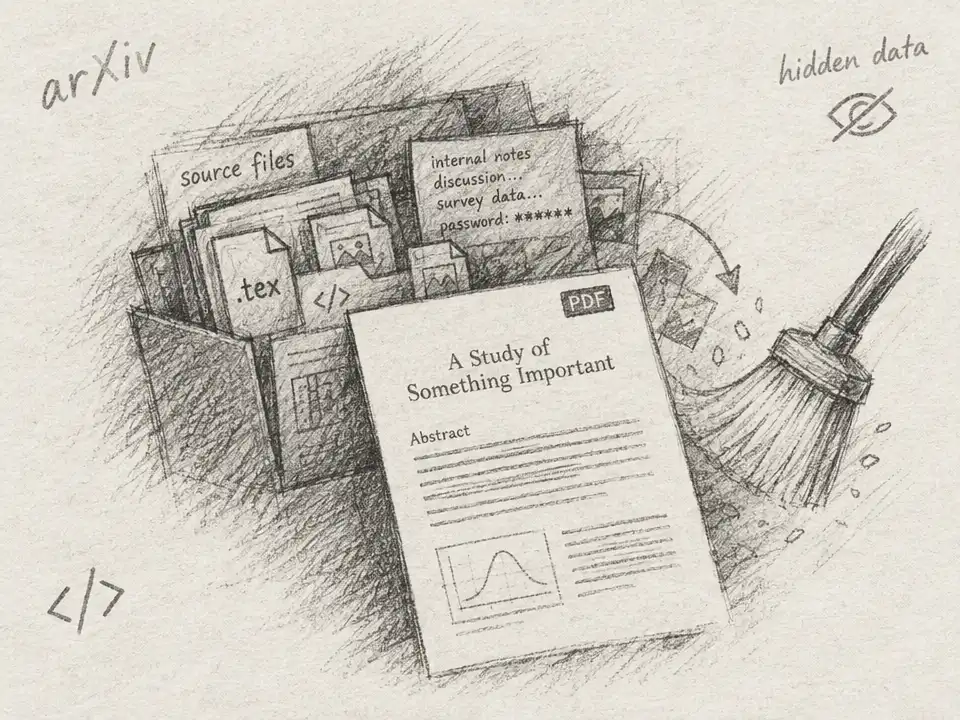
A scientific paper looks finished when its pages line up: title, abstract, figures, conclusions. But the PDF is only the visible surface of a small publishing machine. Behind it may sit the files and instructions used to build the document: notes, image metadata, backup material, even text the final pages never show. A study posted to arXiv on April 22, 2026, set out to inspect that backstage layer at a scale no one had tried before.
The researchers examined source files from 2.7 million arXiv submissions, covering papers through the end of 2025. That amounted to 93% of arXiv submissions in their dataset. They looked for three kinds of traces: files not needed to compile the paper, metadata embedded in files, and source text that does not appear in the compiled document, such as comments. It was a search not for what authors meant to publish, but for what the publishing process carried along with it.
The first surprise was how common these traces were. The team found at least one kind of what they defined as “hidden” information in 88% of submissions with LaTeX sources. That figure needs a careful reading: it does not mean that 88% contained a password or a dangerous secret. Many traces were mundane. The researchers filtered out items repeated in more than two submissions, aiming to separate author-specific material from common templates. Even so, their broad measure included everything from harmless extra files to genuinely sensitive content.
The scale of the raw material helps explain the challenge. Across the archive, the researchers identified 12 million unused files, 144 million metadata entries, and 644 million LaTeX comments. A large share of these were routine. But an unused file can be more than a forgotten figure, and a comment can be more than a reminder to fix a typo. Each is a little pocket of information that the polished paper may conceal.
Some pockets held traces of how and where a document was made. Metadata can record software, usernames, email addresses, or details about hardware. In 7,326 submissions, the team found metadata that revealed GPS locations. A coordinate is not automatically a privacy breach: it may point to a university or lab. But the researchers sampled locations and found cases associated with both research buildings and residential areas. In the right circumstances, a file can quietly say more about its authors than the paper itself does.
Other clues were not hidden in technical metadata at all. They were links left inside source files. The study found references to shared documents and collaborative platforms, including Google Docs and Overleaf. The team manually checked a sample of links; some led to material that could be viewed or edited without an access restriction. Among the sensitive material they confirmed were reviews, rebuttals, revision notes, meeting records, and survey data. The paper reports 18 cases where researchers gained access to survey data about study participants.
Then there were the strings that security teams dread finding in a public archive: credentials. After manually checking candidates, the researchers reported 265 API tokens across 128 submissions, four private keys in four submissions, and 171 generic passwords across 82 submissions. Their placement suggested the material was not intended for public release. The team says it did not test or use the credentials, and the findings do not establish that every exposed string remained active. The discovery matters because even a key that once worked can reveal a lapse in how research files were prepared.
To find these traces without mistaking normal paper content for a leak, the team had to look past quick text searches. A LaTeX comment can be tucked into different structures, including conditional branches and ignored command arguments. A blunt search rule might miss a comment—or delete something needed to build the paper. The researchers instead parsed the source into a structured representation, like a map of the document's syntax. To identify unused files, they also tracked which files the compiler actually read. Metadata required a separate inspection.
That combination became ALC-NG, a cleaner designed to strip files, metadata, and irrelevant text while preserving the document readers see. The difference between a PDF and its source is crucial here: the aim is to remove backstage material, not to edit the scientific claims. In tests on 2.32 million submissions that could be compiled in their environment, 98% had files or text the tool could remove. After sanitization, 87% of PDFs were visually identical to their originals. That is a substantial step forward, but not a guarantee that every archive can be cleaned perfectly without review.
The problem also has a memory. arXiv keeps earlier versions of a submission available, so replacing a source file may not erase material already released. The researchers found individual cases where later versions removed exposed items, but their broad analysis did not show that authors generally reduced hidden information when updating papers. They also describe the limits of their method: unusual, custom ways of hiding text could escape detection, and their results should be treated as a reliable lower bound rather than a complete inventory.
There is a quiet tension in this discovery. Keeping source files public can help readers reproduce work, inspect methods, and build on research. The same openness can preserve a trail authors did not realize they were leaving. The study does not argue that every draft note is a crisis or that transparency should end. Instead, it shows that a publication is more than the page a reader sees. Somewhere behind the PDF, the tools that assemble science can also carry its forgotten scraps into public view.