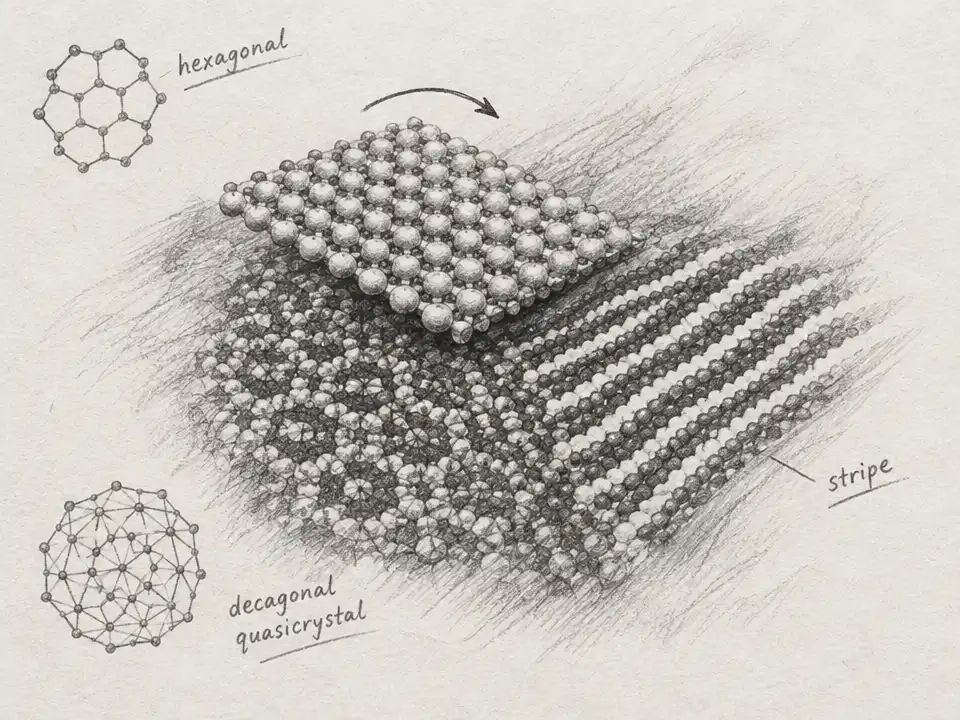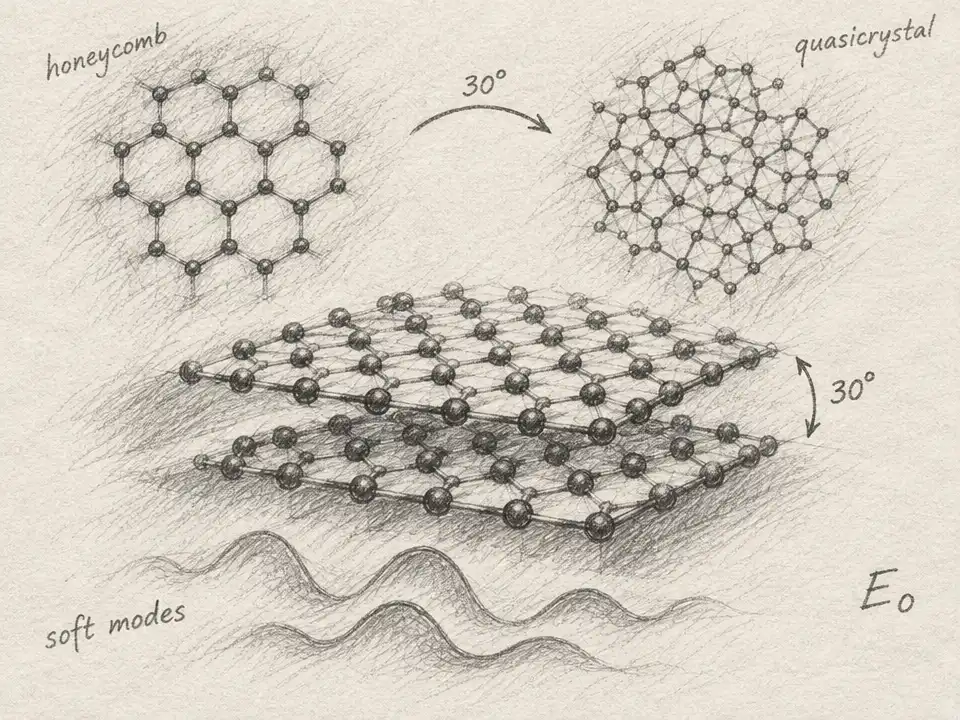
Two sheets of electrons face a simple choice. Stay lined up, and the charges can settle into a familiar honeycomb arrangement. Twist one sheet against the other, and their orderly triangular patterns stop repeating in step. The result is a quasicrystal: ordered, but without the regular repeating unit of an ordinary crystal. By the usual rules, that twist should be a losing move. So why would the electrons choose it?
The question reaches into one of condensed matter physics’ oldest ideas. At low enough density, electrons can repel one another so strongly that they stop behaving like a fluid and arrange themselves in a crystal. These Wigner crystals are made of electrons, not atoms. In a wide semiconductor quantum well, the electron system can behave like two such layers, each with its own triangular pattern. The layers interact, and their separation and electron density help decide how the patterns line up.
In their 2026 theoretical study, Pierre-Antoine Graham, Filippo Gaggioli, and Liang Fu set out to explain a strange candidate state in that bilayer system: two triangular electron crystals rotated by about 30 degrees. The twist makes a quasicrystal. Their central clue is that the winner depends on what counts as energy. A static, classical calculation gives one answer. The quantum motion that remains even at absolute zero gives another.
First, the classical case. Each layer prefers its own triangular arrangement. When the layers are aligned in the honeycomb configuration, electrons in one sheet can sit in a favorable pattern relative to those in the other. Their calculations find this arrangement wins on the classical energy ledger. Twisting the layers weakens that neat interlocking, so the quasicrystal starts at a disadvantage. If the electrons were fixed points, the puzzle would be over: choose the honeycomb.
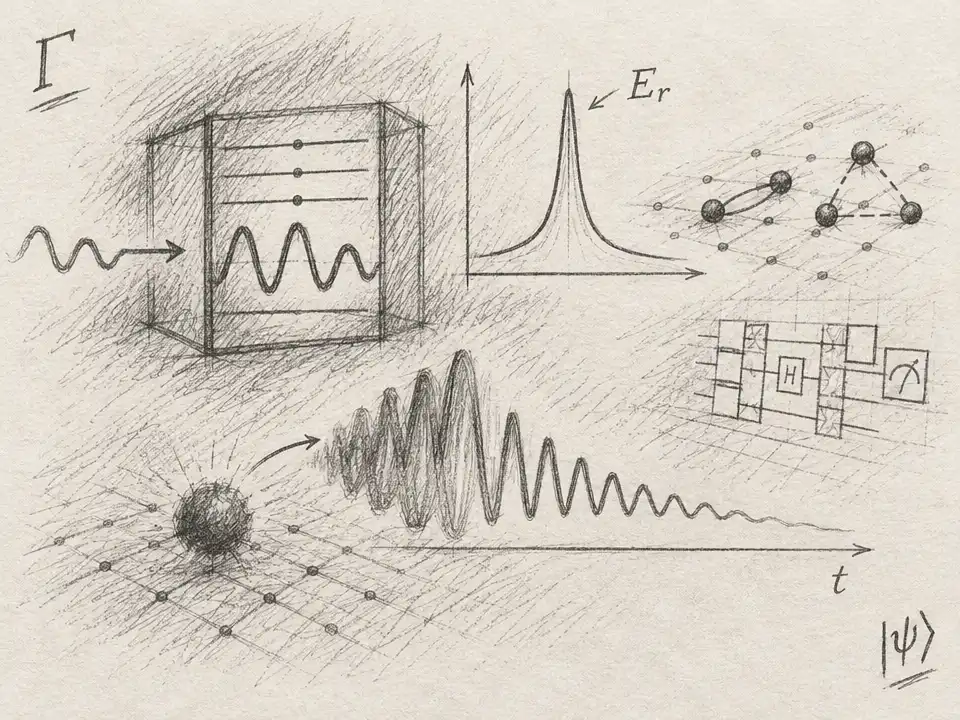
But electrons are not fixed points, even in a crystal. Quantum mechanics leaves them with zero-point motion: a residual jitter that cannot be switched off, even at absolute zero. The electron arrangement determines how its collective vibrations behave, just as the structure of a drum determines the notes it can make. Those vibrations have their own zero-point energy. To compare the contenders fairly, the researchers calculated the collective modes around each arrangement and summed their contributions.
Here the evidence turns. The twisted quasicrystal has more of its collective modes at low frequencies than the honeycomb arrangement. In the language of the paper, the quasicrystal’s zero-point energy is lowest at 30 degrees, while the honeycomb’s is highest. The static advantage and the quantum advantage pull in opposite directions: honeycomb wins when interactions dominate, but as quantum fluctuations grow, the quasicrystal can win the total-energy contest.
One special kind of soft motion helps explain why. In a quasicrystal, sliding one layer slightly relative to the other can rearrange local patterns without much changing the overall energy. That near-freedom gives rise to modes called phasons. They are not ordinary vibrations of a repeating lattice; they reflect the unusual way the two nonmatching patterns fit together. The calculations find these modes nearly gapless in the quasicrystal. More generally, the spectrum shifts toward lower frequencies, bringing down the summed zero-point energy.
That is not quite the same as saying the electrons jiggle wildly and thereby make the quasicrystal stable. Too much motion would destroy the crystal altogether. The researchers therefore checked where their vibrational calculation remained self-consistent, using a standard melting test that compares the size of the fluctuations with the spacing between electrons. They find a broad range of model conditions where the quasicrystal is both energetically favored and still ordered. As the fluctuations grow further, the crystal eventually gives way to a fluid-like state.
The balance also changes with density. In the paper’s description, large values of the electron-spacing parameter rs favor the classical honeycomb arrangement; as rs decreases, zero-point motion becomes more influential and the 30-degree quasicrystal becomes the global energy minimum. The change is predicted to be first-order—a jump between competing arrangements, rather than a gradual turning of one into the other. The authors’ phase diagram agrees well with an earlier numerical study, lending support to their explanation.
The result is a theoretical prediction, not a report that anyone has watched electrons assemble into this quasicrystal. The authors identify semiconductor quantum wells, transition-metal dichalcogenide structures, and rhombohedral graphene as possible places to look. They suggest that transport measurements, optical probes, or direct imaging could test for the state. Each would have to distinguish this particular arrangement from other electron-crystal patterns.
The puzzle’s answer is therefore not that electrons ignore the classical rules. It is that the rules leave out part of the account. A structure that makes the static charges less comfortable can still be favored if it gives the quantum system a lower-energy set of collective motions. In this predicted electron quasicrystal, a 30-degree twist trades a tidy classical fit for a quieter quantum spectrum. The unexpected order may be written not just in where the electrons sit, but in how easily their whole pattern can move.