In the crowded strip of sky near the Milky Way’s plane, stars overlap until a faint object can disappear in the glare. That is exactly where 2026 ED138, a distant object beyond Neptune, might seem hardest to find. Yet a spacecraft that had already photographed this patch of sky kept an accidental record of its journey—years before astronomers knew what to look for.
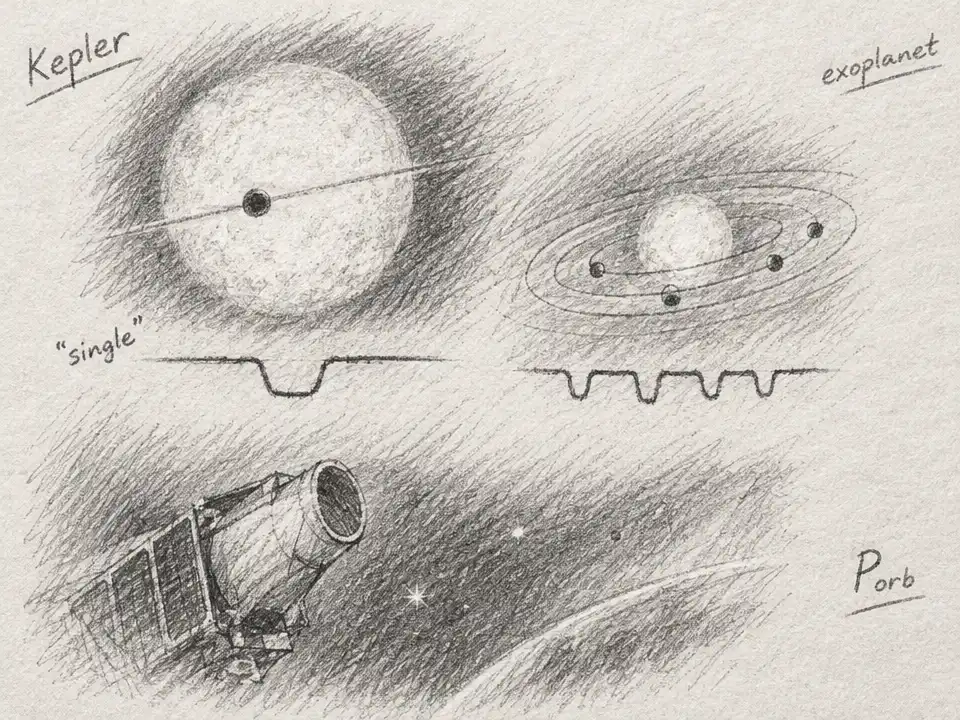
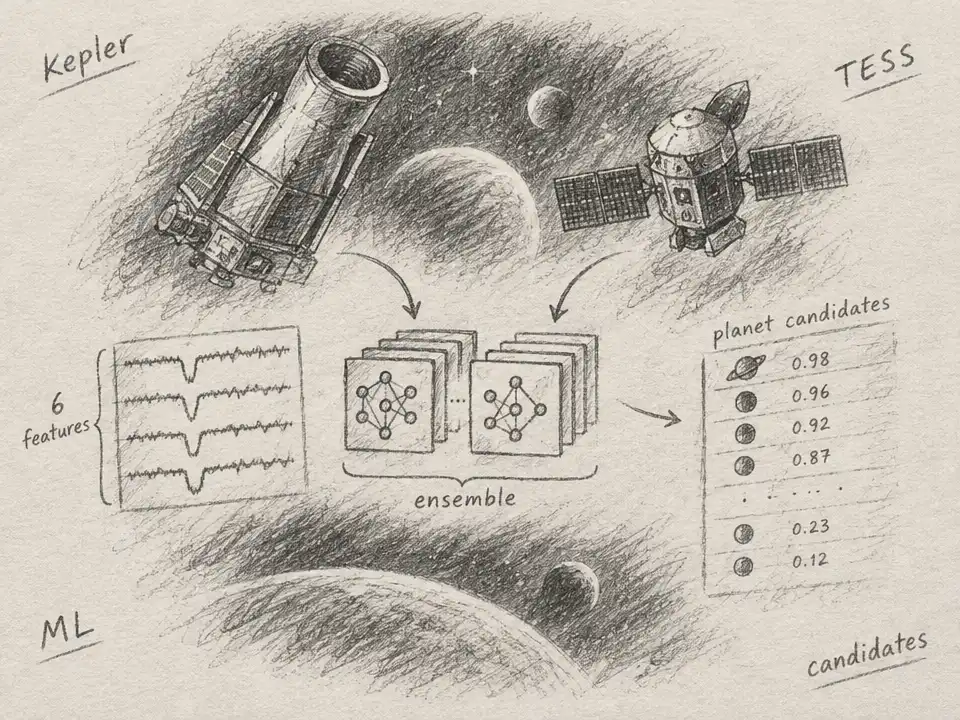
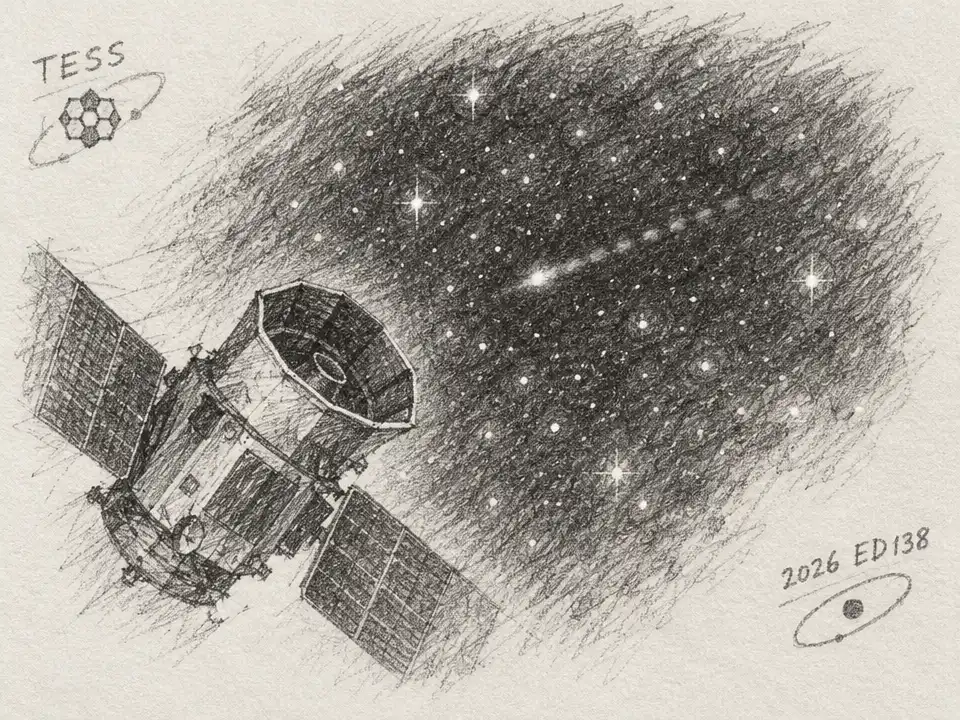
The spacecraft was TESS, NASA’s Transiting Exoplanet Survey Satellite. It searches for planets by watching stars for the tiny dips in brightness caused when a planet crosses in front of its star. But TESS also takes broad images of the sky. After the Vera C. Rubin Observatory announced 2026 ED138 as a dwarf-planet candidate in October 2026, researchers went back through TESS images and found the object in five observing periods between 2019 and 2026. Four of those records came from before the discovery.
Finding a moving world in old images sounds straightforward: calculate where it should have been, then look there. But TESS pixels cover 21 arcseconds of sky, and the object passed through a field so crowded that 7–21 Gaia catalog stars fell within each pixel. In a single exposure, ED138 was too faint to pick out. Its light was buried among stars and the small imperfections left behind when their light was measured.
The researchers’ solution was to turn the clutter into a subtraction problem. They used Gaia’s catalog of stars to predict how much light each one should contribute to the TESS images, then modeled and removed those stars. Next, they estimated the remaining pattern of fixed errors by comparing each pixel with images taken 1.5–3 days earlier and later. Because the target was moving, they masked its expected position during that step so its own light would not be erased.
That sequence made a striking difference. After modeling the stars, pixel-to-pixel scatter fell to 7–17% of its original level. Removing the remaining static errors reduced the scatter further, to 0.5–1.7%. The trick was not to make each image perfect. It was to clear enough of the stationary mess that a moving point of light could add up across many images.
To do that, the team followed the object’s predicted path through each set of exposures. Imagine laying transparent images on top of one another while shifting each one so a moving target lands in the same place. The target’s faint light accumulates; stars and other fixed features slide away from the aligned track. This shift-and-stack approach has been used to search for faint moving objects before. Here, the key advance was pairing it with detailed star subtraction to work in a particularly crowded field.
The researchers also guarded against a false catch. They measured the noise along 84 nearby paths that the object did not travel, using these control tracks to estimate how much apparent signal could arise by chance. They gave less weight to images in which the predicted path crossed bright or variable stars. And they tested the process by inserting copies of the object’s signal into the images: the method recovered 90–100% of the inserted light.
After those checks, ED138 emerged in all five TESS observing sectors. The detections ranged from 5.1 to 20.7 sigma; combined, the signal reached 34 sigma. The faintest individual detections are a reminder that no single image delivers a crisp portrait. The discovery comes from many imperfect glimpses, carefully lined up and compared.
The archived images provided more than a glimpse of brightness. By measuring where the object appeared in eight stacked observations, the researchers tested its motion against the orbit calculated from other observations. The positions agreed with that orbit as expected. Using the TESS positions alone, they derived orbital values consistent with the more precise JPL solution. TESS also supplied a distance estimate within each sector, constrained to ±0.06 au.
Brightness offered another check, though not a dramatic one. As ED138 moved farther away, its distance from the Sun increased from 46.5 to 47.2 au. The team expected the object to fade by 0.080 magnitudes over the years, but the measured brightness was also consistent with no change. The TESS data did not reveal a clear repeating variation in brightness, either. The archive could recover the object and check its path, but it did not turn every unknown into an answer.
That distinction matters. 2026 ED138 is a candidate for dwarf-planet status, not a confirmed dwarf planet. Its estimated size, 600–1500 km, and brightness helped make it notable, but the TESS analysis was not a direct measurement of its size or a final verdict on its classification. Its main achievement was methodological: it showed that old TESS images can yield useful observations of a newly discovered object even in a star-packed region.
There is a quiet shift in perspective here. A telescope’s archive is often treated as a record of what researchers already knew to ask. But as new discoveries supply precise paths and positions, those same files can be searched again for faint traces that were invisible at the time. TESS was not pointed at ED138 to study it. Still, its repeated views gave astronomers a way to reach backward, recover the object, and check its motion across years of spaceflight.
The next opportunity may come from Rubin, whose discoveries can send astronomers back to older images from other observatories. The TESS study does not promise that every new object will be hiding in an archive. It offers something more concrete: a tested way to look, even where the starfield seems to make the search hopeless. In astronomy, sometimes the new instrument is not a spacecraft at all. It is a better question asked of data already in hand.