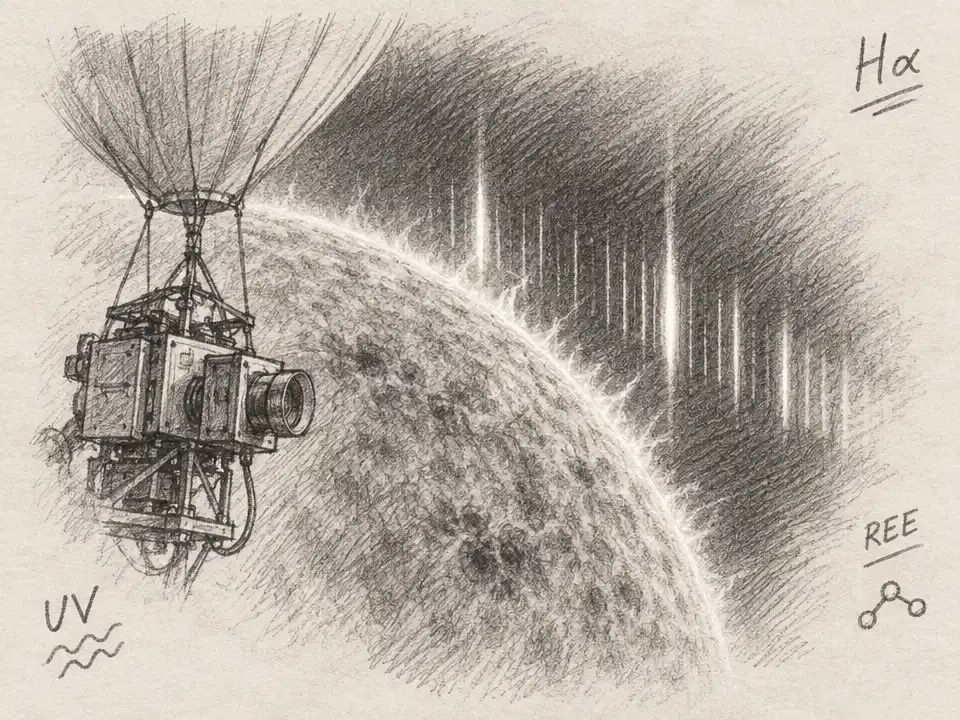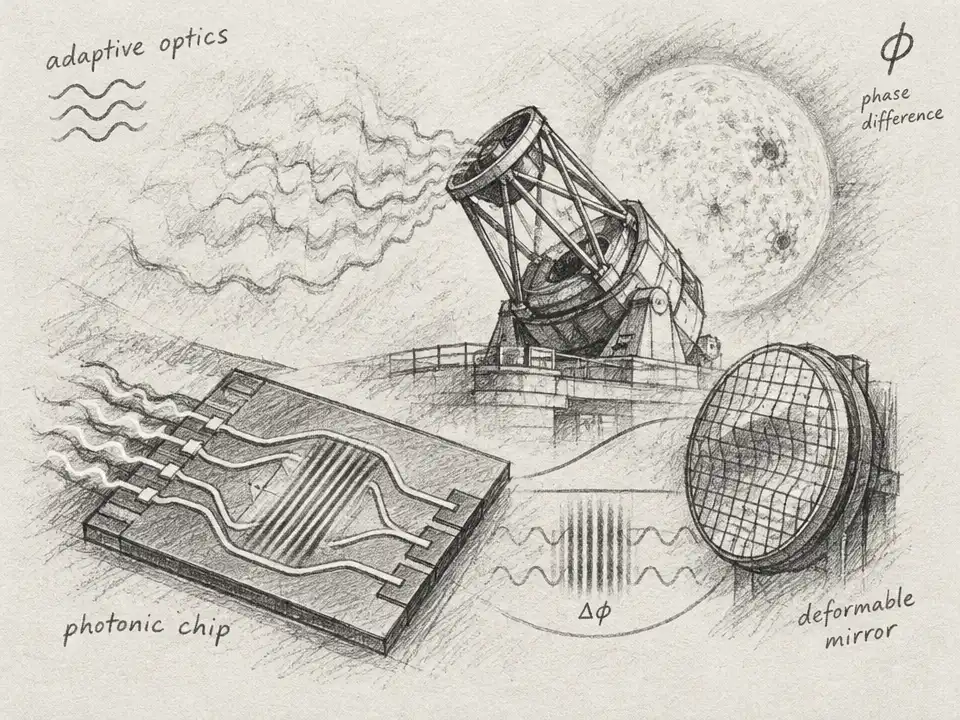
Sunlight reaches a telescope after crossing air that is never quite still. Warm and cool pockets bend the incoming waves by tiny amounts, blurring details on the Sun’s surface. To undo that blur, solar telescopes use adaptive optics: a sensor measures the distortion, then a flexible mirror reshapes itself to cancel it.
The tricky part is getting a clean measurement. At night, a sensor can track how a point of light shifts. The Sun is an extended source, covered in features rather than a single bright point. Existing systems use those features as references, but the amount of detail they can recover is limited by how finely they can sample the image.
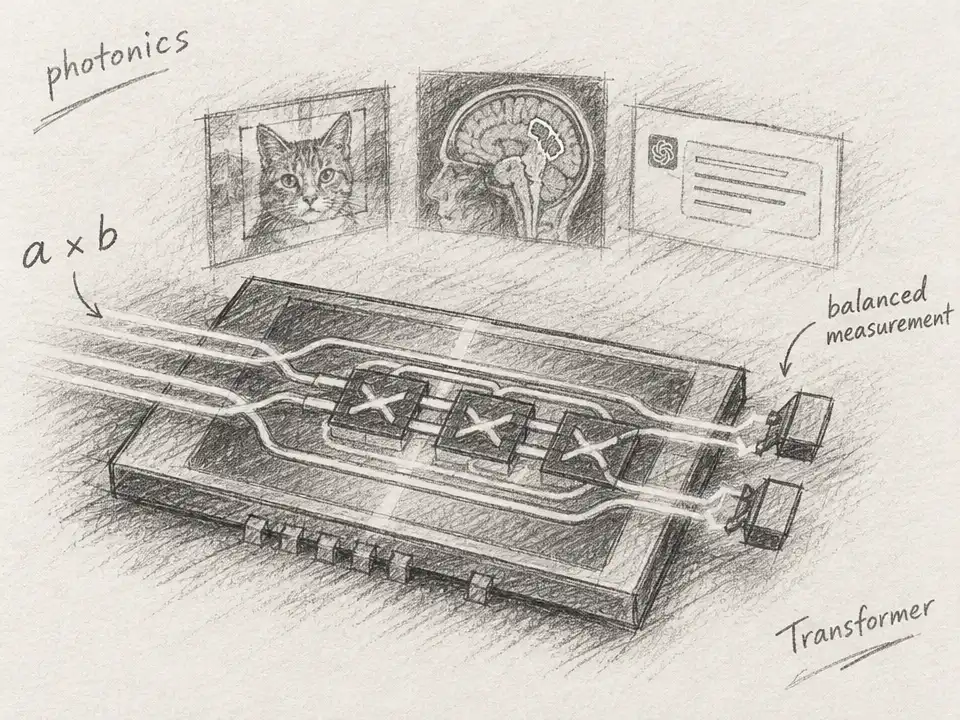
A team of researchers proposes a different route: stop forming an image to measure the distortion. Instead, send small portions of the incoming wavefront into a photonic chip and let them interfere. The chip reads the light’s phase differences—how far one part of the wave has advanced or fallen behind another—and turns those comparisons into signals for the telescope’s deformable mirror.
The idea borrows a familiar trick from physics. When two light waves meet, their peaks and troughs combine. Depending on their relative timing, they reinforce each other or partly cancel. A photonic circuit can compare light from neighboring regions of the telescope’s pupil this way. Rather than first making tiny images and tracking their motion, the circuit measures the relationships between the waves directly.
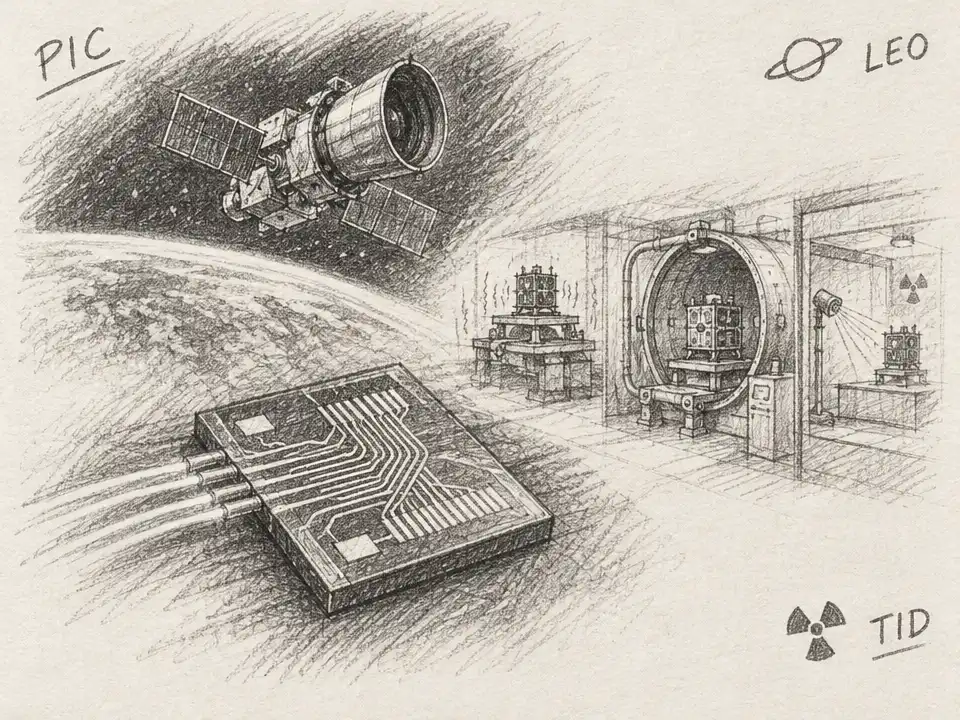
In the proposed setup, a microlens array divides the pupil into small patches and sends their light into optical fibers or grating couplers. On the chip, components called multimode interferometers split and recombine the light. Photodetectors read the resulting intensities, from which the phase differences can be inferred. A control unit can then use those measurements to command the deformable mirror.
The circuit also has to contend with imperfections of its own. If two paths through a chip differ slightly in length, they can create a false phase difference. The researchers include phase modulators that can calibrate those delays: known signals are sent through the inputs, and the modulators are adjusted until the detector readings reach their intended maximum. The paper also compares circuit layouts. One is simpler, while another uses more components to give each input multiple paths to a reference, making it less vulnerable to a single comparison failing.
To see what such a sensor might achieve, the researchers built a computer simulation of an adaptive-optics loop. They modeled a 4 m-class telescope and tested arrays with different numbers of microlenses. For the main simulated example, the wavefront sensor worked at 1550 nm; its guide-star signal stood in for a pinhole mask used in solar observations. The team applied corrections to a simulated target in the K-band under seeing of 0.5 arcsec.
The modeled image sharpened as the array grew. With a 20×20 microlens array, the simulated Strehl ratio—the brightness of the image’s central peak relative to an ideal, undistorted image—rose from 0.463 ± 0.056 to 0.974 ± 0.006. That is a striking result, but it belongs to a computer model, not an observing run. The simulation assumed, among other things, no delay between measuring the distortion and correcting it.
More sampling is not free. A larger array means more components and greater power use, while each microlens collects less light. That creates a practical balancing act: finer measurements may reconstruct the wavefront more accurately, but the chip must still receive enough light for its detectors to work well. The authors also identify the choice of photonic platform and the efficiency of coupling light into the circuit as open design questions.
For now, the proposal is a blueprint, not a finished instrument. The next steps laid out by the researchers include choosing a chip platform, designing a prototype, and testing it on a solar adaptive-optics bench. Those tests will reveal how well the modeled phase comparisons survive real optical losses and hardware imperfections.
If the approach holds up, it could give solar telescopes a new way to sense the atmosphere’s blur: not by asking what a small image looks like, but by listening to how neighboring light waves line up. That distinction matters because the Sun’s fine features are both the science observers want to see and the imperfect reference their instruments must work around.