A random number can look perfectly ordinary and still carry a hidden weakness. Imagine a coin that lands heads a little too often—and whose next flip may be partly predictable to someone watching. Strings made from such a source are useful, but they are not automatically trustworthy. The surprising idea behind a new silicon photonic chip is that quantum behavior can help turn this imperfect starting point into a much longer stream of private, nearly uniform bits.
The researchers call the task randomness amplification. It is not simply a matter of running a biased string through a clever algorithm. In the setting they study, classical processing alone cannot certify that a partly compromised source has become secure. The quantum system supplies something the original source lacks: measurement outcomes whose unpredictability can be tested against the rules of quantum mechanics.
The experiment starts with a weak random source whose bias is bounded. In the team’s model, each bit may deviate from a fair coin by as much as a specified amount, even after accounting for earlier bits and an attacker’s classical information. Some bits choose the quantum experiment’s inputs; others serve as a seed for a later extractor, which compresses the raw results into a shorter, more uniform output.
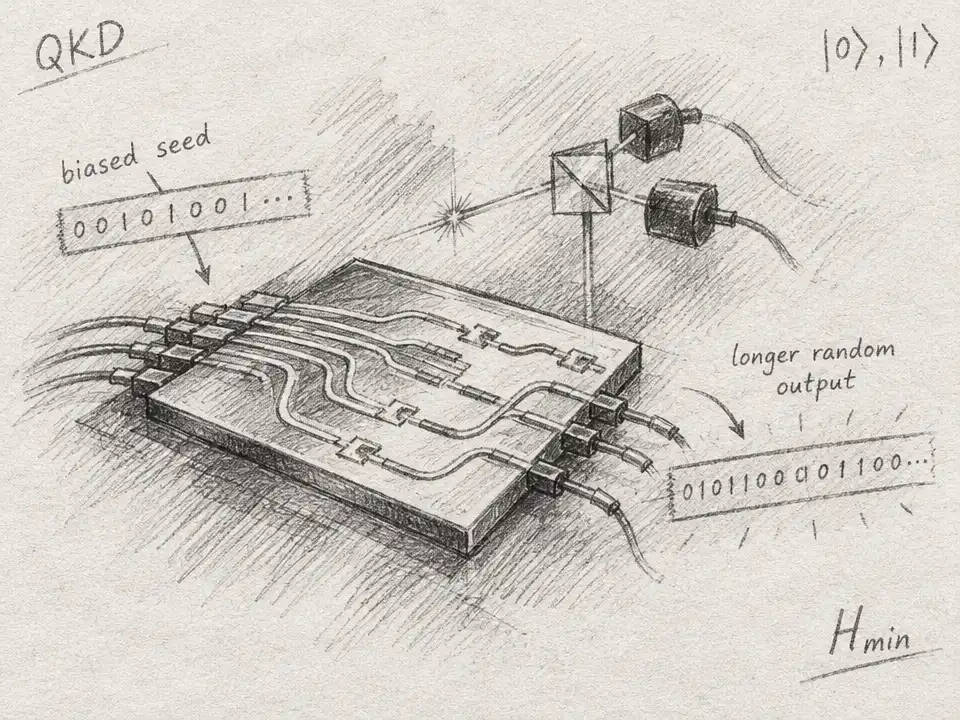
At the heart of the setup is a photonic chip measuring 11 mm × 11 mm × 3 mm. A laser operating at the standard 1550 nm telecom wavelength sends light through the system. Depending on the input bit, the preparation stage sets the light’s phase to one of two alternatives. The resulting weak coherent states travel to a measurement stage, where heterodyne detection reads an optical signal. The sign of the measured position quadrature determines the output bit.
The restraint is crucial: the light must stay below a specified energy limit. That condition is the “semi-device-independent” part of the protocol. A fully device-independent test aims to certify randomness without assumptions about how the devices work, but often requires demanding arrangements such as separated measurement stations. Here, the researchers do not need to know every internal detail of their preparation and measurement devices. They do need to trust a physical bound on the energy of the prepared states, along with assumptions about the weak source and how it interacts with the devices.
Why should a low-energy limit help? Without a constraint, a preparation device could encode each input bit in a perfectly distinguishable state, letting a measurement device recover the input and produce predictable outputs. Restricting the allowed energy limits that escape route. The team then checks the observed relationship between input and output bits using a score designed to distinguish quantum behavior from what a classical strategy could produce under the same constraints. A result that crosses the classical boundary certifies that the output contains intrinsic randomness.
There is another, less visible part of the story: calculating how much randomness the experiment has actually earned. The researchers developed a method they call variational Gauss-Radau, which improves the mathematical estimate of the output’s entropy. The intuition is a bit like adjusting a measuring scale so its finest marks fall where the object being measured is most delicate. In this case, the calculation must handle quantum states whose relevant eigenvalues can cluster close to zero, where the logarithm used in the entropy calculation is especially sensitive. Moving the numerical sampling points toward that region can produce a tighter, still-valid lower bound on the randomness.
That improvement matters because a tiny gain in the certified randomness for one measurement can accumulate over an enormous number of rounds. For a representative source bias of 0.12, the team’s analysis uses 1011 protocol rounds and yields an output string of 1,797,309,120 bits, certified to be within 10−12 of uniform under the stated security model. The researchers report an estimated end-to-end rate of about 20 Mbps. Their accounting includes roughly 70 seconds to acquire the experimental data and about 20 seconds to run the extractor on a separate NVIDIA GeForce RTX 4090 graphics card.
The chip itself can also operate at a 1 GHz modulation rate. At that speed, the paper estimates a peak certified randomness-generation rate of approximately 1.8 × 108 bits per second before the extractor and finite-size processing reduce the end-to-end rate. The distinction is important: the headline throughput is not a demonstration of a self-contained quantum-security device running inside a phone. The experiment used external equipment, including a laser, power monitoring, an oscilloscope and the GPU used for extraction.
Nor is the security claim assumption-free. For the finite-size analysis that allows quantum correlations between an attacker and the devices, the researchers retain an independent-and-identically-distributed rounds assumption. They note that removing it is an open theoretical challenge. Their result is therefore a proof of principle under a defined model—not a guarantee against every imaginable source of compromise.
Still, the shift in scale is striking. A weak signal, carefully limited and measured on a small photonic platform, can help turn uncertainty into something that can be audited mathematically. The hidden work is not just inside the chip’s waveguides; it lies in the boundary between what the experiment assumes and what its measurements can certify. The next step toward portable quantum-secure hardware is not simply making the chip smaller. It is shrinking the surrounding equipment and strengthening the chain of evidence that says the output is genuinely hard to predict.