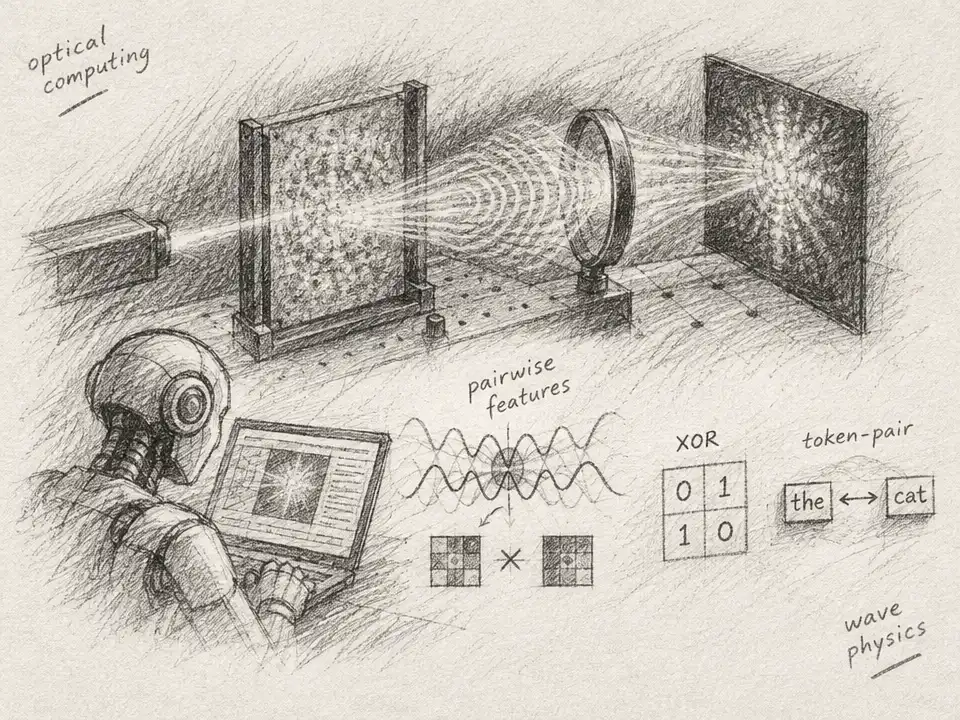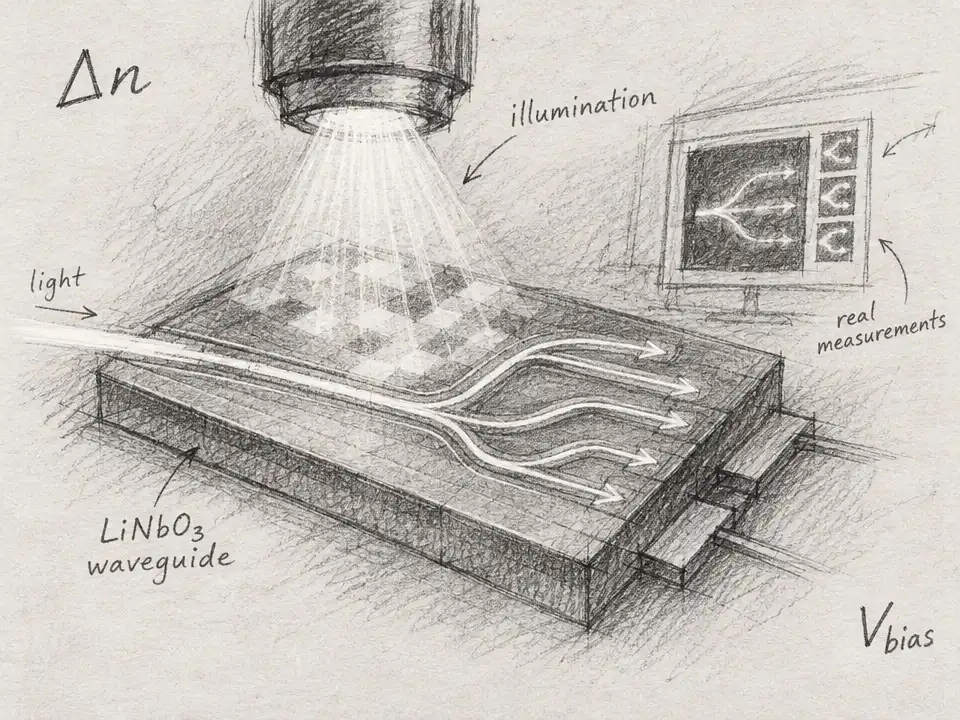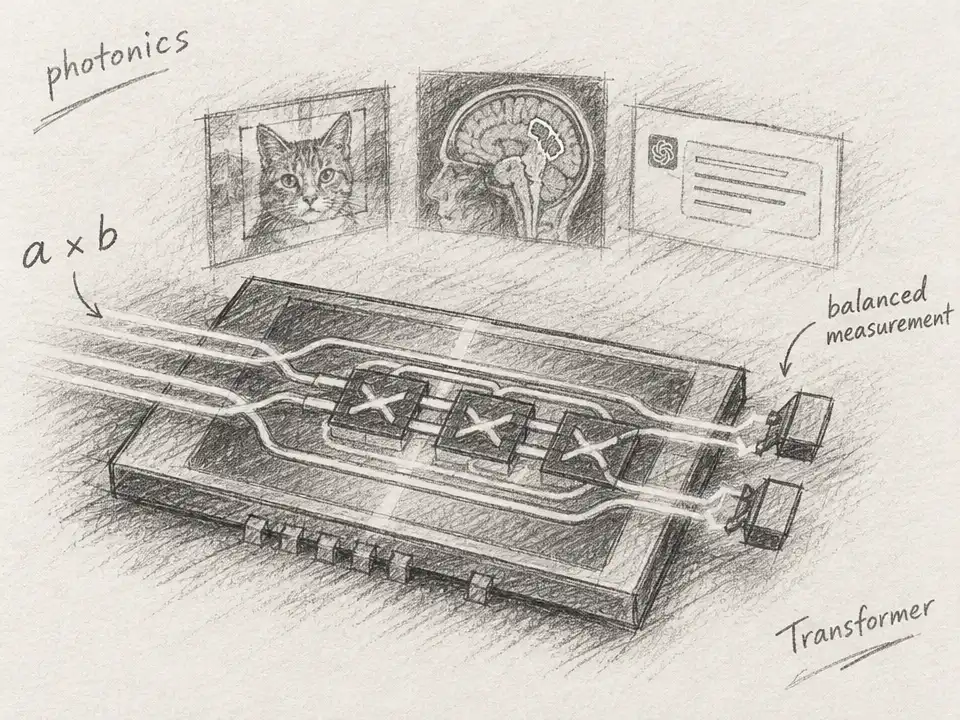
Inside a photonic chip, a beam of light enters a maze of branching paths. Tiny heaters nudge the light’s phase; at the far end, detectors compare what emerges. The goal is not to send a message through the maze. It is to make the light do arithmetic—specifically, the repeated multiplication and addition that consume much of an AI system’s computing effort.
A team of researchers calls its approach DUET. In a paper posted to arXiv in May 2026, they describe a fabricated chip designed to tackle an especially tricky assignment: the changing calculations inside modern AI, including the attention step in language models. The possibility is a more general-purpose optical processor. The price, visible in the team’s own experiments, is that light may be only one part of the machine—and the electronics around it can still set the pace.
Why use light at all? In conventional computers, data must travel among processors and memory, and moving it can consume substantial time and energy. Photonic computing aims to perform certain operations as light passes through optical components, using its physical behavior to carry out calculations in parallel. But turning that promise into a useful chip is not as simple as shining numbers into a beam. AI calculations often involve signed values—positive and negative—and, in attention systems, both sets of numbers can change from one step to the next. Many optical designs either handle only restricted operations or need extra circuitry and processing to make the numbers fit.
DUET’s central component, a vectorized operand differential interferometric cell, is built to take in two operands together. Think of it as a pair of light paths that receive carefully related electrical signals. Those signals alter the paths’ optical phases. When the paths meet again, a balanced detector compares their light levels. The shared parts of the signal cancel in the comparison, leaving a result related to the product of the two inputs. A cell can combine several such contributions, performing a multiply-and-add operation in the optical hardware rather than breaking every signed value into separate positive and negative routes.
That design choice matters because AI models do not just multiply fixed weights by inputs. A Transformer’s attention mechanism repeatedly compares changing representations of words or other data, then uses those relationships to decide what information matters. The underlying calculations are matrix multiplications, but their operands vary during use. DUET is intended to handle those dynamic operations without repeatedly translating the numbers through a large digital preprocessing detour. In principle, that could make an optical processor useful beyond one narrow task, especially where a workload’s arithmetic keeps changing.
The researchers did not stop at a diagram. They fabricated and packaged a prototype photonic chip with interferometric cells, calibrated how its modulators behaved, and measured the output. A key step was teaching the chip’s software model to account for imperfections found in the real device: noise, fabrication variation, and small departures from the ideal optical response. The team calls this hardware-aware training. Instead of pretending the chip is perfect, it incorporates measured quirks while training models, so those models can better tolerate the hardware they will actually run on.
In tests, the chip performed core convolution and linear operations for image-classification models, reaching 90.24% accuracy on Fashion-MNIST and 93.71% on the German Traffic Sign Recognition Benchmark. It also carried out selected convolution operations on a photograph, producing familiar effects such as edge detection. For brain-tumor image segmentation, the team measured some computationally intensive layers on the chip, while other stages ran digitally. On a test cohort of 70 patients, the reported segmentation scores from the hardware-aware model were comparable to a full-precision digital baseline. These were computing demonstrations, not a clinical diagnostic system.
The language-model test was similarly targeted. The researchers used a 25.8-million-parameter Transformer trained on WikiText and ran its changing self-attention matrix multiplications on DUET. Other parts of the model—including operations between those matrix multiplications—remained on digital processors. The generated text stayed broadly connected to its prompts, but the authors also report semantic drift, grammatical mistakes, and factual hallucinations. The experiment shows that dynamic attention arithmetic can be executed using their optical approach; it does not show that a complete, large language model has moved onto a light-powered chip.
That distinction is central to the frontier—and to its price. The demonstrated prototype used thermo-optic tuning, in which heat adjusts the light’s phase. Its measured modulation frequency was 12.5 kHz, far below the tens-of-gigahertz operation the authors discuss for possible high-speed electro-optic implementations. Their projections of computational density and energy efficiency depend on scaling the design and using faster modulation; those are not measurements of a finished, high-speed AI accelerator. The researchers also identify a less glamorous bottleneck: the surrounding electronics. Converters, amplifiers, and circuitry that refresh input signals can consume more power than the photonic core itself.
So the chip’s most revealing result may not be that light can do AI arithmetic. It is that optical computing’s next challenge is no longer just making a clever interferometer. It is coordinating the whole system: fast modulators, detectors, data movement, digital support, and enough precision to keep a model useful. If those pieces can be made to work together, light may become a specialized engine for the calculations that change most rapidly. For now, DUET offers a working glimpse of that possibility—and a clear accounting of how much engineering still stands between the glimpse and the frontier.