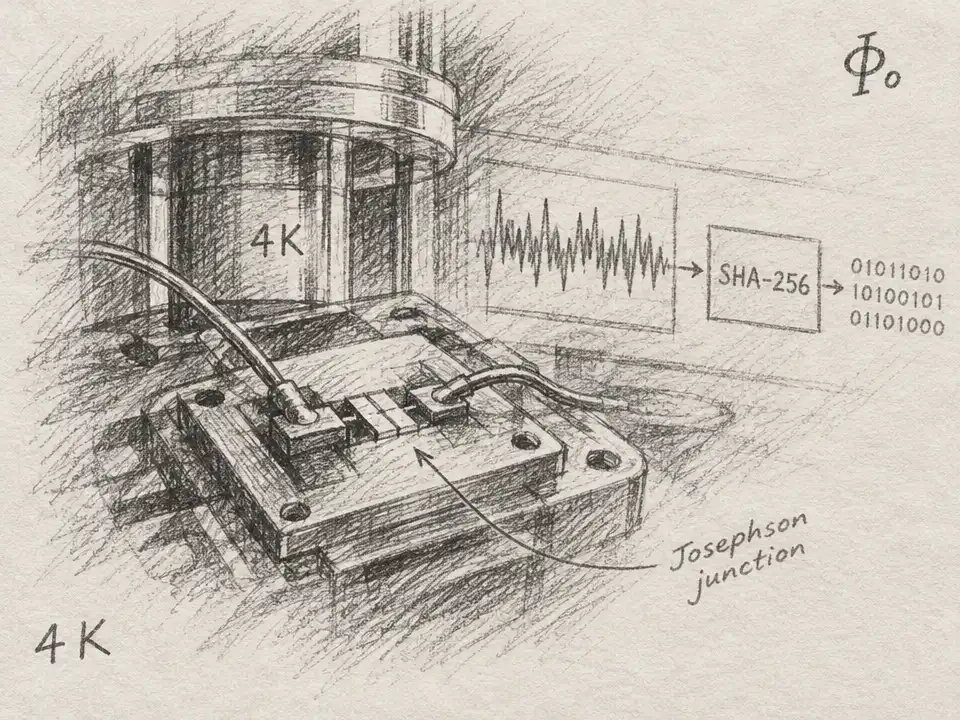
In superconducting electronics, a badly made component is usually a dead end: its electrical behavior falls too far from the design, so it gets set aside. But a Josephson junction that looked wrong by an enormous margin has now done something useful precisely because it can switch unpredictably. Researchers turned that fluctuation into random bits, challenging the assumption that a reliable entropy source must be built from a carefully perfected device.
A Josephson junction is a tiny sandwich: two superconductors separated by an insulating barrier. Send enough current through it and it changes from a zero-voltage state to a resistive one. The threshold current is called the critical current. In the experiment, the team deliberately chose a junction with electrical parameters so far from conventional expectations that it would be rejected for a standard superconducting logic circuit.
Its measured critical current was 0.672 mA, compared with a theoretical prediction of about 3.09 µA—a difference of three orders of magnitude. Its critical-current–resistance product was 61.25 mV, roughly an order of magnitude above typical values for the junctions discussed in the paper. The mismatch may have come from unwanted electrical paths created during fabrication. For one established use, those defects were disqualifying. For generating randomness, they did not stop the show.
The key is what happens just below the junction’s switching threshold. Physicists describe the superconducting phase across the junction as a particle in a tilted washboard landscape, with valleys separated by barriers. A current pulse tilts the landscape. Thermal fluctuations—and, at the lowest temperatures, quantum tunneling—can sometimes push the phase over a barrier. The junction then switches into its voltage-carrying state.
That switch is not scheduled in advance. For each pulse, it either happens or it does not. The researchers treated those outcomes as a one or a zero. By adjusting the pulse current until the junction switched about half the time, they aimed for the most useful balance: neither outcome would be easy to guess from its frequency alone.
At 100 mK, a pulse amplitude of 0.3512 mA gave a measured switching probability of 0.5033. The team used 0.5 ms pulses with a 50% duty cycle and tested repetition frequencies of 0.5 kHz and 1 kHz. The switching probability changed sharply with pulse amplitude: a shift of about 0.1 µA could move it from nearly never to nearly every time. That sharp response made the device tunable, even though its underlying parameters were far from the expected values.
The raw bits were impressively balanced in one important measure. At 100 mK and 1 kHz, their Shannon entropy was 0.9981 bit per bit, close to the theoretical maximum of 1 bit. But the sequence had a catch: neighboring bits were correlated. The first-order autocorrelation was 0.3195, meaning the result of one pulse was not entirely independent of the next. The researchers traced this short-term memory to the junction’s electrical recovery, with an estimated correlation time of about 0.4 ms. At 0.5 kHz, the correlation fell to 0.0764.
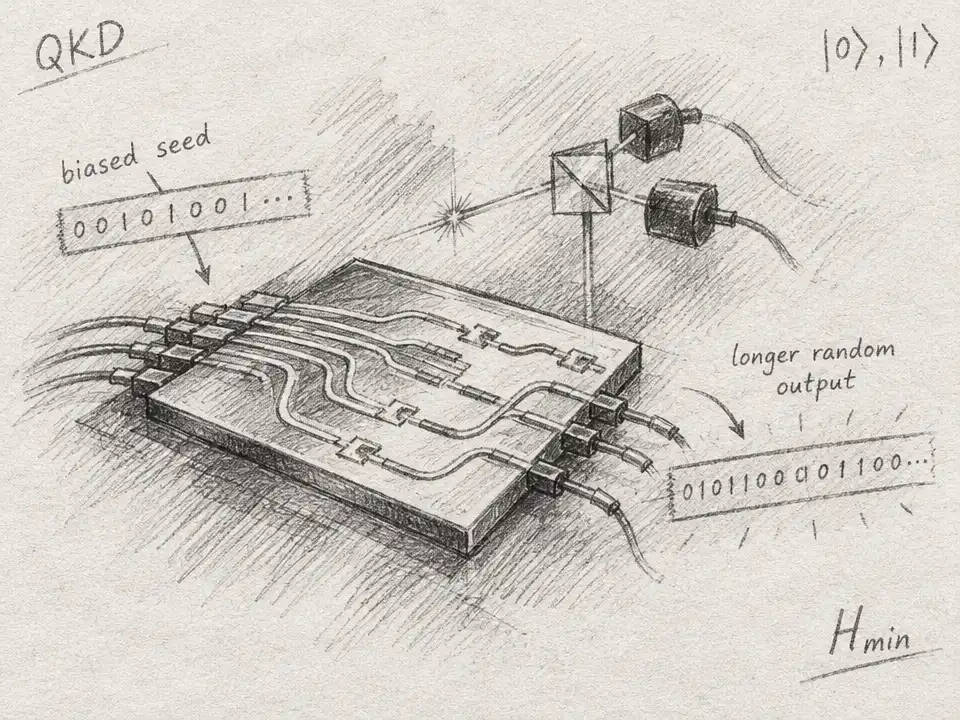
That detail makes the result more interesting—and more useful—than a simple claim that the device produces perfect randomness. The junction’s unpredictability survived a serious fabrication flaw, but its output still needed attention. The researchers used SHA-256 to compress groups of 512 raw bits into 256 bits. A cryptographic hash cannot create physical randomness; here, it served as an extractor to reduce bias and short-range correlation in randomness already present in the switching events.
After that processing, the resulting bit sequences passed all applicable tests in the NIST SP 800-22 statistical test suite across the tested temperature range of 100–700 mK. The study reports 15 tests passing under its stated conditions. There are important limits to what that means: statistical tests cannot, by themselves, prove that a generator is secure against every attack. The researchers used three independent one-million-bit sequences, fewer than the 100 recommended for a full assessment of the uniformity of test results. For two tests that require special sequence properties, only one sequence qualified, and that one passed.
There is also a gap between the experiment and the device’s proposed destination. The demonstrated output rate was about 1 kbit/s—not the nanosecond response or gigahertz-scale operation discussed as future possibilities. Faster pulses and improved readout might raise the rate, the paper argues, but that remains an engineering goal, not a result of this test. Nor does one deliberately selected junction establish that every flawed device will work equally well; the demonstration is a proof of principle.
Still, the unexpected lesson is concrete. The junction’s usefulness did not depend on making its switching behavior orderly. It depended on finding a way to tune an inherently stochastic event, measure it, and account for its memory. The authors’ tests show that a junction with strikingly non-ideal electrical characteristics can produce high-entropy bits at cryogenic temperatures, where ordinary room-temperature electronics are a poor fit.
For future superconducting computers, that suggests a different way to think about fabrication waste. A component that misses one specification might still be valuable if another function depends on a physical process that tolerates variation. The next challenge is to turn this single-junction demonstration into a faster, fully integrated source—and to test its reliability at production scale. For now, the surprise is not that a flawed component behaved like a perfect one. It is that, for this task, perfection was not the requirement.