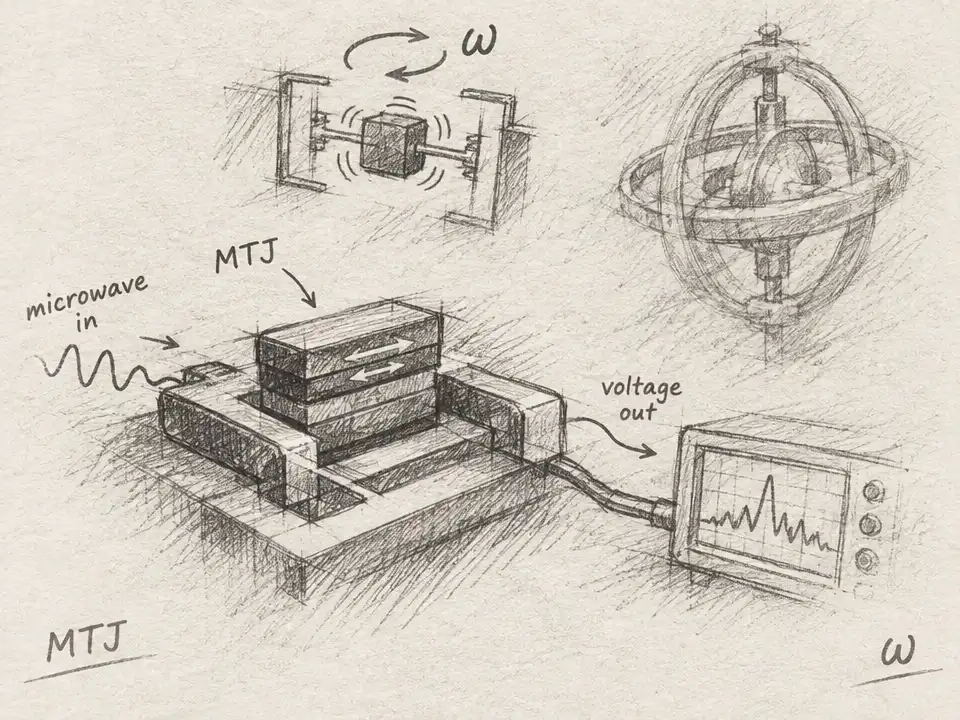
A gyroscope has a deceptively simple job: notice that its casing has turned. Inside many tiny gyroscopes, a proof mass vibrates back and forth. Rotate the device, and the mass feels a sideways Coriolis force. The resulting motion can be so small that reading it becomes an engineering mystery of its own: how do you detect a minute displacement without building an even fussier sensor around it?
The familiar answer is capacitance. A moving mass changes the electrical relationship between nearby surfaces, and the resulting signal reveals its motion. But that solution depends on carefully controlled gaps and readout electronics. A research team asks whether the mass’s magnetic field could carry the message instead. Their proposed detector is a magnetic tunnel junction—a nanoscale device that can turn a tiny change in magnetic conditions into a voltage.
The central clue is a phenomenon called the spin-torque diode effect. Feed a magnetic tunnel junction a microwave current and, near its magnetic resonance, the junction can rectify that rapid signal into a small direct voltage. The voltage shifts when the surrounding magnetic field shifts. In the proposed gyroscope, the proof mass is magnetic, so a sideways nudge changes the field reaching nearby junctions. If the field change can be read reliably, the voltage becomes a proxy for rotation.
That is the idea. But a single junction might also respond to temperature changes, electrical drift, or other common disturbances. How could the system tell a genuine Coriolis signal from background movement in its own readout? The researchers’ answer is to place two junctions symmetrically on opposite sides of the proof mass and compare their outputs. As the mass shifts, one junction’s local field changes one way and the other’s changes the opposite way. Subtracting their voltages should emphasize the motion signal while reducing changes shared by both.
Before trusting that design, the team had to establish whether the magnetic clue was real enough to use. They experimentally characterized magnetic tunnel junctions patterned into ellipses 300 nm by 750 nm. With microwave signals, they measured rectified voltages in the microvolt range and estimated a sensitivity of about 20 µV/mT over the measured field range. That result supplies a measured ingredient: these junctions can indeed translate magnetic-field changes into electrical output.
But it does not yet solve the whole puzzle. The researchers did not build and test a complete working gyroscope. Instead, they used the measured junction behavior to calibrate a coupled model of the magnet, moving proof mass, and readout. The mechanical properties—including a proof mass of 1 × 10⁻⁶ kg—were estimated for the design. The difference matters: the junction response is experimentally characterized, while the complete sensor’s rotation readings are predictions from a model.
In that model, the gyroscope’s drive and sense motions are matched near 250.4 kHz, helping the sideways Coriolis response build. Two magnetic tunnel junctions sit about 1 µm from the proof mass. As it moves, its stray magnetic field changes at each detector. The paired voltages produce a differential signal that tracks the mass’s tiny displacement—and, after calibration, the rotation rate.
For steady rotation rates from 10 to 50 rad/s, the modeled output voltage rose approximately linearly with rotation. The predicted rate-to-voltage sensitivity for this initial design was 0.0563 µV per radian per second. The team also fed the model a changing rotation profile, then used digital homodyne demodulation—a signal-processing method that picks out changes synchronized with a known carrier—to recover it. The reported reconstruction error was about 0.05% across the profile, reaching about 0.35% at its edges.
At first glance, that looks like the answer: the magnetic readout can follow a changing turn. Yet there is another clue, and it complicates the case. A signal can track a simulated input accurately while remaining too weak to make a useful instrument. Using estimated electronic noise, the authors calculate an angle random walk of about 1.8 × 10³ °/√h for the initial design. That is far above the values they cite for tactical and intermediate-grade gyroscopes. The reconstructed curve tests whether the model’s signal-processing chain can follow the modeled input; it does not show that a fabricated device could measure rotation with comparable precision.
The team explores one possible escape route: replace the magnetic proof mass with a spin-torque nano-oscillator, which could act as an on-chip radio-frequency source. In a second modeled design, the sensitivity increases by about 70 times and the estimated angle random walk falls to about 25 °/√h. That is a substantial improvement, but it remains a projection—and it still leaves a wide gap between a promising sensing concept and a precision gyroscope.
So what has the research actually established? Not that a new magnetic gyroscope is ready to guide a drone or a phone. It has shown that measured magnetic-junction behavior can support a detailed design in which microscopic motion is converted into a differential voltage, and that a modeled signal can be decoded under changing rotation. The remaining uncertainty is practical and revealing: can the whole mechanical and magnetic system be built with enough sensitivity, stability, and control to close the noise gap?
The answer will depend on improving the junction response, the magnetic field gradient, the mechanical resonator, and the readout noise—not simply turning up the voltage amplification. That is the puzzle’s final turn. The proposed detector may avoid one of the hardest constraints in conventional gyroscopes, tiny capacitive gaps, but it trades that challenge for a different one: making a whisper of magnetic motion loud enough to matter.