A camera sees the world as a flood of numbers: a color value for each tiny patch of a scene, arriving whether or not the computer downstream needs it. A person in the frame? A hand moving? An eye turning? Most of those numbers may be irrelevant to the question the device is meant to answer. Yet in a conventional vision system, the image usually travels outward first, and the analysis begins afterward.
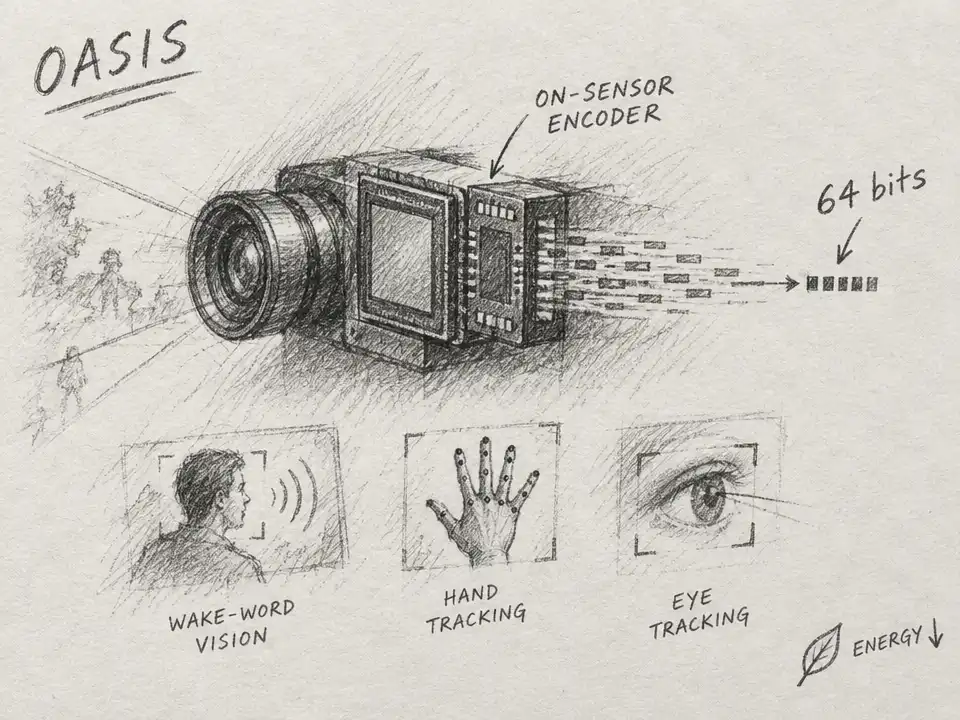
OASIS, a research framework for vision computing near an image sensor, flips that order. Before information leaves the camera-side hardware, a small processor turns the image into a compact representation shaped around the task. The shift is easy to miss because it happens before the image becomes something we would recognize as a picture. But that is precisely the point: the system is built to send useful clues to another computer, not to preserve every pixel for a human viewer.
Consider the scale of the traffic. A 224-by-224 color image, with 8-bit values for its red, green, and blue channels, contains a large stream of data. In OASIS, a lightweight encoder first makes a smaller internal description of the scene. The challenge is to shrink that description without throwing away what the next stage needs. Push too little information onward, and the downstream task falters. Keep too much, and the camera still pays the cost of moving a bulky stream.
The researchers trained the encoder to balance three aims: keep information useful for the task, produce values that compress efficiently, and retain enough detail to support image reconstruction during training. That last aim acts like a reminder not to discard everything except the answer. But the reconstruction decoder is removed when the system is used. At run time, the sensor-side processor does not need to rebuild a photograph; it only needs to make a useful compact representation.
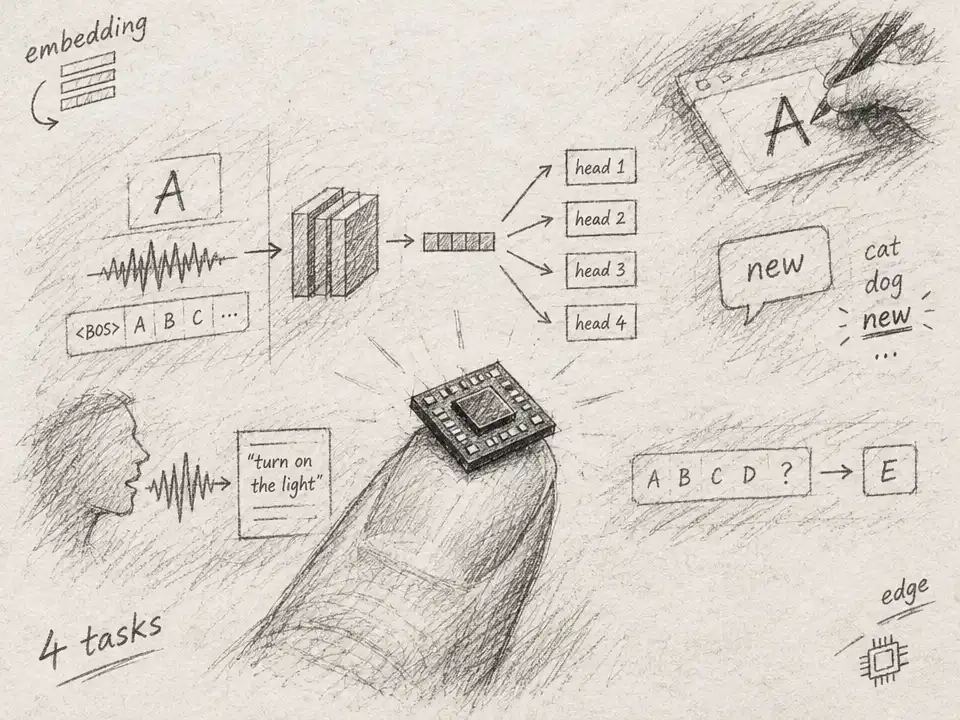
From there, OASIS offers two routes. One keeps the representation’s spatial arrangement, then compresses it using 4-bit quantization and Huffman coding. That route can preserve the organized features needed for jobs such as tracking a hand or segmenting an eye. The other route is more radical: for classification, the system can turn its internal representation into a fixed-length binary pattern called a hypervector. An outside processor compares that pattern with stored class examples, rather than receiving a spatial feature map. This route is not suited to tasks that need to know where each feature is located.
The camera-side design is not simply making a smaller JPEG. A conventional photo format aims to keep an image looking good to a person. OASIS learns what to preserve for a machine task. In visual wake-word classification, for example, the question is whether a person is visible—not whether the system can reproduce every texture or color in the scene. In the researchers’ SwinViT-based setup, the encoder’s compact representation could be mapped to a 64-bit hypervector. That cut the communication payload by 18,816 times compared with sending the raw 8-bit image, while the classification accuracy was 86.0 percent. With a 128-dimensional hypervector, accuracy was 86.89 percent: a modest difference for a further reduction in what must cross the link.
The less extreme route has a different advantage: it keeps the spatial structure that dense predictions need. For eye tracking, the team reduced the encoder output channels from 32 to 4 and used 4-bit quantization. On the OpenEDS dataset, the reported mean intersection over union was 0.974, compared with 0.988 for the EyeNet baseline. That is a 1.4 percent drop, alongside a 24-fold reduction in encoder-output size compared with the baseline. The result shows the bargain in concrete terms: fewer bits traveling outward, with some performance traded away but much of it retained.
Compression has a limit. In a visual wake-word test using a ResNet encoder, moving from 8-bit to 4-bit values nudged accuracy from 87.9 percent to 87.6 percent. Reducing to 2 bits, however, dropped accuracy to 70.3 percent. The data stream got only a little smaller beyond the 4-bit setting, while the task became much harder. The hidden engineering problem is therefore not merely to squeeze. It is to find the narrow point where the system can still see what matters.
There is another scale shift inside the proposed system. The image data moves from the sensor to a neighboring logic layer through a local, high-bandwidth connection; only the compact representation then travels through the external camera interface. The paper estimates that the local connection offers about 200 times the bandwidth of MIPI, the external interface considered. Moving computation closer to the sensor can therefore reduce the more expensive outward traffic, though it does not make the local transfer vanish.
The energy results are promising, but they need the right frame. The researchers implemented the digital encoder and compression pipeline on an FPGA and measured board-level power. Their full-system energy comparison also combines measurements with sensor circuit simulations, implementation analysis, and a 7-nanometer ASIC projection. On that basis, OASIS reduced modeled total system energy by about 2 to 4.5 times across visual wake-word classification, hand tracking, and eye tracking. The team did not fabricate a camera with the proposed integrated sensor and custom logic chip, so these figures are not a demonstration of a finished product.
Still, the idea changes where we imagine a camera’s intelligence begins. The lens may deliver a scene, but the first useful act of vision could happen before a complete image ever leaves the device. For one application, the camera can pass along a carefully compressed map; for another, it can send something closer to a tiny signature. The world remains visually rich. What changes is how much of it needs to travel.