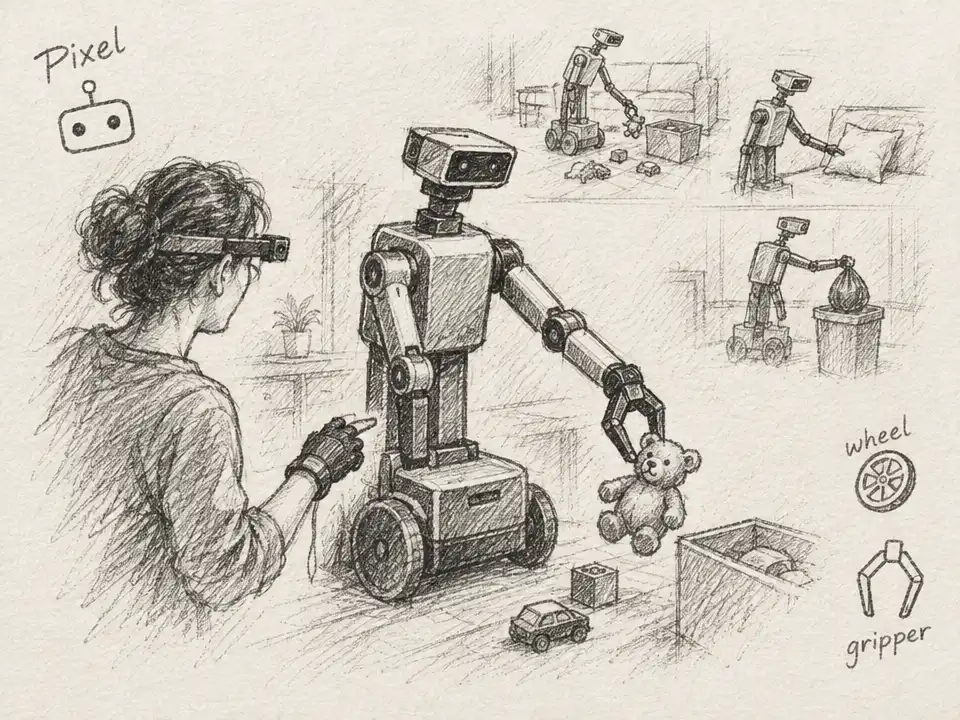
Picture a toy on the floor, a basket several feet away, and a robot that must pick up the toy, move across the room, and drop it in. The arm is only part of the job. The robot must lower its body, keep the toy in view, steer without losing its grip, and coordinate all those movements in the right order.
That ordinary sequence is a useful test of a hard problem: how to teach a robot skills that involve both moving through a room and handling what it finds there. A team’s open-source system, called Pixel, takes an intriguing route. Instead of making people operate the robot for every demonstration, it lets them perform tasks themselves while wearing sensors designed to give the robot a compatible view of their movements.
Pixel’s shape is part of the idea. It has two arms, a movable torso and head, and a lift that raises or lowers the upper body. But it rolls on a wheeled base rather than walking on legs, and its hands are simple grippers rather than intricate, multi-fingered mechanisms. The authors report that the robot can be assembled for under $15,000. That is still a substantial price, but far below the cost and complexity of many full humanoid platforms.
The trade is deliberate. A wheeled base is stable and can move smoothly across indoor floors, while the lift and torso let the arms reach across a broad vertical workspace. Those parts also make the robot’s working space resemble a person’s: the reach and arrangement of a human body are easier to match than they would be on a robot with a radically different shape. The design gives up stairs, rough terrain, and the fine finger movements a more elaborate hand might manage.
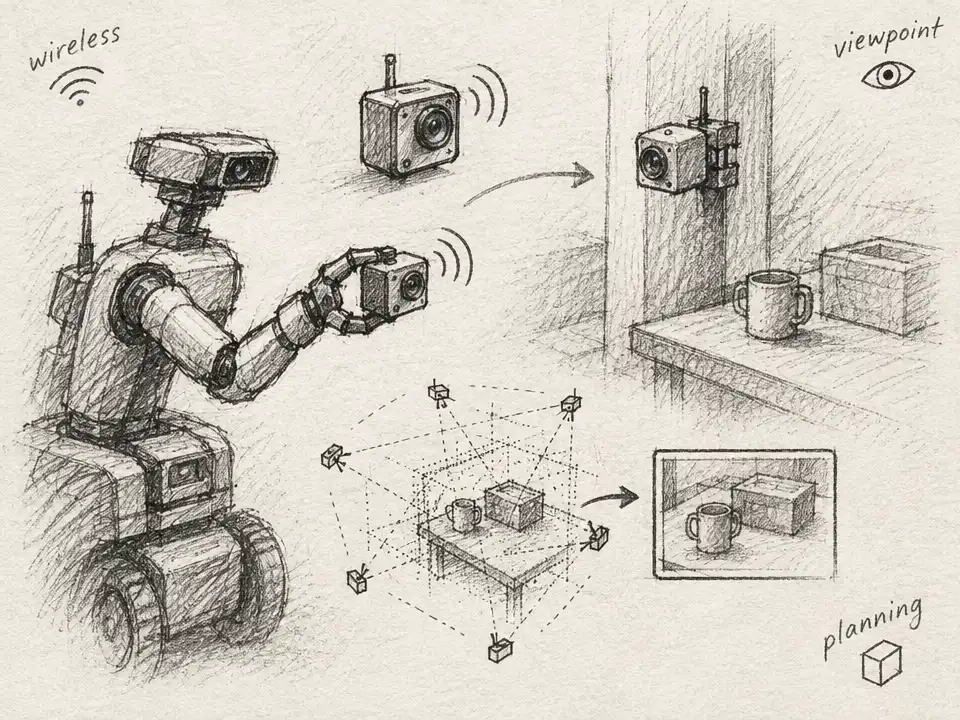
To collect a demonstration, a person wears a headset and lightweight sensorized grippers. The system records the person’s head and hand positions, along with views from cameras arranged to resemble the robot’s head and wrist cameras. A person can then demonstrate a task without first learning to steer a robot through a remote-control interface. The wearable kit, made mostly with off-the-shelf sensors and 3D-printed parts, costs under $1,000, according to the paper, and can run untethered for about 2.5–3 hours.
There is a subtle point here: Pixel does not simply copy the person’s joint movements. A human elbow and a robot arm do not bend in exactly the same way, and a motion that is comfortable for one body could be awkward or unsafe for another. Instead, the system converts the demonstration into targets—where the hands and head should go—and uses a shared controller to coordinate the arms, torso, lift, and base. It also accounts for joint limits and tries to keep the robot from colliding with itself.
One design choice addresses a problem that can hide inside a long sequence. If a robot’s predicted head position becomes its reference for its hands, small errors in the head estimate can pull both hands off course. Pixel’s researchers created a shared, ground-anchored reference for the head and both hands, so a drifting camera target does not redefine where the grippers should be. In the team’s tests, this representation helped preserve coordination during longer tasks such as arranging pillows.
The system’s results are promising, but they are not a claim that a general-purpose housekeeper is ready. Policies trained on human demonstrations reached an average task-progress score of 82.0% across three evaluated tasks: picking up toys and putting them in a basket, tidying couch pillows, and carrying a cup to a trash can. Robot-teleoperation demonstrations reached 78.7% on a separate set of three tasks. These scores measure progress through specified tasks; they should not be mistaken for a broad success rate across everyday homes.
Collecting the human demonstrations was notably quicker in a small user study. Twelve participants tried different interfaces on pillow-tidying and wine-glass-pouring tasks. Everyone preferred the sensorized-human approach, and it was 4.2×–6.2× faster than the teleoperation comparisons. That advantage matters because robot learning needs examples: if gathering each one requires an operator to master a control system and guide a machine through every motion, building a large, varied library of behavior becomes harder.
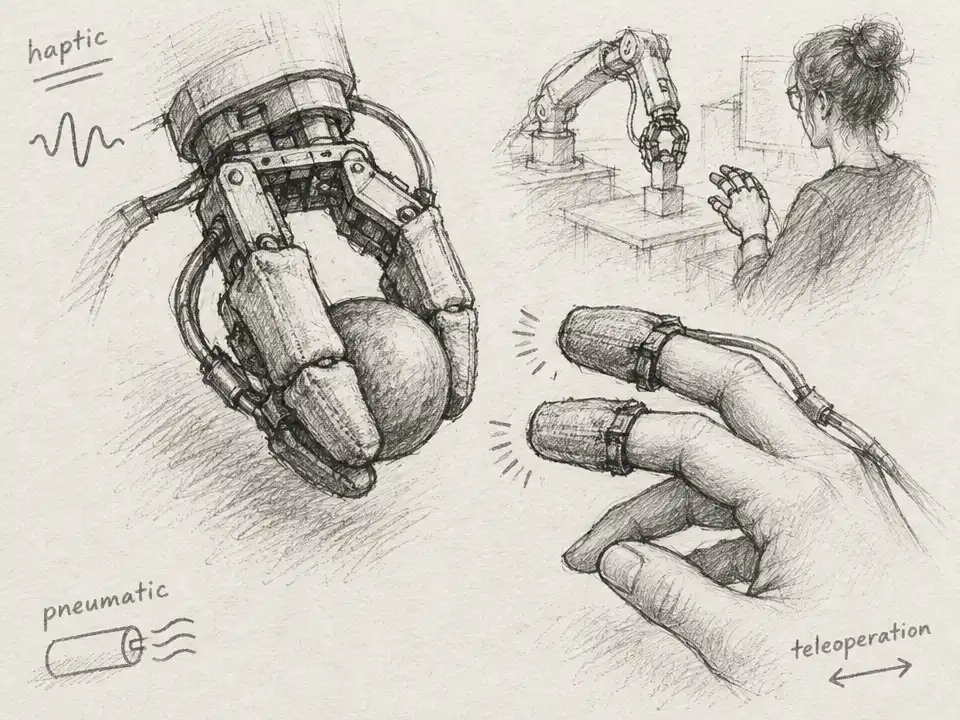
Still, translating human skill into robot skill is not as simple as recording a person and pressing play. The wearable setup captures head and gripper trajectories, not every useful movement or contact. It cannot record someone bracing a door with an elbow, and it lacks tactile sensing that could tell the robot how an object feels in its grasp. The robot also cannot perform skills that are absent from its predefined library, and the authors say its ability to combine learned skills has not yet been systematically evaluated.
Those limits reveal the price of the frontier: the more a robot is expected to learn from human examples, the more carefully its body, sensors, control system, and training data must be made to line up. A familiar task may depend on information a wearable device never captured, or on a capability the robot simply does not have. Pixel’s contribution is not to erase that mismatch, but to build a system around reducing it—and to show that the details of the body and the way a demonstration is recorded can change what a learned policy manages to do.
If this approach develops, ordinary demonstrations could become a practical source of robot training data: people performing tasks naturally, then machines learning the parts their own bodies can reproduce. For now, the work points to a narrower but important possibility. A robot may not need a human-shaped body to benefit from human know-how. It does need the right viewpoints, a way to translate motions into its own mechanics, and an honest accounting of what the demonstration left out.