Imagine a robot tending a pot on the stove. The water is close to boiling, but a laundry basket waits in another room. If the robot leaves to fold clothes, its camera goes with it. The pot disappears from view, just when watching it matters most.
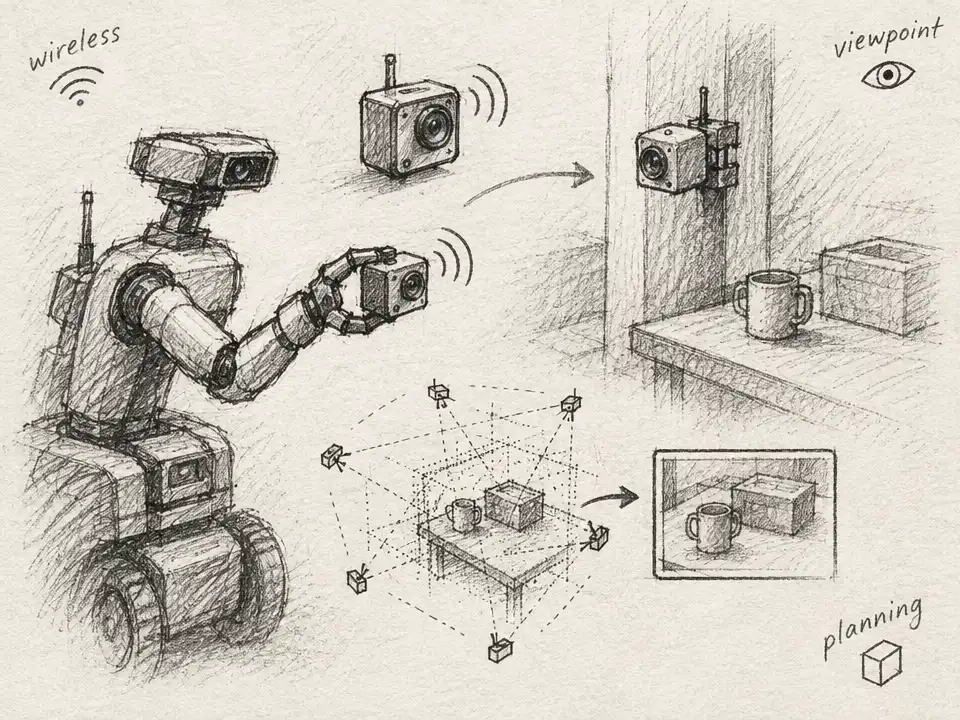
A research team’s answer is to let the robot leave a camera behind. In SensorPerch, the camera is not permanently part of the robot or installed as household infrastructure. The robot carries it to a useful spot, attaches it to a surface, and moves on. For a while, the room itself becomes an extra set of eyes.
That shift sounds simple until you ask where the camera should go. A view from the counter might show a pot’s rim; one from across the room might show the whole stovetop but miss what is happening inside. And the best angle for checking a pot is not necessarily the best angle for cutting vegetables. SensorPerch treats a viewpoint as something the robot must choose for each task, not a fixed feature of its body or the room.
The camera platform is a compact, wireless assembly with a two-degree-of-freedom gimbal, onboard computing, and a battery. To attach it, the robot turns a vacuum stand against a surface; a magnetic connection holds the camera module to the stand. Turning the base the other way releases the vacuum. The platform can then be lifted off and mounted somewhere else. In the reported design, the platform itself weighs 201.4 grams and measures 99 mm × 66 mm × 67 mm.
Before placing it, the robot needs a map of the scene. The researchers reconstruct the environment from images, then identify surfaces that seem flat, rigid, large enough for the mount, and reachable by the robot. They generate possible camera positions and simulate what each view would look like. A task-specific scoring system ranks the views: for monitoring a pot, it favors a clear sightline to the rim and surface; for preparing food, a wider view may help show the work area.
There is a second, less obvious problem. A view can look informative to a person and still be wrong for a robot’s learned behavior. If a manipulation policy was trained using a top-down view, switching to a side view may confuse it. So the team also tested a strategy that chooses a new viewpoint to resemble the visual perspective used during training. The camera’s gimbal matters here: a sensor attached to a wall may need to tilt down toward a counter or pot.
The experiments used a robotic arm in a lab setup designed to represent household tasks. In one group of tests, the camera watched for changes after the robot had moved away. Scenarios included a pot boiling over, water leaking, a dropped cup, a microwave fire hazard, and a person falling. These were research demonstrations of object-state monitoring, not evidence that a home robot is ready to handle emergencies on its own. The key result was that a camera placed for the task could keep observing when the robot’s wrist camera could no longer see the scene.
In another set of tests, the researchers asked whether SensorPerch could find views that supported manipulation. The tasks included peeling, cutting, and pouring. Across those three tasks, the system reached about 80% success, close to results with a human manually placing the camera at an “oracle” viewpoint. A fixed third-person camera did worse because the useful angle changed from task to task. Randomly choosing a physically possible mounting location reached only 20% success in the reported comparison. A mountable spot, in other words, was not automatically a useful spot.
The team also staged a longer demonstration with multiple SensorPerch platforms. While preparing breakfast in the simulated household environment, the robot used one camera to watch a pot, another to support its cutting view, and a third to observe a coffee cup. Across 10 trials, it detected relevant object states with 90% success and supported cutting with 80% success. When a camera was no longer needed, the robot returned it to a charging dock on its mobile base.
There are practical limits behind the tidy idea of movable sight. With a RealSense camera streaming, one platform ran for 2.25 ± 0.17 hours. Reattaching it took 12.53 ± 3.40 seconds, and video-stream latency averaged approximately 180 ms. The vacuum mount also depends on surfaces that can hold a seal; porous or soft materials may not cooperate. The authors note another open challenge: the system does not yet explicitly account for how the robot’s own movement might block or uncover a view.
SensorPerch does not give a robot perfect awareness. It offers a different way to think about what awareness might depend on. A robot need not see everything from where it stands, and a room need not be permanently outfitted with cameras. Instead, a viewpoint can be placed where a particular moment calls for it, then moved or collected when the task changes. The hidden change is not just a camera leaving the robot’s body. It is perception becoming something the robot can arrange in the world around it.