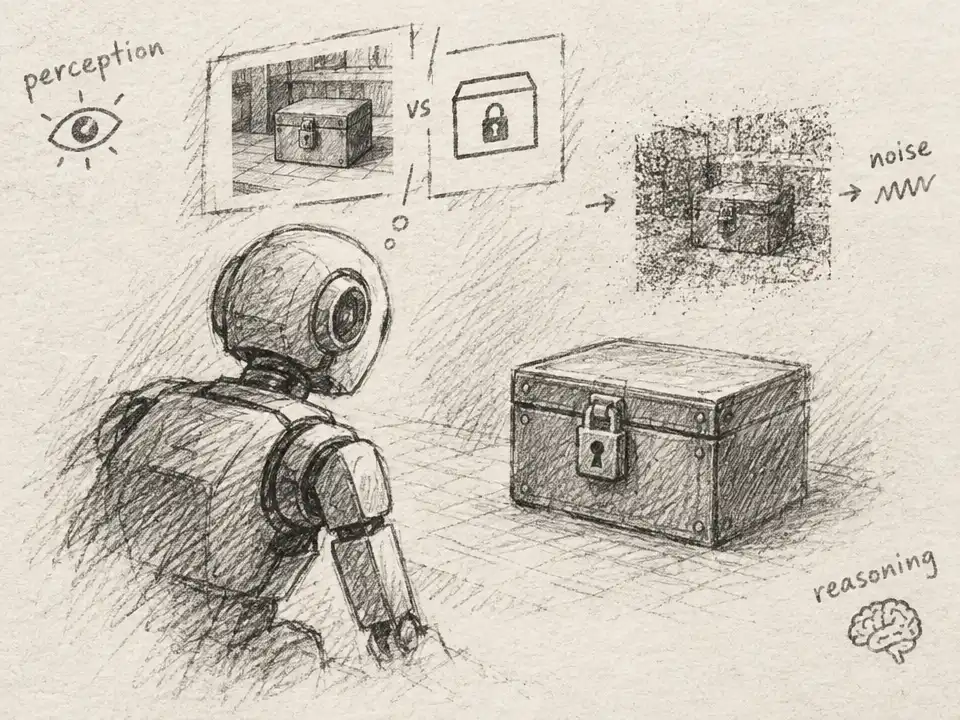
A smartphone camera rode around a small track, trying to identify objects as they flashed past. The scene kept changing: the phone moved, the light shifted, and the image could blur before its software had a chance to decide what it was seeing. The obvious fix might be a bigger, smarter model. But the researchers behind a new system tried something more basic: help the camera collect a better image first.
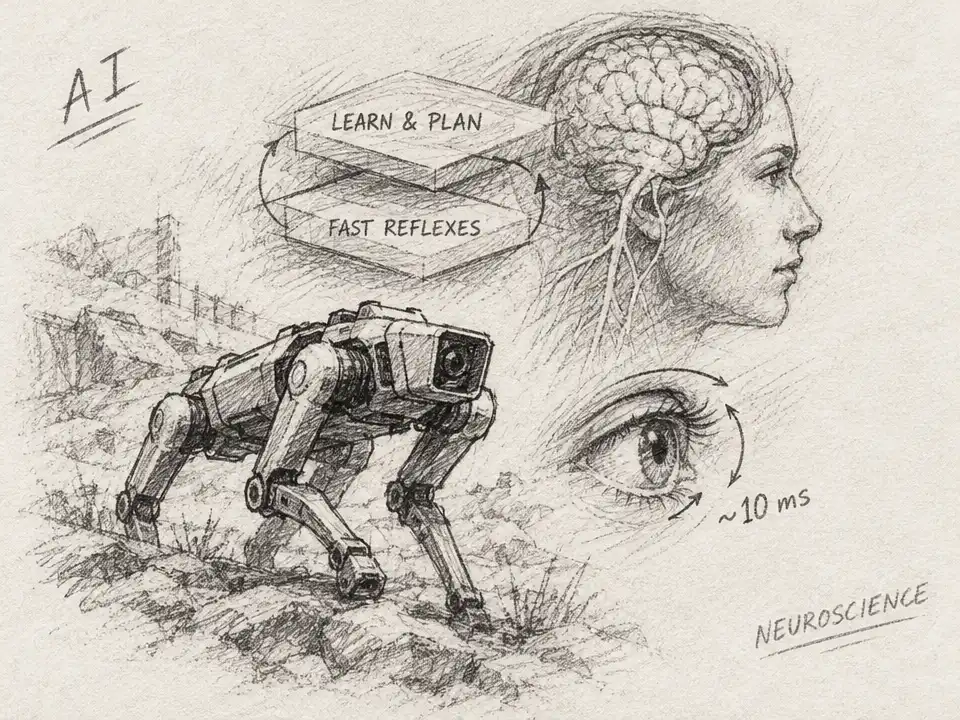
Their idea came from neuroscience. Brains do not wait for a single grand act of reasoning before responding to the world. Fast reflexes protect the senses; other circuits adjust perception as conditions change; slower processes handle harder questions. The researchers translated that layered arrangement into a computing architecture for devices that have to perceive and act in the physical world.
They call it Artificial Tripartite Intelligence, or ATI. The name sounds grand, but its key move is practical: treat the sensor as part of the intelligence, not just a camera that hands its image to an AI. A system that can control how it senses may be able to prevent some failures that no amount of later analysis can reliably undo.
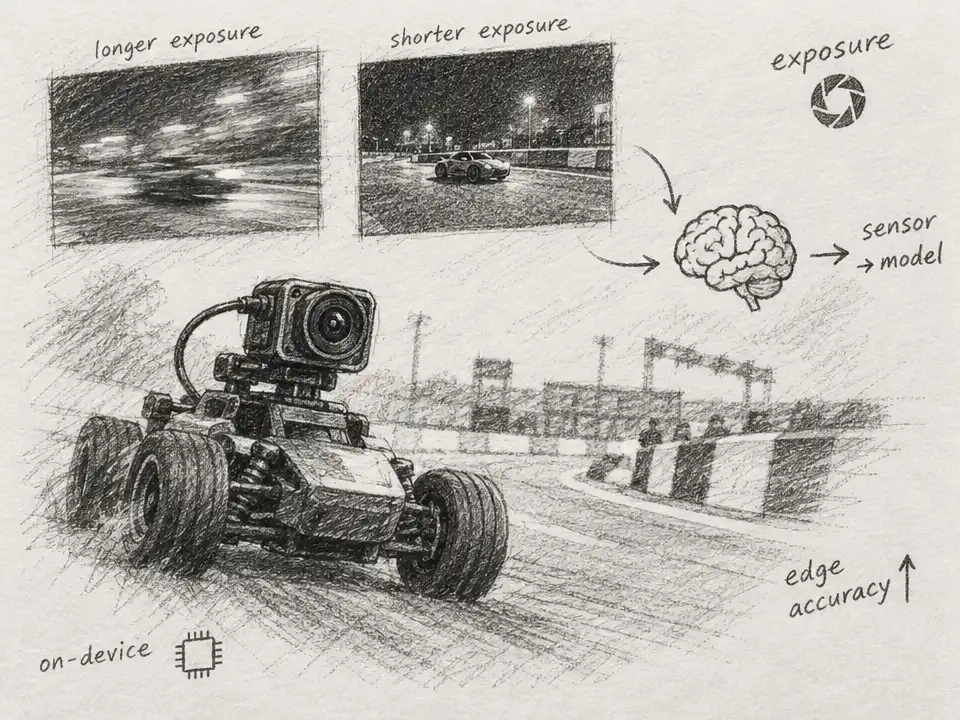
Consider a dark, moving scene. A camera can leave its shutter open longer to gather more light, but that also gives motion more time to smear an object across the image. Shorten the exposure and edges may stay crisp, but the picture grows darker and noisier. The camera has to make a trade-off before the recognition model gets its turn.
ATI divides that work into layers inspired by different brain functions. Its quick-response layer, named the Brainstem, places safety limits on camera settings. It uses motion measurements to favor shorter exposures when the phone is moving, but does not let the exposure fall so far that a very dark scene loses nearly all its signal. It also limits how far the camera can raise its sensitivity, since more gain can mean more noise.
Within those guardrails, a second layer, named the Cerebellum, learns which settings help recognition. The team implemented it as a contextual bandit: in plain English, a learner that tries small adjustments in a particular situation and keeps track of which ones work. It used motion and light readings to distinguish among conditions, then nudged exposure and sensitivity up or down. Its feedback came from the classifier’s confidence and an image-sharpness measure. The system was not simply hunting for the brightest frame. It was learning how to get an image that was both usable and easier to classify.
Then came the split between fast and slow interpretation. A compact classifier ran on the phone, while a more capable model could examine selected images remotely. A coordinator saved remote calls for cases where the local answer was uncertain and the image was still sharp enough to be useful. Sending a badly blurred frame for deeper analysis could waste time: a larger model cannot reliably recover information the sensor never captured.
To test the design, the researchers mounted a Samsung Galaxy S25 on a small vehicle circling a closed track. Each lap lasted about three seconds, and an object appeared intermittently as the camera’s angle, distance, and motion changed. The team evaluated eight object classes under bright and dark lighting, comparing the system with the phone’s ordinary auto-exposure and with a commercial stabilization mode.
The layered system’s strongest result was a paired improvement: better recognition with less reliance on remote inference. Across the eight classes, the ATI setup reached 88% classification accuracy and sent 31.8% of laps to the remote model. The auto-exposure setup with the same local-and-remote arrangement reached 53.8% accuracy and used remote inference on 56% of laps. In this test, improving the image before classification helped the phone answer more often on its own.
A separate experiment switched the lighting between dark and bright at the start of each lap. For one object, a teddy bear, the system’s local classifier reached 100% accuracy, compared with 64% under ordinary auto-exposure; remote calls fell from 22% of laps to 4%. That is a striking result, but it came from a controlled setup with a single object in this fast-switching-light test—not a guarantee that the same gains will appear in a busy street, warehouse, or unfamiliar environment.
The biological inspiration is a design analogy, not a claim that the phone has recreated a brain. The researchers map fast protection to reflexes, adaptive calibration to cerebellar function, and the division between routine and difficult decisions to higher-level brain systems. What crosses fields is the organizing principle: perception can improve when control begins at the sensor, rather than treating the raw signal as fixed.
The paper also sketches an auditory version of the idea and reports a small proof of concept. A microphone system adjusted gain and noise suppression before a keyword recognizer processed the sound. In a noise-heavy physical test, it improved signal-to-noise ratio by 0.31 dB and recognition accuracy from 31.6% to 32.7%. Those gains are modest; they suggest a possible extension, not a finished smart-hearing system.
There are other reasons to keep the claims in proportion. The camera study used a closed track and a limited classification task. Remote inference was tested by replaying captured frames offline, so the experiment did not measure the effects of a live, changing network. The authors also note that a classifier’s confidence can be misleading, and that one sensor may serve several tasks that want different things from its settings.
Still, the work points to a different way to think about edge AI. Instead of asking only how to make a model reason harder, designers can ask how to keep its inputs informative, how to make the first useful decision locally, and when a more expensive answer is worth requesting. Sometimes the smartest next step is not more computation. It is getting the light, motion, or sound right before the computation begins.