Imagine a small device encountering a new sound it needs to recognize: a household keyword, perhaps, or a phrase that matters to one particular user. The familiar solution is to send examples elsewhere, retrain a model, and send the update back. But that can cost time, power, and privacy. A research team has tested another route: give a tiny chip one compact way to turn information into useful features, then let it adapt those features to different kinds of learning right where it runs.
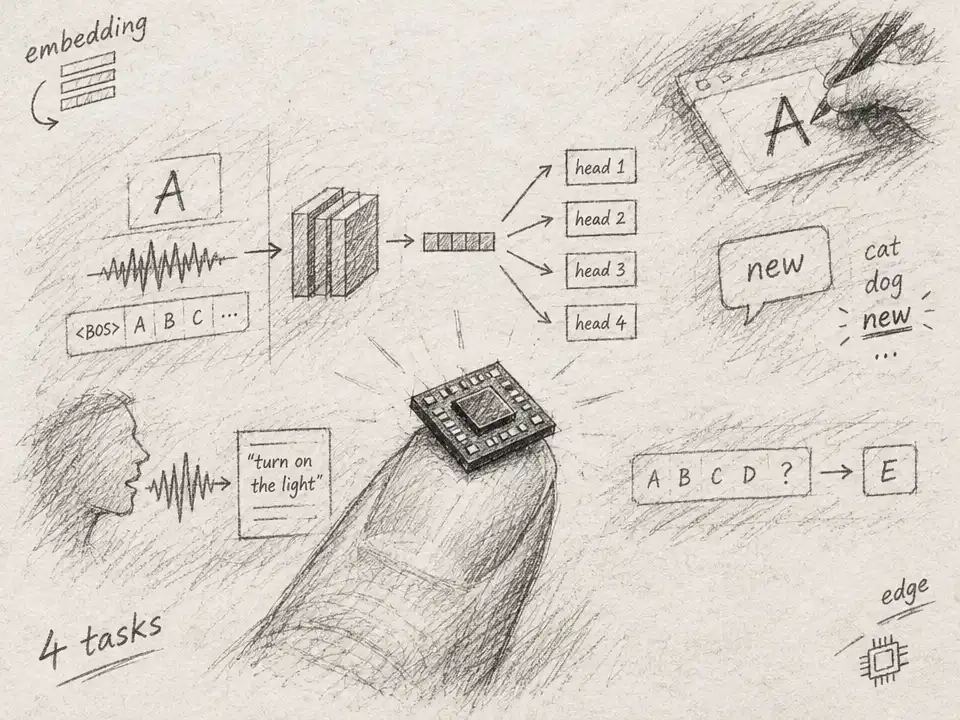
The framework, called embedder-centric learning, was demonstrated on the Chameleon system-on-chip. Its central idea is a division of labor. First, a neural network called an embedder converts an input—a picture, sound, or sequence of tokens—into a compact numerical representation, or embedding. Then a small task-specific component uses those representations to make predictions. The same basic processing path can support different learning tasks; what changes is how the chip organizes and uses the embeddings.
That distinction matters because “learning” covers several different situations. Sometimes a device gets just a few labeled examples of a new category. Sometimes new categories arrive gradually, and the device must remember old ones. Sometimes it receives a description rather than labeled examples. And sometimes it must use examples in a sequence to predict what comes next. Building a separate learning engine for each situation could make a small device too complicated. The team’s approach tries to make the distinctions mostly in the compact task-specific component, while reusing the embedder and much of the hardware.
For few-shot learning, the chip turns a handful of examples into embeddings and averages examples of the same category into a representative point. A new input is assigned to the category whose representative is closest. In the researchers’ implementation, that comparison is arranged as a standard neural-network layer, so the chip can use its ordinary inference machinery rather than special-purpose distance-comparison hardware.
For continual learning, the chip can add a new category without replacing the representations it already uses for older categories. The team tested this with spoken keywords, learning classes incrementally. After accumulating 200 classes, the hardware system reached 71.8% accuracy. It processed each sample in 1.0 s at an average power of 9.5 µW, and stored the class embeddings in 6.4 kB. Those results show a practical tradeoff: the chip can keep adding categories within tight memory and power limits, but the reported accuracy is not perfect recognition.
A more unusual test asked whether the device could learn a category from meaning rather than from labeled examples of the thing it would later hear. The researchers paired spoken audio with text transcriptions. The chip processed the transcription as semantic information, then compared it with an audio embedding to identify which of five phrases had been spoken—even though the audio examples for those test-domain categories were not labeled for adaptation. On the hardware, this zero-shot test reached 60.6% accuracy. Learning the five categories took 383 ms and 3.1 µJ; inference ran at 8.0 µW. The result is a demonstration on a small benchmark, not a general-purpose speech assistant.
The fourth case goes beyond sorting inputs into categories. In-context learning lets a model use examples placed in a sequence to predict a later item, without updating the model’s stored parameters. The team tested this on RegBench, a benchmark for simple sequence and formal-language tasks. Their small temporal convolutional network processed the sequence and produced predictions. At the 500th token, the hardware version reached 46.2% cumulative accuracy, using 16.8 µJ per token. In software, the unquantized model came within one accuracy point of a parameter-matched transformer on the task, while the chip’s quantized version lost 5.3 points compared with the unquantized model.
Here, the hardware choices are part of the story. Chameleon uses 4-bit activations and 4-bit logarithmic weights, a compact format that replaces general multiplication with simpler operations. Its inference pipeline is also reused to process embeddings and task-specific layers. The researchers report that the extra hardware logic needed for learning adds only 0.5% to the accelerator’s area. Instead of relying on full backpropagation on the device, the framework chiefly stores and rearranges compact representations and layer parameters.
But the boundary of the achievement is important. The embedder still has to be pretrained off-chip for each new sensory modality; the chip is not learning everything from scratch. The evaluation uses relatively small datasets and models, and low-bit quantization can noticeably reduce accuracy—especially in the spoken-language zero-shot test. Nor does moving adaptation onto a device automatically guarantee privacy or make every application suitable for it. The work is a hardware demonstration of a flexible method, not evidence that one tiny chip can learn any task it encounters.
Its striking move is more modest, and perhaps more useful: treat different kinds of adaptation as variations on a shared representation, rather than as four separate machines. A small device may not need a new neural engine each time its task changes. If it can turn inputs into compact, reusable features, then the question becomes how to arrange a small amount of task-specific information around them. On Chameleon, that idea carried from handwritten characters to audio and token sequences—an early sign that the edge device could be more than a fixed predictor.