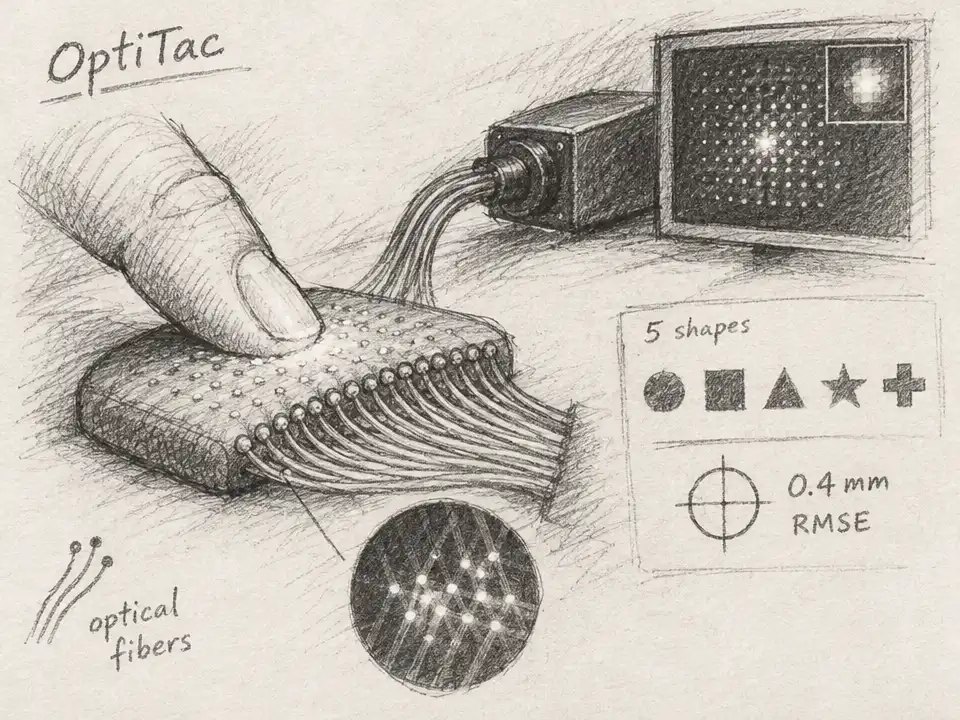
Touch leaves a pattern. Press a fingertip against a table and the skin dimples; underneath, tiny receptors turn that deformation into signals the nervous system can carry onward. A new soft sensor borrows that basic arrangement—but swaps nerve fibers for strands of plastic that carry light. In laboratory tests, the device used those optical signals to estimate where a touch landed, how wide it was, and whether it came from an edge or a simple geometric shape.
The prototype, called OptiTac, brings together ideas from biology, fiber optics, and computer vision. Its central trick is not simply making a soft surface sensitive. It is deciding how information should travel after contact. Instead of putting an imaging camera directly behind the sensing skin, the researchers routed local signals through an array of optical fibers to a camera set apart from the soft sensing module.
Inside that module, a black rubber skin sits over a transparent gel. Small pins extend from the skin’s inner surface, each tipped with a white marker. When an object presses the skin, the pins lever and the markers shift. An LED ring illuminates them; depending on their movement, more or less light enters the fiber ends. The fibers carry those changing light levels to the camera, where a computer turns them into a map of the touch.
The array contains 217 plastic optical fibers, each 1 mm in diameter, arranged in a compact hexagonal pattern. The key design choice was to line up one pin with each fiber. That pairing echoes how biological touch receptors collect local information and send it along pathways. It is an architectural analogy, not an artificial copy of a human nerve: the fibers carry light, and the camera reads the pattern at the other end.
Getting that arrangement right mattered. The researchers tested three layouts of the pins: sparse, dense, and aligned with the fibers. When they pushed the same 5 mm ball 3 mm into the skin, the sparse pattern spread the light changes across a broad area. The denser layout made a more localized response, but the pattern was complicated. Only the one-pin-per-fiber layout produced a localized change simple enough to interpret directly. The sensor’s physical design had already organized the signal before the software began to analyze it.
To test localization, the team pressed the sensor at known positions with a robot arm and compared those positions with the camera’s estimate. A calibration map helped correct errors that varied across the surface. In a set of test indentations made between neighboring fibers—positions the calibration procedure had not directly used—the calibrated estimates had a root-mean-square error of 0.4 mm in both directions. That was finer than the 1.5 mm spacing between neighboring fiber-and-pin pairs. The result is called hyperacuity: estimating a touch’s position more finely than the spacing of the sensor’s individual sensing points, under the tested conditions.
OptiTac also estimated contact width. The researchers pressed circular indenters ranging from 1.85–20.09 mm in diameter and compared the measured widths with their known sizes. The estimates tracked the true diameters across that range, though their accuracy varied: for indenters smaller than 10 mm, the reported errors were lower than for larger ones. The sensor was most precise for small contacts, a useful distinction for a system meant to detect local touches rather than merely register that something had pushed on it.
Could the pattern reveal what made the contact? The team tested five printed shapes: an edge, a circle, a square, a triangle, and an ellipse. They treated the camera’s light map like an image and used simple measurements of its shape, followed by a clustering method, to sort the contacts. In this controlled test, the selected image features produced an average diagonal classification score of 96%. The edge was especially distinctive, with a 100% true-positive rate in the reported test. Those results show proof-of-principle for a small set of shapes, not general recognition of arbitrary objects.
That distinction matters. The researchers’ aim was not to prove that simple image analysis beats every machine-learning system. It was to show how a biologically inspired sensor layout can make the signal easier to understand. When touch creates a clean light pattern, basic image analysis can estimate its position, size, and shape without requiring an end-to-end model whose internal cues are harder to inspect. The underlying idea crosses fields: arrange the hardware like a sensory pathway, then use methods from vision to read what it carries.
For now, OptiTac remains a laboratory prototype. Its fibers were short—95 mm after polishing—and the tests used carefully controlled indentations. The paper identifies longer fiber routes, repeated bending, packaging differences, and changing environmental conditions as engineering questions still to investigate. The team also describes robotic grippers as a possible future application, rather than reporting a completed robot hand using the sensor in the wild.
Even so, the design points toward a different way to distribute touch. A soft sensing surface could sit where contact happens while its camera and processing hardware sit elsewhere, linked by fibers. That separation may be useful when sensing needs to spread beyond a single fingertip. OptiTac does not yet give a robot human touch. It does show how an idea borrowed from the body, carried by light and decoded like an image, can turn a press on soft skin into a signal with a readable shape.