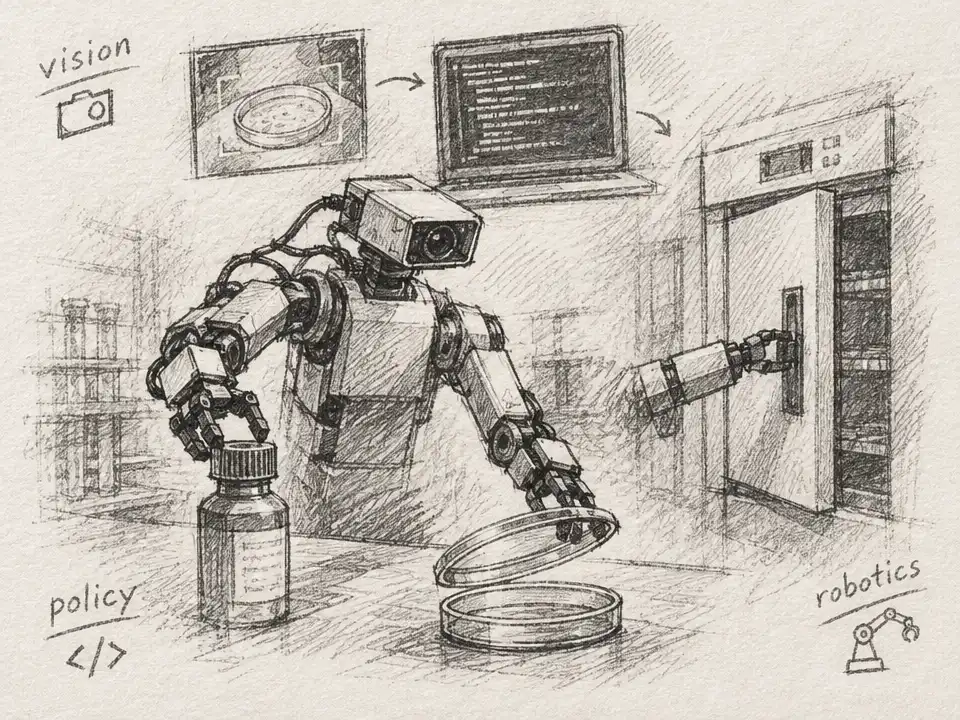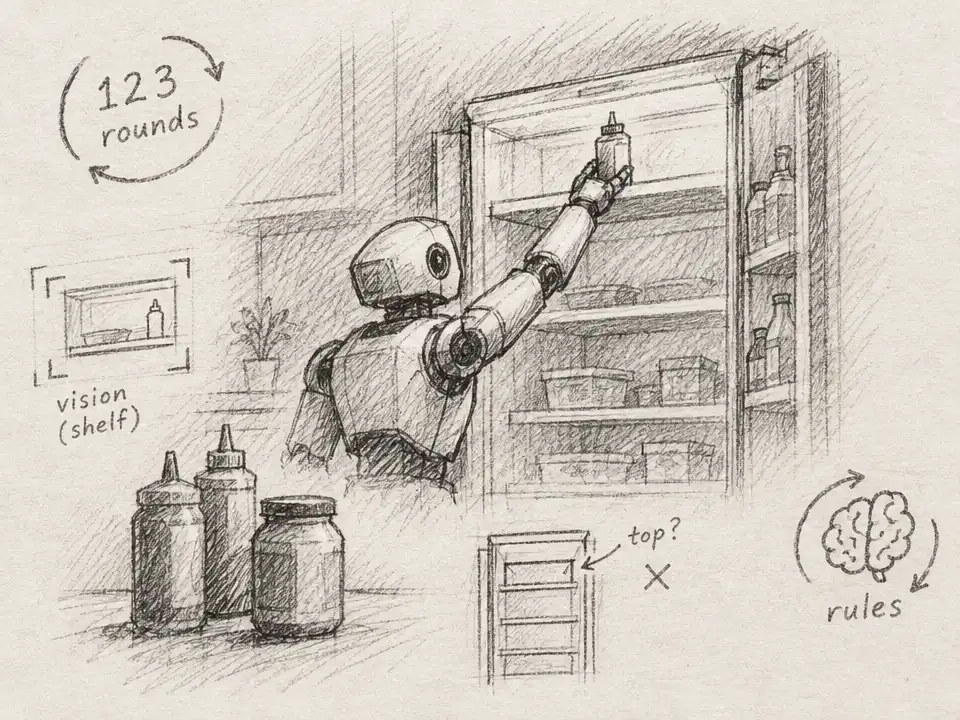
The bottle tilts over the cup. Water arcs forward—and misses. For the robot, the problem is not simply choosing the wrong movement: while it holds the bottle, its wrist camera can lose sight of the pour. It needs a way to keep watching while it acts. In a new study, researchers show how a robot can address this kind of failure without changing the weights of the AI model directing it. The key is to look beyond the model, at the tools, views, and instructions through which it meets the physical world.
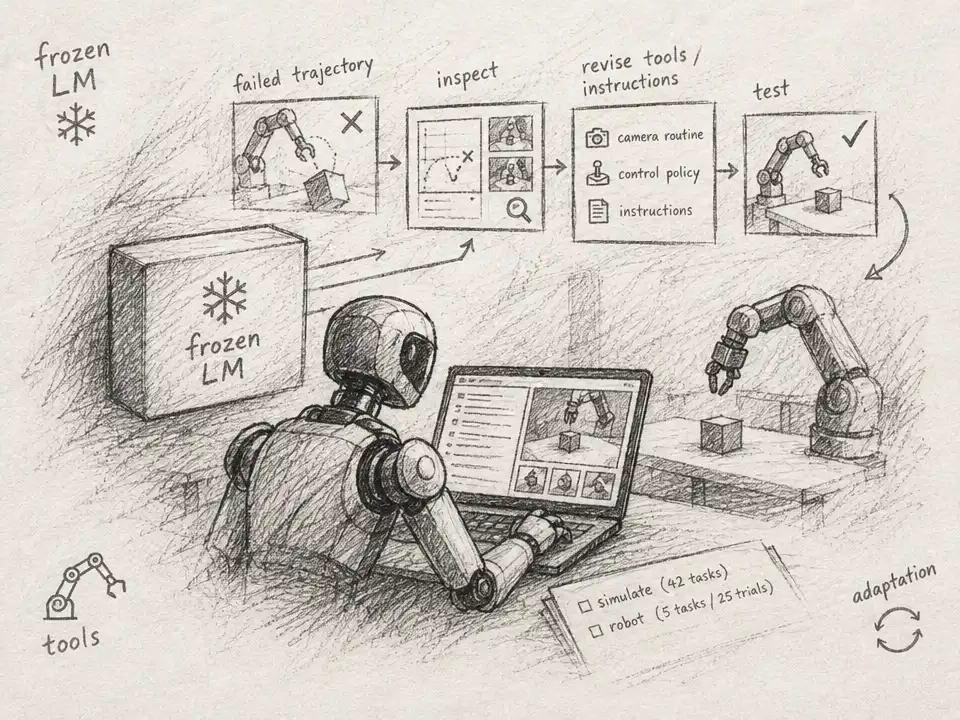
The system, called PhysEvo, puts one frozen model named Astra in two roles. A task agent uses cameras and robot controls to do the job. A second, meta-agent reviews what happened, examines images and robot states, and can revise the software tools and skills that shape later attempts. The model’s learned parameters stay fixed. What changes is the surrounding setup: what the robot can control, what evidence it can gather, and which practical lessons are kept for next time.
That setup is a kind of interface between an AI and its body. In the researchers’ initial arrangement, Astra could ask the arm to move its gripper to a target point. A motion solver then worked out the arm’s posture. But a solver can reach the right point with the arm folded into an awkward position, one that blocks a camera or makes the next movement difficult. The robot could name a destination without choosing a useful way to get there.
PhysEvo’s developers changed the control tool so Astra could set the arm’s joints directly. Posture became part of the decision. In a focused comparison of six episodes, the joint-control setup scored an average of 100, compared with 40 for the target-point interface. The combined option scored 55, a reminder that simply adding more buttons is not the same as giving the system a better way to act. The hidden ingredient was a more useful connection between the model’s decision and the robot’s body.
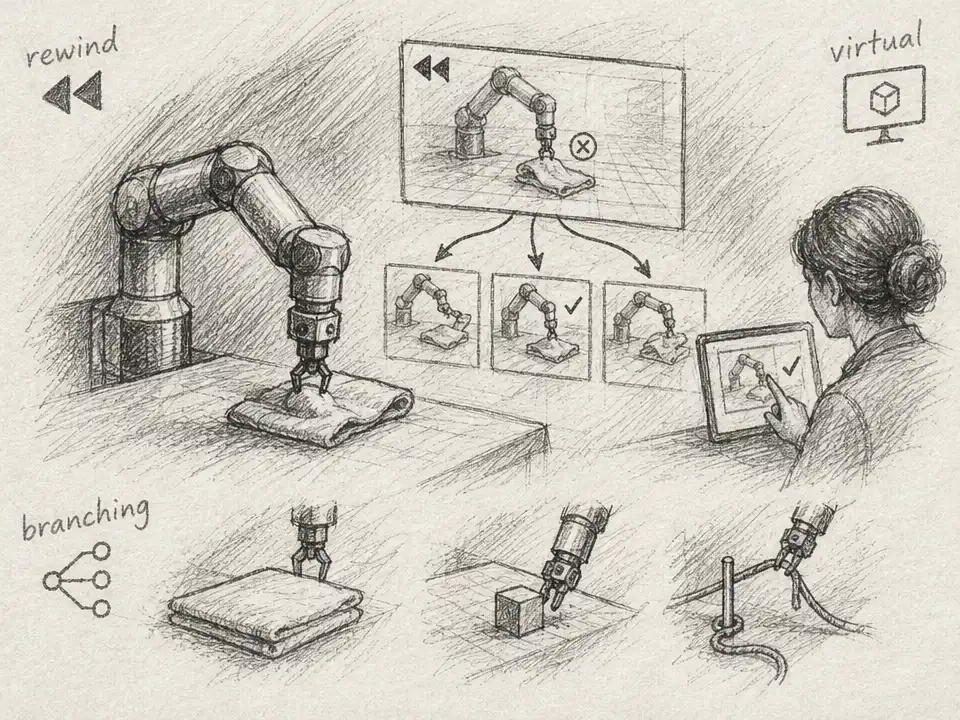
The same shift applies to sight. During pouring, the revised skill tells the robot to use its free arm to keep a side view of the bottle, stream, and cup while the other arm does the work. The model can also call tools to retrieve earlier images and aligned robot states from the same episode. That means a failed motion need not vanish into a single score—success or failure. The system can inspect a sequence: what it saw, what it commanded, and what the arm and object did in response.
One packing mistake illustrates why that sequence matters. A box ends up displaced, apparently out of reach. Instead of treating the final position as the whole story, the meta-agent uses a review tool it had built earlier to trace the movement back to contact between the robot’s wrist or gripper and raised box flaps. It then revises the packing guidance: clear the flaps before turning. On a later attempt, the robot avoids pushing the box away. An earlier failure has supplied both a lesson and a way to investigate future failures.
Changes are tested before they are kept. The meta-agent checks that edited tools run and return the expected information. For behavioral changes, it compares the revised setup with the old one on the same task and initial scene; revisions that lower the score are rejected. Crucially, the layouts reserved for final simulation scoring are not used to develop or select the revisions. The tools and skills persist between episodes, while the model itself remains unchanged.
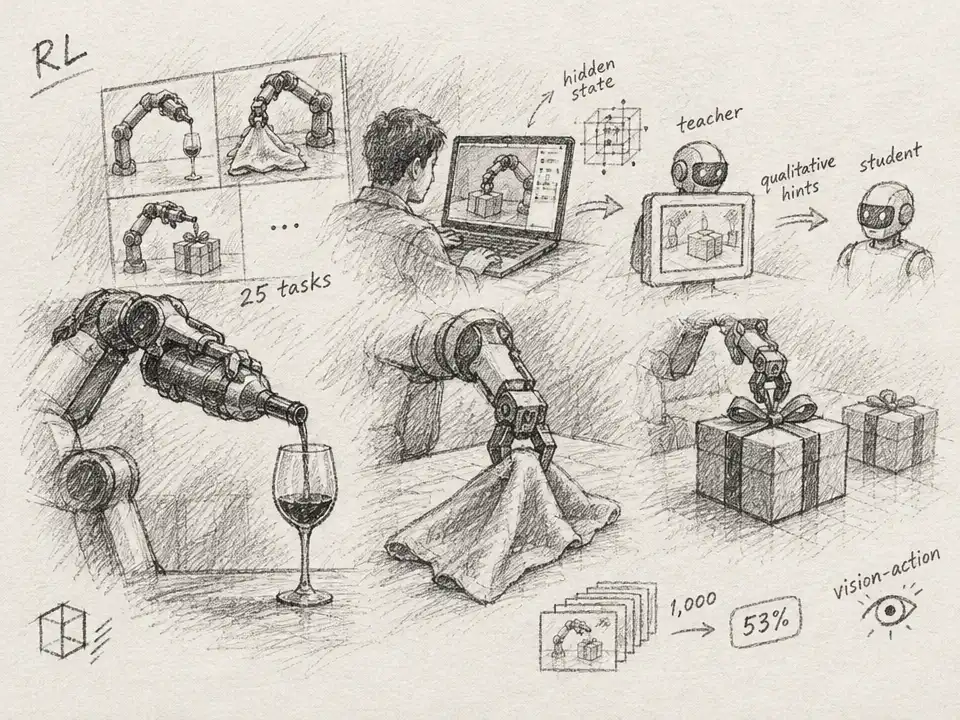
Across 42 RoboDojo simulation tasks, covering areas such as precision, long-horizon execution, memory, and open-ended instructions, the retained system reached 62.00% success under the researchers’ equal weighting of five capability dimensions. For comparison, the paper reports 47.17% for a one-shot Astra setup. On a subset of eight manipulation tasks where direct Astra had less than 5% success, PhysEvo reached 55.00%; the direct reference scored 1.25%. These are results within the study’s benchmark, not a claim that the robot has mastered manipulation in general.
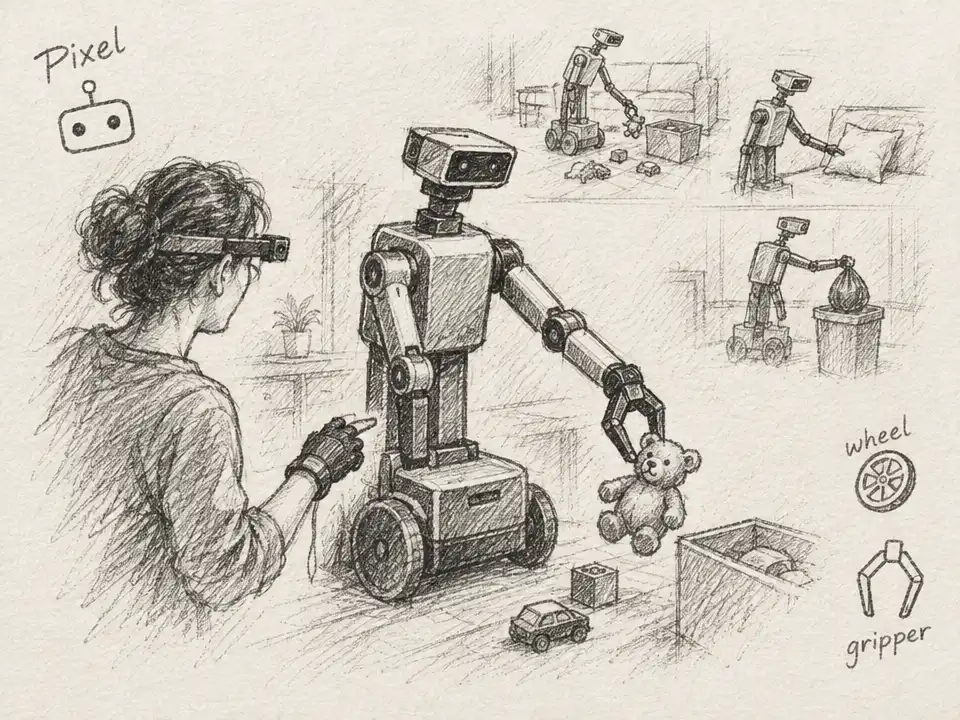
The researchers also carried the approach onto an AgileX PiPER robot. Across five physical tasks—stacking blocks, stacking bowls, placing pens, pouring water, and writing the word PhysEvo—the system completed 84.00% of trials, with a mean score of 90.60/100. There were five trials per task, 25 in all. Real hardware brought its own surprises: the water stream’s momentum carried it past the cup, so the pouring skill learned to aim the bottle opening backward. And because the real arm positioned itself less accurately than its simulated counterpart, a revised skill used visual guidance for the rough approach, then geometry for close-range adjustments.
That small set of physical trials is promising, not conclusive. And although the paper calls its process physical recursive self-improvement, that phrase does not mean the model rewrites its own learned weights. The authors’ claim is narrower: its experience can produce tested, persistent changes to the software harness around it—including tools for diagnosing what went wrong. The real-world evaluation covers five tasks on one robot platform, so much more testing would be needed to establish how reliably those changes transfer to new situations.
Still, the work changes where to look for a robot’s capabilities. A familiar image of AI puts the intelligence inside the model, like a brain receiving a scene and issuing a command. PhysEvo suggests another view: competence also depends on the channels around that model—whether it can choose its posture, get a useful camera angle, recover an earlier observation, or connect a bad outcome to the contact that caused it. Sometimes the next step toward a more capable robot is not a larger brain. It is a better way for the brain it already has to see, move, and remember.