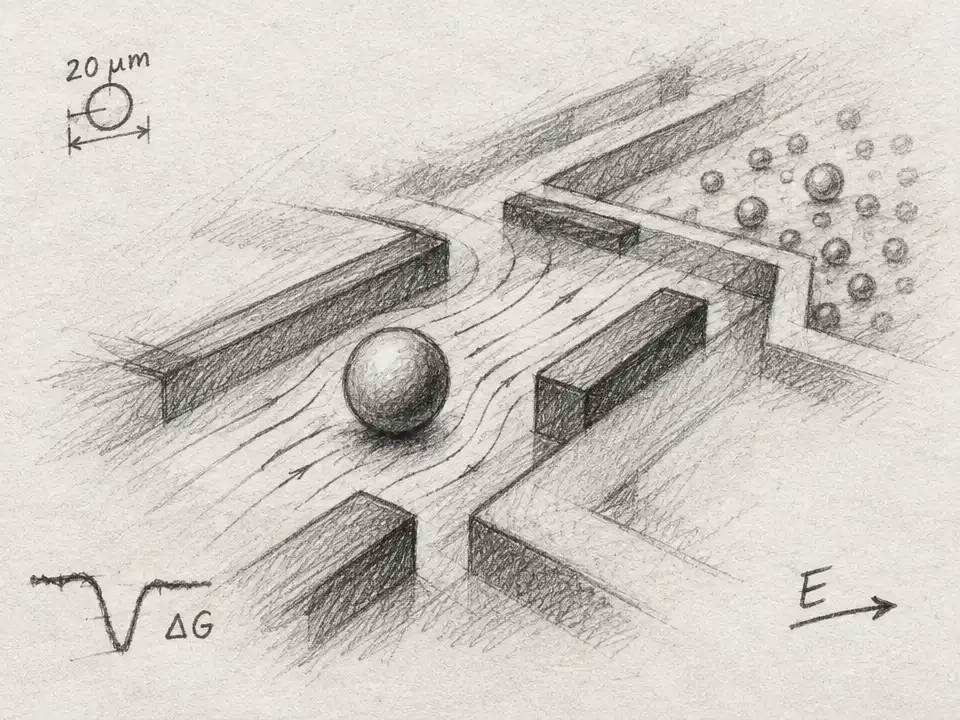
Inside a narrow fluid channel, a silica bead only 20 μm across moves through an electrode maze. A voltage pattern pulls it one way; another sends it back. The surprising part is how the system chooses those patterns: it does not begin with a detailed map of the electric field or a complete description of the bead and its surroundings. Instead, it listens for a faint electrical change the bead leaves behind.
That change is easy to overlook. Current flows through the conductive liquid, and some of its energy is dissipated as heat. When the bead shifts position, it slightly alters the paths taken by the current. Researchers at EPFL turned those small changes in electrical conductance into clues about the forces acting on the bead—and then used the clues to steer it. Their approach, called dissipation-guided electromagnetic manipulation, makes the system’s electrical losses part of the control signal.
The idea reverses a familiar instinct. In many devices, energy loss is something to minimize: it wastes power and can muddy a measurement. Here, loss carries information. The bead disturbs the electric field around it; that disturbance changes how readily current passes between electrodes. Measure the change as the bead moves, and the pattern of conductance becomes a kind of electrical shadow of the hidden field and its forces.
To build that shadow, the team placed a bead in a microfluidic channel above an array of 20 electrodes. They moved it to different positions and measured how conductance between electrode pairs changed. A microscope tracked the bead, while a computer used the position measurements to estimate how the conductance pattern varied across the channel. From those variations, the researchers calculated which combination of electrode voltages should push the bead in a chosen direction.
The physics behind the trick is subtle, but the practical picture is intuitive: the bead changes the current’s routes, and those changes reveal how to arrange the next push. The researchers’ mathematical framework connects conductance changes at the electrodes to mechanical force on the particle. In the low-frequency, conduction-dominated conditions they studied, the measured conductance provides a direct way to retrieve that force. The controller then selects a voltage pattern that makes the force point the desired way.
“Model-free” does not mean that no theory or measurement is involved. The team derived the connection between conductance and force, and used computer simulations to check how the fields behaved. Rather, the controller does not need a detailed, pre-calibrated map of the field or a precise inventory of the particle’s electrical properties before it can act. It learns from the system’s measured response as the bead moves. A microscope still has to locate the target, and conductance still has to be measured.
In one demonstration, the system guided a single bead about 300 μm from one boundary of the device to another in approximately 40 seconds, over 20 iterations. Each update took about two seconds. The bead’s movement produced conductance changes of roughly 2 to 4 nS—small shifts within measurements whose absolute values were about 100 to 500 nS. Yet those shifts stood above the reported noise levels, allowing the researchers to extract a useful signal from the electrical background.
The test grew more demanding when the bead was steered in two dimensions and through branches in a microfluidic channel. Then came a more cluttered scene: a 20 μm target moving among smaller, 5 μm silica beads. Some of the smaller beads formed chains in the alternating electric field and stuck to the target. Its shape changed as it traveled. Even so, the target continued along its prescribed route, though the algorithm was not explicitly tracking the smaller particles.
That crowded experiment points to a different way of thinking about precision control. Often, making a tiny object move means knowing a great deal in advance: its properties, the local field, and how the surrounding material will affect both. But a microscopic environment can change while the device is operating. If a bead acquires extra particles or its surroundings shift, an exact prediction can quickly become outdated. This method instead uses fresh measurements of the system’s response to choose its next move.
The demonstration remains a proof of concept, not a ready-made tool for sorting cells or cleaning water. The experiments used silica beads in a controlled microfluidic setup. The authors suggest that the method might eventually apply to cells, droplets, or other particles, and could perhaps extend to nanoscale objects if their electrical signals can be distinguished from noise and the resulting forces are strong enough. Those possibilities still require testing.
For now, the notable discovery is smaller and more fundamental: dissipation need not hide the route to control. In this miniature world, the particle’s faint effect on electrical current gives the controller a way to navigate a field it did not map in advance. The bead’s movement changes the signal; the signal helps shape the next movement. A little lost energy becomes a guide.