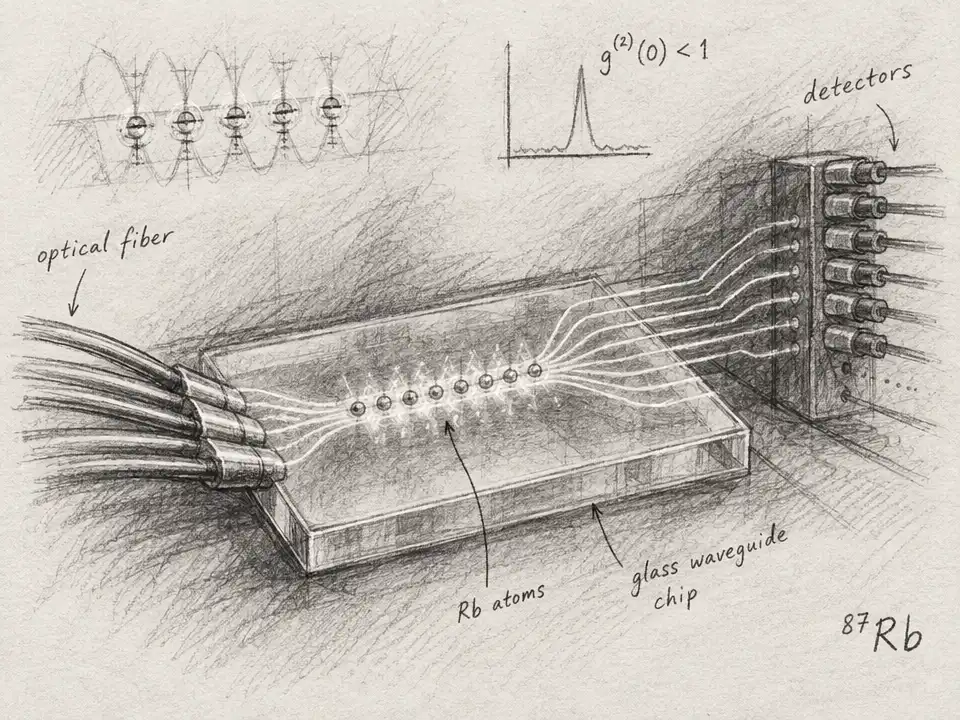
Imagine a row of rubidium atoms, each held in its own tiny optical trap. The atoms are separated by just 5 micrometers. Now imagine trying to collect light from every atom in a separate optical fiber—while keeping each beam narrow enough to fit neatly into its fiber. The mismatch is almost comically large: standard fiber arrays space their channels 127 micrometers apart.
That gap between the microscopic and the everyday turns out to be a serious engineering problem. Magnify the atom row until it matches the fibers, and the light spots grow too wide for the fibers to capture efficiently. Keep the spots small, and they will not line up with the fiber array. A team of researchers has built a glass waveguide chip that solves the mismatch by changing the spacing of the light after it enters the chip.
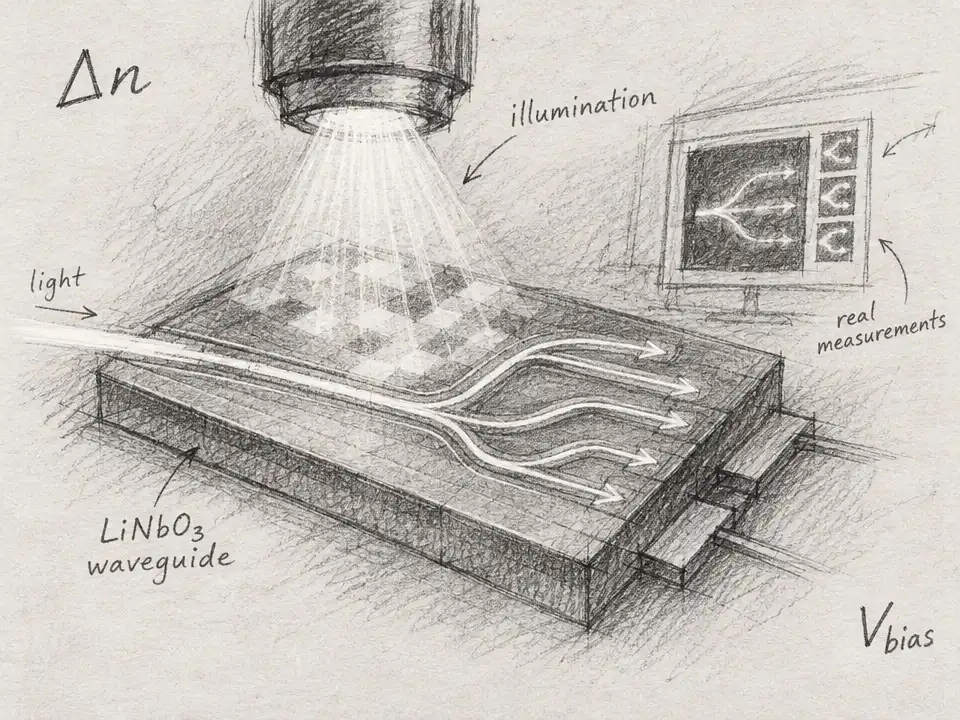
The result is a kind of optical fan-out. First, an imaging system enlarges the 5-micrometer atom spacing to 36 micrometers, matching the waveguides at the chip’s input. Once light from each atom is inside its own waveguide, the paths gradually spread out. At the other end, they emerge at 127-micrometer spacing, ready to meet a commercial fiber array. Each fiber connects to its own single-photon detector.
The important trick is that the chip separates two jobs that would otherwise compete: keeping the light in a useful, narrow optical mode and arranging the channels far enough apart for standard hardware. The atoms stay close together. The waveguides carry their light onto a much roomier grid.
To test whether the routes truly stayed separate, the researchers moved a single atom across the focal plane and recorded which waveguide received its fluorescence. The scan produced 50 distinct peaks, one for each channel. The collection spot measured about 1 micrometer wide at the atom plane—small compared with the 5-micrometer spacing between traps. In other words, a channel could mostly listen to its own atom rather than its neighbor.
Across the 50-channel device, average cross-talk between neighboring channels was 0.4%. The average insertion loss—the light lost as it travels through the fiber-to-waveguide interface and the waveguide—was 2.9 decibels. These measurements show that the optical paths can keep the atoms’ signals distinct while translating their arrangement into a format that existing fiber hardware can handle.
Then came a more demanding test: operating the sources together. The team routed fluorescence from 50 individually addressable atoms through the chip. To check that the light from an atom really behaved as single photons, they measured one representative channel. Its photon-correlation result was 0.29, consistent with single-photon emission. That confirms the character of the light in that channel; it does not show that every channel has the same performance, or that photons from different atoms are indistinguishable.
Keeping an array useful also means dealing with empty traps. Atoms can be lost, so the researchers first identified which traps were occupied, rearranged the atoms into a chosen pattern, and kept extra atoms nearby as a reserve. They prepared target arrays of up to 24 atoms with a 93% fill fraction. When an atom disappeared from a target site, one from the reserve could take its place. For small target arrays, the reset rate reached 118 times per second, limited by the time needed to detect and rearrange the atoms.
The researchers also made a much larger waveguide chip: 784 channels, laid out compactly at one end and fanned out to fiber-compatible spacing at the other. But this was a test of the photonic interface, not a demonstration of 784 operating atom sources. The larger chip was preliminary and had an average insertion loss of 6.4 decibels, compared with 2.9 decibels for the 50-channel device. The authors describe it as unoptimized and say fabrication improvements are needed.
There are other limits between this experiment and a ready-made photon network. Only about 1% of the emitted light entered the waveguide mode. The team did not test whether photons from different channels could interfere as identical photons—a key property for many proposed uses. Such a test would require collecting far more light or waiting prohibitively long for enough detections.
Still, the chip changes the scale of the problem. Rather than force a dense array of atoms to fit the geometry of conventional fibers, it gives each atom a private optical route and lets those routes spread out downstream. The 50-atom demonstration shows the approach working; the larger chip sketches how far its wiring might extend. Between a row of atoms and a useful fiber array, the hidden world is not just the photons themselves. It is the careful path that lets each one find its way out.