A metal bracket can be perfectly still and still not be quiet. Warmth makes electric charges inside conductors jiggle, producing tiny currents and faint, fluctuating magnetic fields. For an ordinary object, that static is negligible. For a precision magnetic sensor, it can blur the signal researchers are trying to hear.
The hard part is predicting the noise from real equipment. A textbook formula may work for a simple plate or wire. But experiments are built from corners, mounts, shields and other parts with shapes too awkward for tidy equations. To test a way around that problem, researchers brought a sensitive sensor array close to a slab of aluminum and a small metal framing bracket—and compared what the sensors heard with what a computer predicted.
The calculation starts with a surprising reversal. Rather than trying to track every microscopic current fluctuation inside a piece of metal, the researchers ask how much energy the metal would absorb from a carefully chosen magnetic field. The fluctuation-dissipation theorem links that energy loss to the size of the thermal noise the metal produces. In effect, measure the conductor’s response to a hypothetical push, and you can infer its restless background.
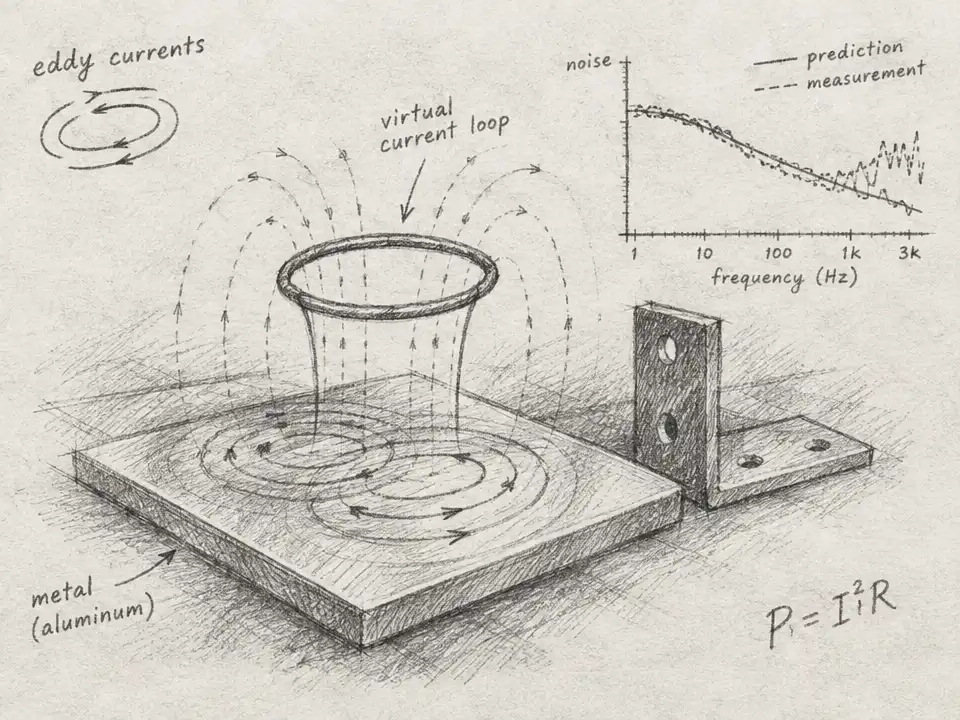
To make that hypothetical push match what a sensor can actually detect, the team represented each detector with a virtual current loop shaped like its pickup coils. They drove the loop with an oscillating current in a finite-element model of the metal part. The resulting magnetic field induces circulating currents, or eddy currents, in the conductor. The simulation calculates how much power those currents dissipate; the theorem then turns that dissipation into a prediction of magnetic noise.
This detail matters: a detector does not respond to one infinitesimal point in space. Its coils gather magnetic field across their area, and a gradiometer compares signals from oppositely wound loops. Modeling the detector itself lets the calculation account for that spatial response—and, in principle, for correlations between signals at different sensor locations.
For the experimental test, the researchers used four two-turn gradiometers made from niobium-titanium wire, mounted together and read out with superconducting quantum interference devices, or SQUIDs. The apparatus sat inside a magnetically shielded room. With no test object present, the sensor noise floor was less than or equal to 5 femtoteslas per root hertz from about 5 Hz to 3 kHz.
First came an aluminum-alloy plate measuring 1.9 cm by 10.2 cm by 30.0 cm. The team positioned the gradiometers near one edge, where a simple infinite-sheet approximation would miss important geometric details. Then came an aluminum corner bracket used in T-slot framing. They tested three arrangements, including rotating the bracket and lowering it by 9 mm. Its ridges and bends made it a more demanding test than a flat slab.
The researchers built the bracket’s shape into the computer model using a computer-aided-design file. They supplied the measured detector geometry and typical electrical conductivity values for the alloys, then calculated the expected noise across frequency. They did not adjust the shape or conductivity to force agreement with the measurements. For the calculations, they assumed a sample temperature of 300 K and assigned an uncertainty of plus or minus 10 K; the sample temperature itself was not measured.
Across the plate and the bracket’s three arrangements, measured noise generally agreed with the predictions from 1 to 3,000 Hz, within the combined uncertainties and the scatter in the data. The agreement included not just the overall noise level, but also the way its spectrum changed with frequency. For the plate, a shift in slope appeared near 30 Hz. The bracket showed one around 100 Hz and a further, less pronounced change over roughly 300–500 Hz.
Those bends tell a physical story. At lower frequencies, fluctuating currents can draw on a larger volume of the metal. At higher frequencies, the skin effect confines more of them near the surface. Meanwhile, the magnetic fields made by those currents resist changes in the currents themselves, through their self-inductance. Both effects reshape the noise spectrum. The model handled them together, even for the bracket, where no single thickness or current-loop size could neatly explain the behavior.
The computation was also practical enough to run on a laptop. One calculation for a geometry with four gradiometers took about 1.5 hours on a 2023 MacBook Pro with an M2 Max processor and 64 GB of memory. The researchers’ result does not mean every oddly shaped piece of hardware can now be modeled perfectly: the prediction depends on accurate geometry and material properties, and a finer numerical mesh costs more computing time.
A tougher check came from combining two of the gradiometers into a second-order gradiometer that measures the difference between their signals. Because both sensors can pick up some of the same magnetic fluctuations, subtraction can cancel part of the noise. The measured difference was substantially quieter than it would have been if the sensor signals were uncorrelated—evidence that the noise was shared across space.
Here the calculation matched the measured difference to within about 10% below 100 Hz, but the gap grew at higher frequencies, reaching roughly 30–40% near 1 kHz and above. The authors did not resolve the cause. Small mismatches in the modeled coil shape or material conductivity are possibilities, but the discrepancy remains a clear limit on the test.
The measurements were made while characterizing a detector system for a planned search for an electric dipole moment in xenon-129, not while measuring such a moment. The practical prize is more modest—and valuable: researchers may be able to estimate how much a conductor’s thermal static will cloud a sensitive experiment before building the apparatus. A virtual loop cannot make a metal part quiet. It can help reveal, in advance, just how loudly that part will speak.