Imagine trying to separate two kinds of tiny particles without catching them one by one or forcing them through a sieve. Instead, give them a winding path and let their own motion do the sorting. In a recent experiment, researchers turned a physics phenomenon called active demixing into a working microfluidic device: a stream of particles that starts mixed gradually separates as it travels through curved channels.
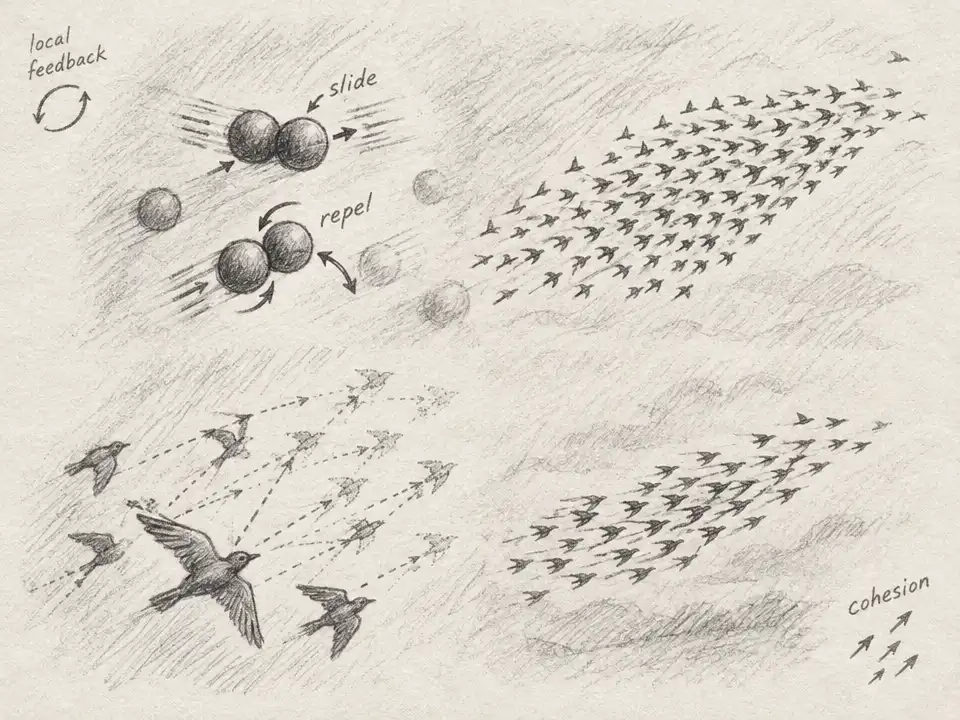
The particles were Quincke rollers: microscopic beads in liquid that, under an electric field, begin rotating and roll along a surface. Pack enough together and their individual journeys become collective. They align into a moving flock, circulating through a confined space. The researchers asked whether differences in how quickly two kinds of rollers move could make that flock organize its members by type—and whether the pattern could be put to practical use.
The first clue appeared in a circular well. In mixtures of polystyrene and PMMA particles, the faster-moving species tended to gather near the outer boundary, while the slower particles were enriched toward the center. Changing the electric field could switch which species moved faster, and the pattern switched with it. That mattered: it suggested that motion, not simply a bead’s material or size, could drive the separation.
This is not sorting by a static property, like a mesh catching larger grains. The particles are active: they keep moving, and their interactions help organize the group. The team’s experiments and computer simulations showed that a speed difference was enough to produce demixing. Curved confinement helped control how quickly and strongly the pattern formed. In smaller circular spaces, separation developed faster without substantially reducing its eventual strength.
A round well, though, keeps its separated populations in the same chamber. To make a sorter, the researchers needed to turn a pattern across a circle into two streams that could leave through different outlets. They tested an annular channel—one with an inner boundary as well as an outer one—and found that the boundaries’ relative curvature mattered. As the inner radius grew relative to the outer radius, demixing weakened. That gave the team a design rule: preserve strong curvature if the channel is meant to keep the populations apart.
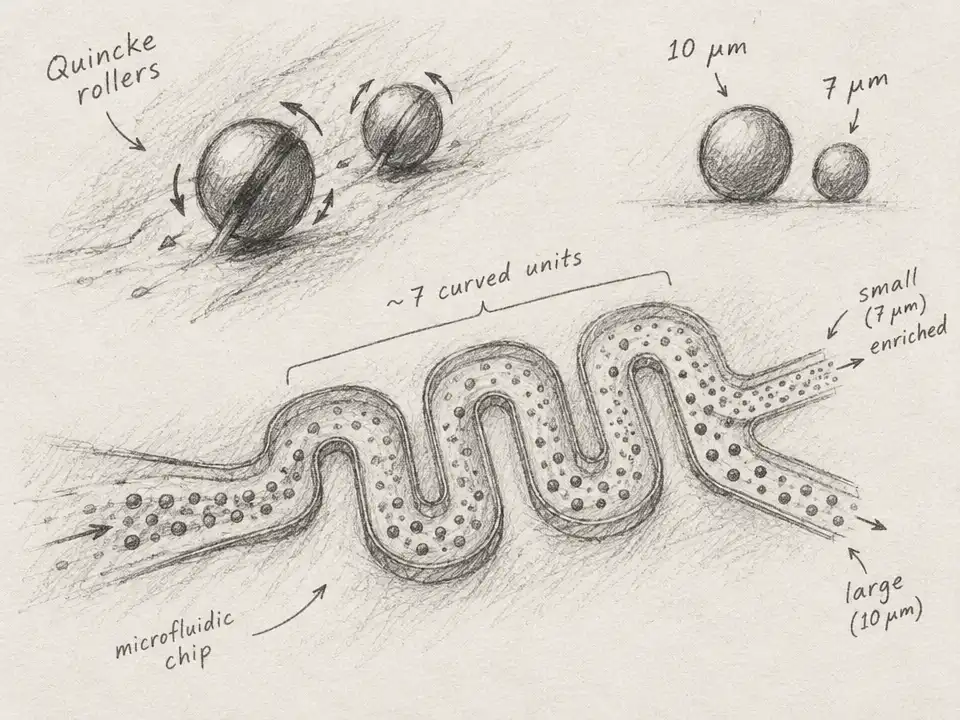
Next came the chip’s more intricate route: curved sections linked into a snake-like channel, with a separating wall that directs particles toward different exits. Simulations helped the researchers choose the channel geometry and the wall’s position. The layout was a balancing act. Moving the wall could increase the purity of one outlet while reducing how much of its target species the outlet recovered. A sample that is very clean is not necessarily a sample that captures most of the particles you wanted.
For the experimental device, the team used an approximately equal mixture of fluorescent polystyrene particles measuring 7 μm and 10 μm across. They set the outer channel radius to 1 mm, used 10 curved sorting units, and continuously fed the suspension into the chip. The smaller particles moved more slowly in this mixture. As they passed through the turns, the two populations became progressively more organized, and the channel geometry routed them toward separate regions.
The signal sharpened with each bend. In the chosen device, the 7 μm, slower particles became increasingly concentrated in the outer region; their measured fraction there approached unity after approximately seven units. In other words, an initially mixed stream emerged strongly enriched in one kind of particle. The result did not depend on a single dramatic trap: separation built up through repeated encounters between collective motion and curved confinement.
That is the crossover at the heart of the work. A principle studied in active matter—the physics of groups whose members propel themselves—became a design tool for microfluidic engineering. The researchers did not simply observe that particles sort themselves in a flock. They used experiments and simulations to identify which features of the motion and geometry mattered, then arranged those features into a continuous-flow device.
The demonstration remains a proof of concept with synthetic particles, not a ready-made device for separating living cells or microorganisms. The paper points to those as possible future targets, but they were not tested here. Different particles, fluids, and operating conditions could bring new challenges, including whether a useful speed contrast exists and whether the desired purity and recovery can be achieved together.
Still, the chip offers a striking alternative to sorting by forceful interception. Instead of making tiny components obey a barrier, it guides their collective behavior. Give a moving crowd the right curves, and its differences can become visible, useful streams—one bend at a time.