To look for something invisible, physicists often try to catch it in the act: a particle slips through a detector, nudges an atom, and leaves behind a faint recoil. But what if the visitor is so massive that the more revealing clue is not a tiny atom’s twitch, but the collective movement of an object you could almost see?
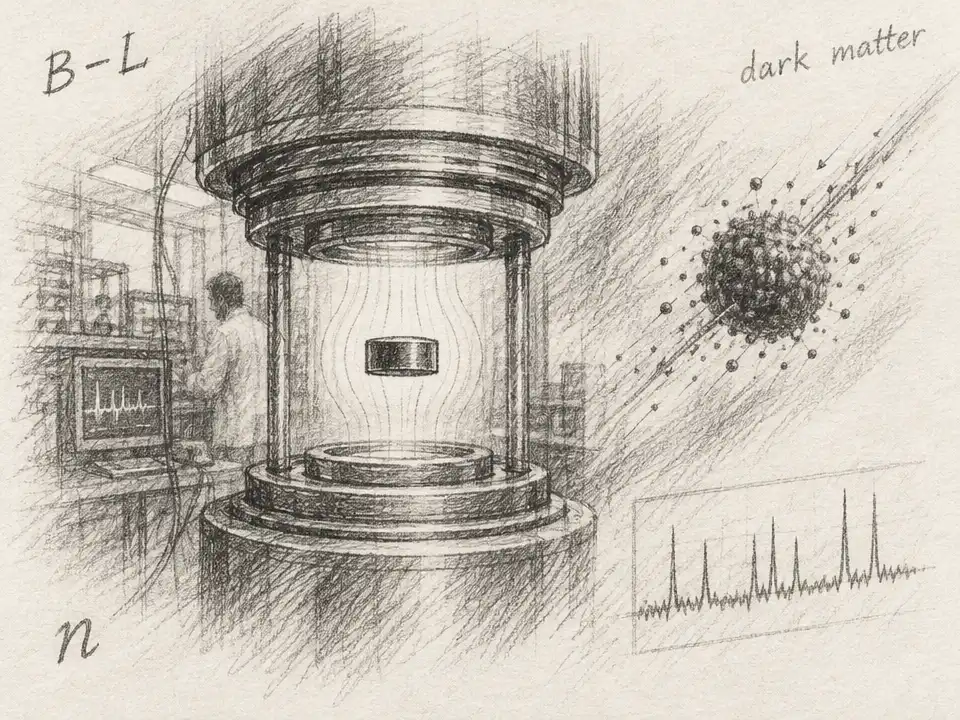
That is the scale shift behind a recent search using POLONAISE, an experiment built around a magnet weighing just 0.356 mg. Suspended inside a superconducting trap, the magnet became a listening device for a possible passage of ultraheavy dark matter. The team did not find evidence of a dark matter signal. Instead, it used the magnet’s quiet motion to set new limits on what such dark matter could be.
The magnet is a small permanent magnet made from neodymium, iron, and boron, with a glass sphere attached to break its rotational symmetry. Its effective radius is about 260 μm. In the researchers’ model, it contains roughly 1.07 × 10²⁰ neutrons that could respond together to a passing particle’s force.
That enormous head count matters. The search looks for dark matter that might tug on neutrons through a hypothetical, long-range force. If the force reaches across the whole magnet, the contributions from many neutrons can add up coherently. Rather than wait for one nucleus to recoil, the researchers can watch a much larger body for a sudden impulse—a brief transfer of momentum—as a dark matter particle passes nearby.
This is not a net thrown around the sky. A dark matter particle would have to pass close enough, interact strongly enough, and deliver a kick the apparatus could distinguish from the ordinary tremors of the laboratory. The trick is to make a macroscopic object quiet enough to notice that kick.
The magnet floats in a Type-I superconducting tantalum trap. A superconducting pickup coil senses changes in its motion; a circuit connected to a two-stage DC SQUID reads the signal. The environment is a stubborn part of the experiment: vibrations reaching the trap dominate its noise. A multistage cryogenic suspension cuts those vibrations by 110–130 dB at the magnet’s motion frequencies. The cryostat itself rests on a 25-metric-ton concrete block, while pumps and cooling equipment are mounted on a separate frame.
Even then, the magnet is not in a magical state of perfect stillness. The experiment’s readout remains in the classical noise regime. Its achievement is more practical: a heavy object can be monitored with enough sensitivity, and for long enough, to search for rare, abrupt changes.
The researchers tracked the magnet between December 22, 2025, and January 21, 2026. They selected night-time data, when environmental noise was expected to be lower, and analyzed 9.15 days of livetime. A passing particle’s impulse would make the magnet’s oscillation shift. Because the motion rings down slowly, a sudden kick would linger as a step in the signal instead of vanishing immediately.
That lasting trace helped the team look for impulses amid the noise. The search produced eight candidate events, with momenta from 1.52 TeV/c to 12.8 TeV/c. But the candidates were not a hidden cosmic chorus: their pattern was non-stationary and correlated with laboratory activity. The researchers could not reliably model and subtract those disturbances, so they made the cautious choice. They treated every candidate as if it might be dark matter, rather than dismissing any as background.
That decision shapes what the result means. The eight events were not a detection; the team says it cannot claim a discovery. Instead, using a statistical method designed to set limits even when the background is uncertain, the researchers asked how strong a dark-matter signal could be without conflicting with the observed impulses.
For the specific possibility they tested—dark matter coupled to neutrons through a long-range force—the resulting limits cover dark matter masses from 4 × 10⁵ GeV/c2 to 8 × 10¹⁴ GeV/c2. That spans nine orders of magnitude and extends the mass range explored by levitated-particle searches by about seven orders of magnitude. For a massless force mediator, the strongest limit excludes neutron couplings above 3.2 × 10⁻⁹ at a dark matter mass of about 5 × 10⁶ GeV/c2, at 95% confidence level.
There is a curious boundary to this hidden world. A dark matter particle must travel through Earth’s atmosphere before it can reach the detector. If its interaction with ordinary matter is too strong, the atmosphere can slow it down—or stop it—before it arrives. The experiment’s calculations include this effect. At the opposite extreme, particles so massive are so rare that the researchers do not claim an exclusion where fewer than a few close passages are expected during the run.
And the magnet’s size is both its advantage and its trade-off. Its many neutrons help amplify a long-range force, making it useful for searching at masses beyond the reach of much lighter optically levitated sensors. But the POLONAISE search has a higher momentum threshold, so the two approaches explore complementary parts of the dark matter landscape rather than replacing one another.
The picture is less of a trap snapping shut than of a tiny object held nearly still, waiting for the universe to give it a shove. No such shove could be identified as dark matter in this data. Yet by turning an instrument for measuring motion into a sensor for possible cosmic passersby, the experiment opens a new scale at which physicists can ask what the unseen matter around us is made of.