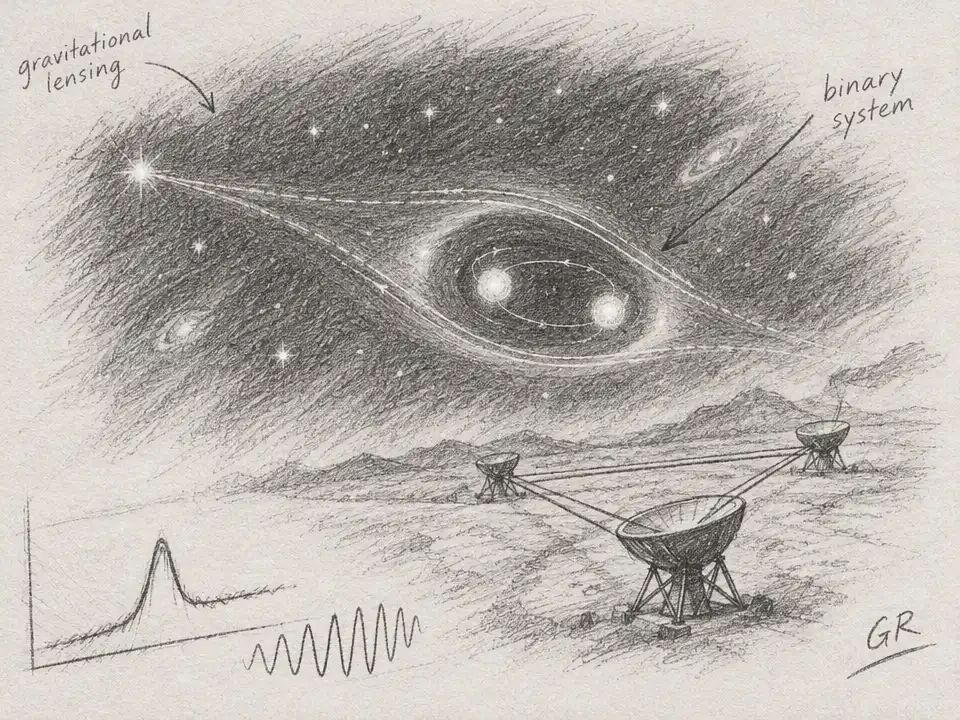
The oldest light in the universe is not quite a smooth glow. On its long journey to Earth, the cosmic microwave background—the afterglow released when the early universe became transparent—passes through galaxies and other concentrations of matter. Their gravity gently bends the light, leaving distortions that let researchers map otherwise hard-to-see matter across cosmic time. Reading that faint imprint is difficult. One bottleneck is not a shortage of sky, but the immense computing needed to tell a genuine gravitational signal from patterns that arise by chance.
Researchers estimate the lensing by looking for subtle relationships among pairs of temperature patterns in the background light. Gravity creates relationships that would not otherwise be there. But random variations in the ancient light, along with effects of the observing process, can create apparent relationships too. Combine pairs into a lensing estimate, then measure how that estimate varies across the sky, and those random patterns produce a built-in false signal called the disconnected Gaussian bias, or N0. Researchers must estimate and subtract it before interpreting the remaining signal as a map of matter.
The standard correction is careful but costly. It compares observations with simulated skies, using many simulation runs to capture the way the bias depends on the particular data being analyzed. Recent analyses can require several hundred simulations for this step. The calculation can take hundreds of times longer than a typical lensing-map reconstruction, and repeating it across many mock datasets to test uncertainty can be impractical.
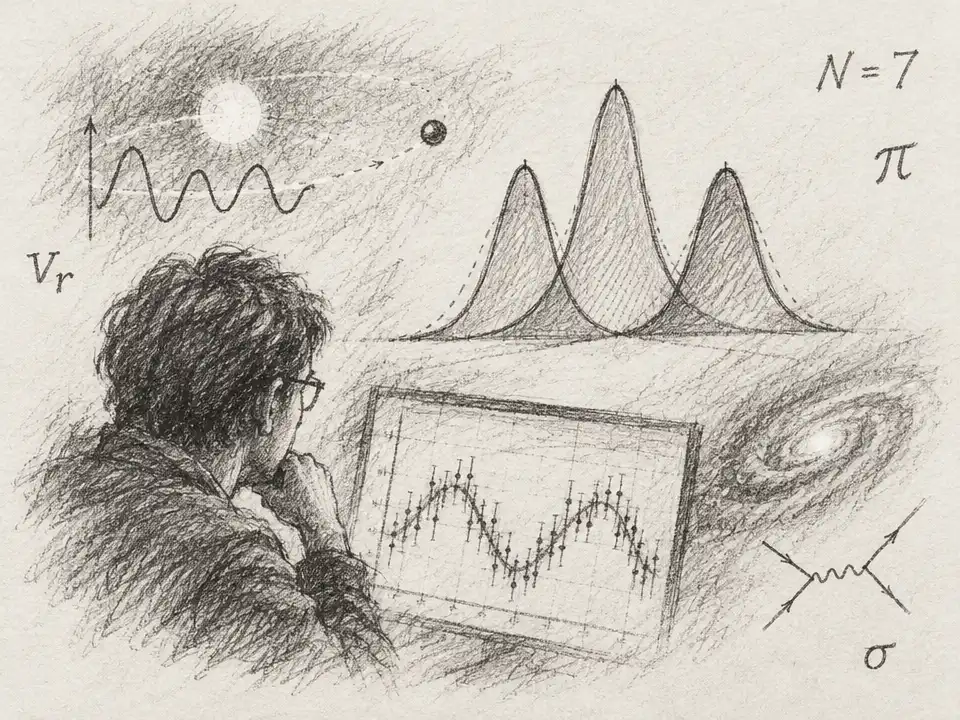
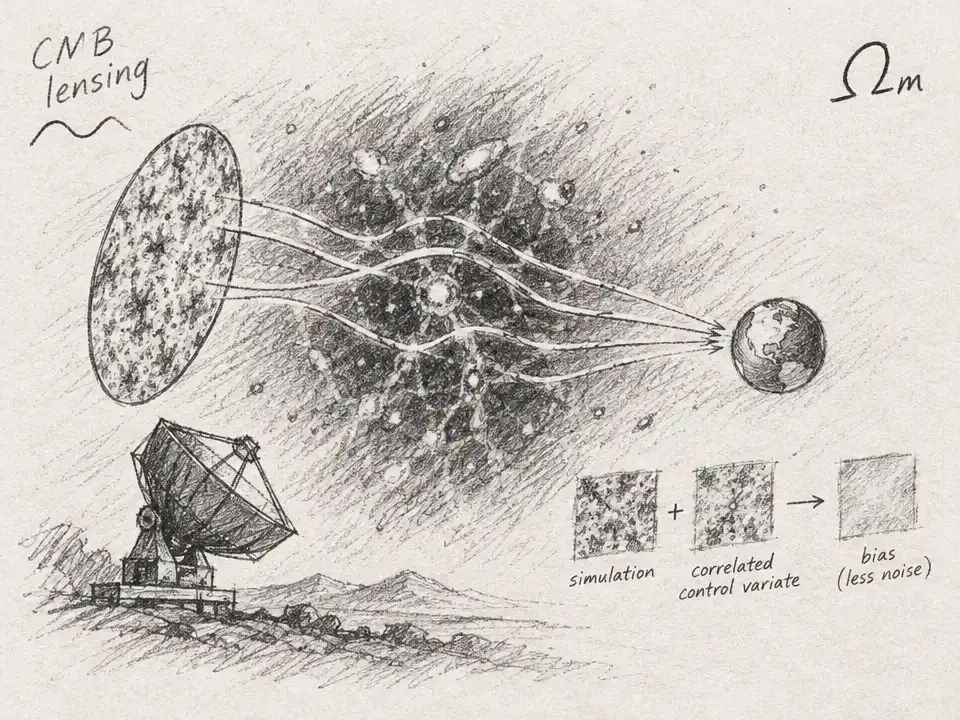
Toshiya Namikawa and Blake D. Sherwin propose a statistical shortcut known as a control variate. The idea is to make two estimates that fluctuate together, then subtract one from the other. If they share much of the same random variation, that common part cancels. Researchers add back the auxiliary estimate’s known average, preserving an unbiased result while reducing the number of simulations needed for a stable calculation.
For CMB lensing, the researchers build the auxiliary estimate from statistically isotropic, full-sky simulations of the lensed background light. The usual estimate still incorporates the actual survey mask and other features that make a real observation uneven. The simpler simulation serves as a companion: it captures much of the same variation, but its average can be calculated efficiently. This is not a replacement of the measured sky with an ideal one. It is a way to use the idealized calculation to subtract shared statistical fluctuations while retaining the realistic estimate.
The choice of companion matters. A simple approximation that assumes the sky’s temperature patterns are uncorrelated across different scales does not capture enough of the estimate’s run-to-run variation. Namikawa and Sherwin instead use isotropic simulated skies, finding that they remain strongly correlated with the realistic estimates. Even though a survey sees only part of the sky, the lensing reconstruction is approximately local: masking one of the paired temperature fields suppresses contributions from outside the observed region. That helps the auxiliary estimate track the fluctuations that matter inside the survey.
In simulations modeled on Planck, the Atacama Cosmology Telescope’s ACT DR6 analysis, and the Simons Observatory, the new method reduced the computation for the bias estimate by about a factor of two in the Planck-like case and about a factor of five for ACT-like and Simons Observatory-like cases. The estimates were highly correlated: approximately 97% in the Planck-like case and more than 99% in the ACT-like and Simons Observatory-like cases. The team modeled survey masks and used noise levels in the filtering, but did not add noise realizations to the simulated skies.
There is an important catch for ground-based observatories. They filter out some patterns in their maps to remove atmospheric noise and other contamination. That filtering also removes information that helps the realistic and auxiliary estimates track each other. With ACT-like filtering, the simulated correlation fell to about 94%, yielding an approximately 50% improvement in computational speed rather than the fivefold gain. Weaker filtering could bring the gain to about a factor of two, but the authors note that it might fail important checks of the measurement. In a further test, they mimicked filling some filtered-out patterns with Planck information; the estimated speed-up returned to around a factor of three for lensing signal at L ≲ 300.
These numbers describe tests of a proposed method, not a new lensing discovery or a shortcut already validated on every kind of observation. The study assumes researchers can use separate data splits to avoid correlated noise, and it does not include foreground contributions. Applying the method to a full dataset would require handling the noise, which is not generally statistically uniform. The authors also identify polarization-based lensing as a promising direction for future work, not a result established by this study.
The broader advance is a change in how researchers spend computation. Instead of asking every simulation to independently pin down a small correction, the method asks what the expensive and inexpensive calculations have in common—and lets that shared variation cancel. If future tests confirm the approach under the demands of real analyses, scientists could spend less time estimating the bias and more time exploring the uncertainties in their maps of the matter between us and the universe’s first light.