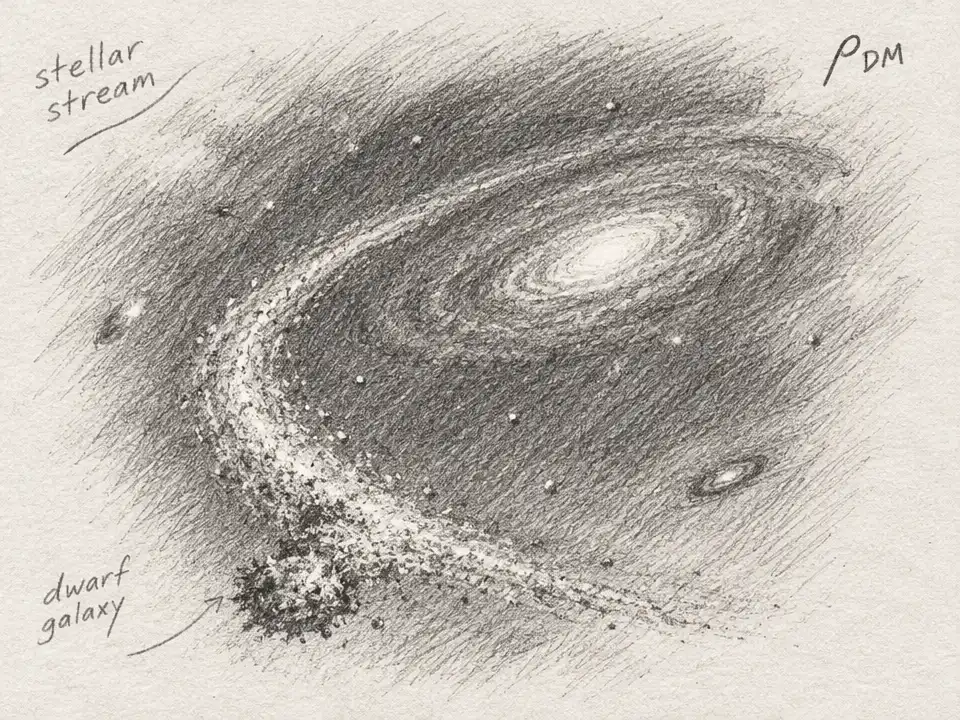
Picture a thin river of stars looping around a distant galaxy. Its original star cluster has been torn apart by gravity, leaving a pale trail across the sky. Now imagine that, for a stretch, the trail curves away from the galaxy it orbits. Is that bend just a trick of perspective—or a clue to the invisible matter shaping the galaxy?
A new study proposes turning that question into a test of dark matter. The surprising part is how little the test asks astronomers to measure: not the stars’ distances or speeds, but the stream’s outline and the apparent center of its host galaxy. The researchers’ work is a forecast for future surveys, not a detection that settles what dark matter is. But it suggests that a simple curve could help distinguish between competing pictures of the unseen halo around a galaxy.
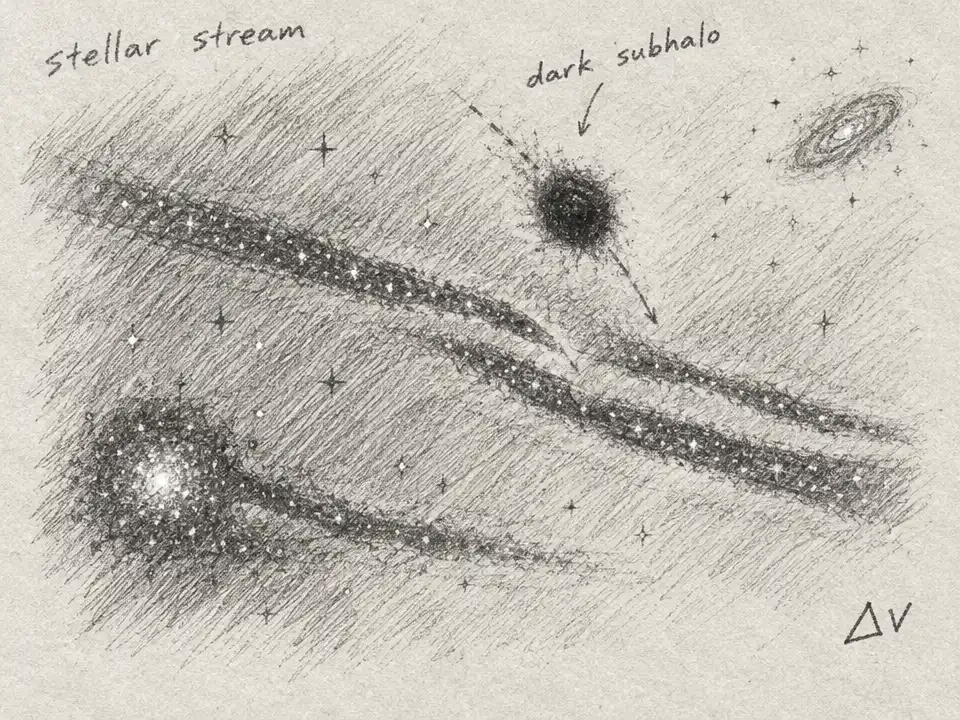
Stellar streams are debris from globular clusters or dwarf galaxies pulled apart by their larger hosts. Their stars continue along nearby orbits, so the stream’s path preserves a rough imprint of the host’s gravitational pull. That makes streams useful tracers of a galaxy’s dark matter halo—the much larger, invisible envelope whose gravity helps hold the galaxy together.
Here is the puzzle. In the standard cold dark matter picture, halos tend to be stretched and lopsided, or triaxial. In one alternative, self-interacting dark matter, dark matter particles scatter off one another. Those interactions can redistribute energy and make a halo rounder. If astronomers could measure halo shapes reliably, they could test which picture better matches the universe. The trouble is that distant galaxies are hard to weigh. Observers often lack the stellar motions and distances available for streams in the Milky Way. And measurements that combine many galaxies can blur the signal if their halos point in different directions.
The new method looks for a specific telltale: a section of stream whose curve points away from the galaxy’s projected center. The authors call this a convex segment. A stream bending toward its host is not, by itself, surprising. But under the study’s assumptions, a clear outward-bending section rules out a broad family of gravitational arrangements that are centrally concentrated and symmetric around our line of sight—including a perfectly spherical halo.
Why should a curve in a flat image say anything so strong? The key is that the stream is a three-dimensional structure seen in projection. In a symmetric gravitational field, the projected curve has to turn in a way that remains aligned with the host’s center. A lopsided gravitational field can twist the stream’s orbit out of that simple arrangement. Viewed from Earth, the twist can make the projected path bend away from the galaxy. The bend is not evidence that the stars are being pushed outward; it is a geometric clue that the gravitational landscape may not be symmetric.
Projection is usually a nuisance: it hides depth and can make a three-dimensional orbit look misleading. The paper turns that weakness into part of the test. To demonstrate the effect, the researchers took the Milky Way’s GD-1 stream and imagined viewing it from outside our galaxy at 104 different angles. In 23.1% of those views, some stretch of the projected stream appeared convex. In 3.2%, the outward-bending section extended more than 10 kiloparsecs; in 1.6%, the whole track appeared convex. These are modelled views of a known stream, not new observations of distant galaxies. They show that the clue can survive projection and be visible in an image.
One stream, however, rarely gives a complete answer. The method is deliberately modest: for each stream, record a yes or no. Does it contain a convincing outward-bending section? A convex segment can reject certain symmetric explanations, but the absence of one does not prove that a halo is round. Many factors—including the stream’s orbit and the viewing angle—affect whether the bend appears. The authors therefore make their main comparison across a population of streams.
That is where the rival dark matter pictures make different predictions. If halos are more often elongated, outward-bending segments should turn up more often. If self-interactions make halos rounder, such segments should be rarer. In the paper’s forecasts, one challenging scenario puts the rate at about 1.3% for cold dark matter, with the self-interacting case at roughly half that rate. Distinguishing the models at a statistical significance of 2σ to 5σ would then require roughly 3,400 to 21,000 streams. With a more favorable predicted detection rate of 7.8%, the estimate falls to roughly 740 to 4,600 streams.
Those large numbers are not a flaw so much as the price of a low-assumption test. The researchers do not fit a detailed gravitational model to each individual stream or assume a specific history for the cluster or dwarf galaxy that produced it. Instead, they ask whether the overall number of outward curves matches what each dark matter model predicts. The authors argue that future catalogs from Euclid, the Vera C. Rubin Observatory, and the Nancy Grace Roman Space Telescope could supply the needed sample. But the paper’s forecasts do not account for every observational complication, including how halo shapes change over cosmic time or how survey viewing conditions affect the effective rates.
There are practical clues to check before counting a bend. The method assumes the host’s visible center is a useful estimate of its mass center, and that the stream is coherent enough for its visible ridge to trace the underlying orbits. A stream that fans out, forms shell-like debris, or bends near the junction of two tails may not be telling us about the halo’s shape. Such regions need to be recognized and excluded. And translating a measured bend rate into a precise dark matter particle interaction strength will require simulations that connect particle behavior to halo shapes.
So the answer to the opening puzzle is not that a bent stream has solved dark matter. It is that a bend pointing the “wrong” way can expose a symmetry that gravity cannot have—if the stream and host center pass the necessary checks. The next clue may come not from one spectacular tail, but from thousands of faint ones. Together, their curves could reveal whether the dark scaffolding around galaxies is lumpy and stretched, or smoothed by interactions invisible to every telescope.