Imagine trying to learn the rhythm of a song from a handful of notes, recorded at irregular intervals. That is close to the challenge posed by many astronomical surveys: they catch distant quasars changing brightness, but not often enough to follow every twist in the tune. A new framework asks whether those incomplete flickers can still help measure the universe.
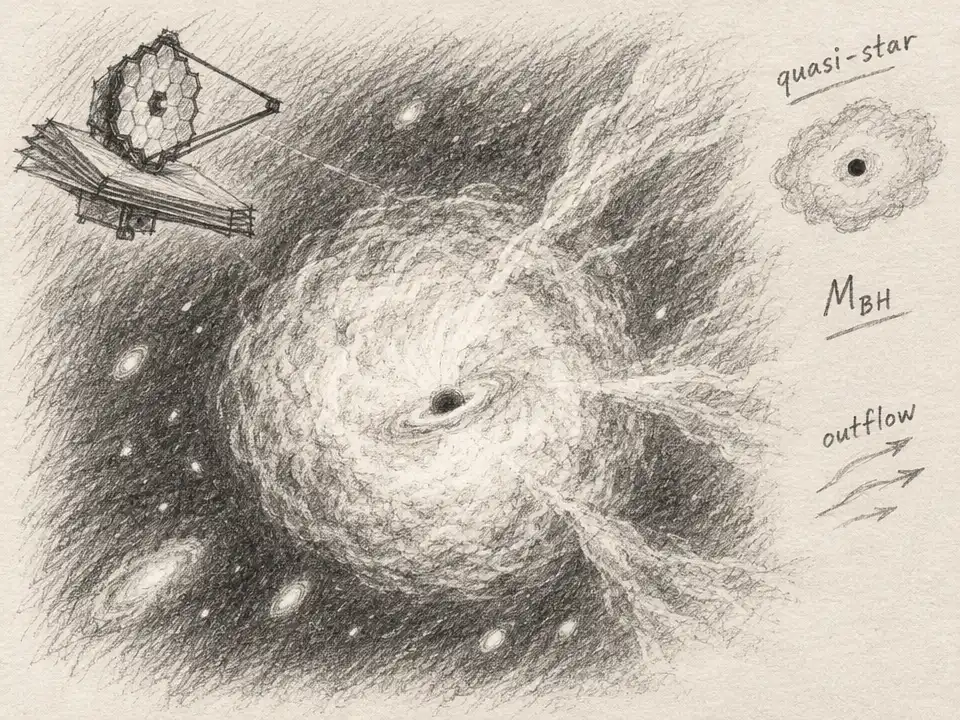
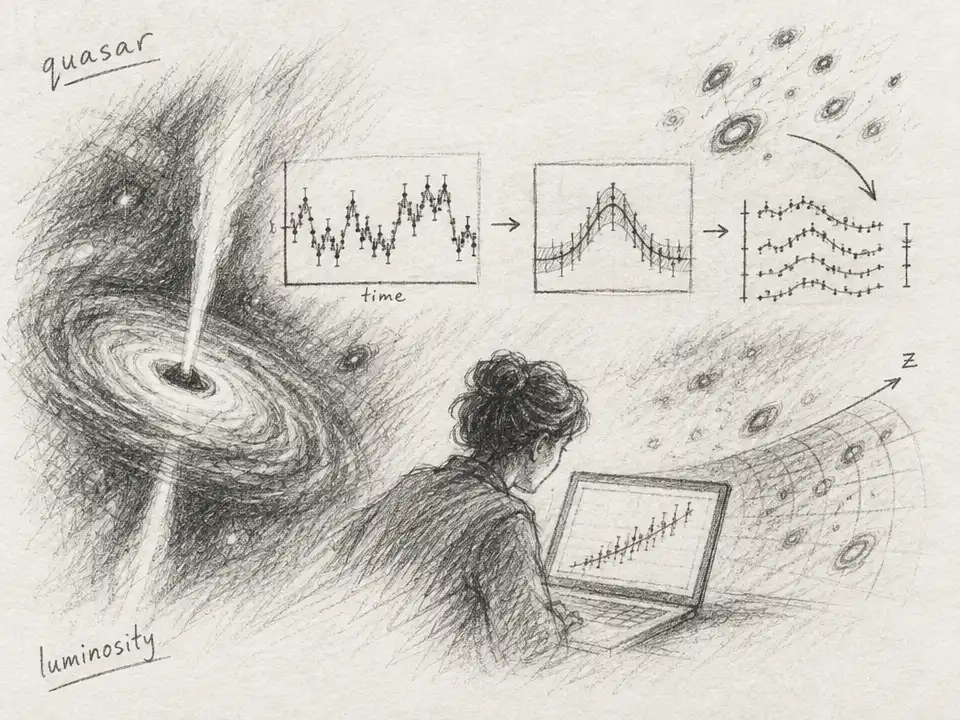
A quasar is the brilliant center of a galaxy, powered by matter spiraling toward a supermassive black hole. Its light does not hold steady. At optical and ultraviolet wavelengths, it brightens and dims in an irregular way. Astronomers have found a useful population-level pattern: at the same wavelength and timescale, more luminous quasars tend to vary less. If researchers can measure that relationship reliably, quasar flickering could help estimate distance—and distance, paired with redshift, can trace cosmic expansion.
The catch is that this is not a simple cosmic yardstick. A quasar’s variability depends on more than luminosity, including the wavelength being observed and the timescale under examination. And to turn observed brightness into luminosity, astronomers must assume a distance-redshift relation—the very thing they hope to test. The method must therefore make the assumptions explicit and compare a whole population, rather than treating any one quasar as a perfectly standardized beacon.
Júlia Laguna-Miralles, Vasily Belokurov, and Miles Cranmer build their approach around a practical constraint: a survey may observe a quasar for only a moderate stretch of time. Traditional models describe a flicker with parameters for its overall amplitude and characteristic damping timescale. But when a light curve does not span enough time to reveal the process’s long-term turnover, those separate parameters can be poorly pinned down. Extracting them anyway risks mistaking the limits of the observations for properties of the quasar.
The researchers instead divide the work into two stages. First, they fit each object’s light curve and retain samples of two quantities the available observations can better constrain: its average brightness over the actual observing window, and how quickly its variability grows over short time gaps. That second measure captures the local pace of the flicker without requiring the survey to witness the quasar’s full long-term pattern. Crucially, the method carries forward uncertainty in those measurements rather than turning each light curve into a single, deceptively precise number.
In the second stage, the team combines those uncertainty-aware measurements across a catalog. For each trial model of cosmic expansion, the framework translates a quasar’s observed brightness into an estimated luminosity, then asks whether the population’s short-timescale variability fits the expected luminosity relationship. A statistical technique called importance reweighting lets the researchers reuse the first-stage samples while testing population-wide relationships and cosmological models. In effect, each quasar contributes a range of plausible readings, and the population helps sort out which combinations fit together.
To see whether the strategy could work with real observing limitations, the team used Gaia DR3 quasar data to build a test environment. Their starting catalog contained 215,938 sources after light-curve quality cuts. They generated artificial light curves using actual Gaia observing times and measurement uncertainties, then ran those mock observations through the analysis. In a separate recovery test, the pipeline processed a mock catalog of roughly 110,000 quasars whose underlying relationship and cosmic distances had been set in advance.
The key result is methodological, not a new measurement of the universe. In these Gaia-like simulations, the window-average brightness and short-lag variability were recovered more robustly than the separate long-timescale parameters. The complete pipeline then recovered the values that had been deliberately put into the mock catalog, including its assumed distance-redshift behavior. That is a useful test: it shows that sparse, uneven observations need not automatically defeat the approach. But because the mock catalog was generated under the model being tested, the exercise does not establish that the model accurately describes real quasars or reveal a new cosmic expansion history.
Several important calibrations still stand between the proof of concept and an independent distance probe. With measurements in just one band, wavelength effects are tangled with redshift: the more distant the quasar, the different the portion of its light that Gaia’s band samples in the quasar’s own frame. The framework also cannot determine the absolute distance scale, expressed through the Hubble constant, without an external calibration of the variability-luminosity relationship. The authors point to multi-band observations and independent calibration as necessary next steps.
That makes the proposed advance less like discovering a new ruler than learning how to read one in poor lighting. The team’s method is designed to extract useful information from survey data before astronomers can build decades-long, densely sampled light curves for every source. Future datasets from facilities and surveys such as ZTF and Rubin/LSST could provide longer or multi-band records for many more quasars, though applying this framework to real samples will require further checks of calibration and selection effects.
If those checks succeed, quasars could add a new set of distant markers to the cosmic map, reaching farther than supernova measurements are plentiful. For now, the important finding is narrower and more solid: even a choppy record of a black hole’s flicker may contain a measurable signal—provided researchers model what the observations missed as carefully as what they caught.