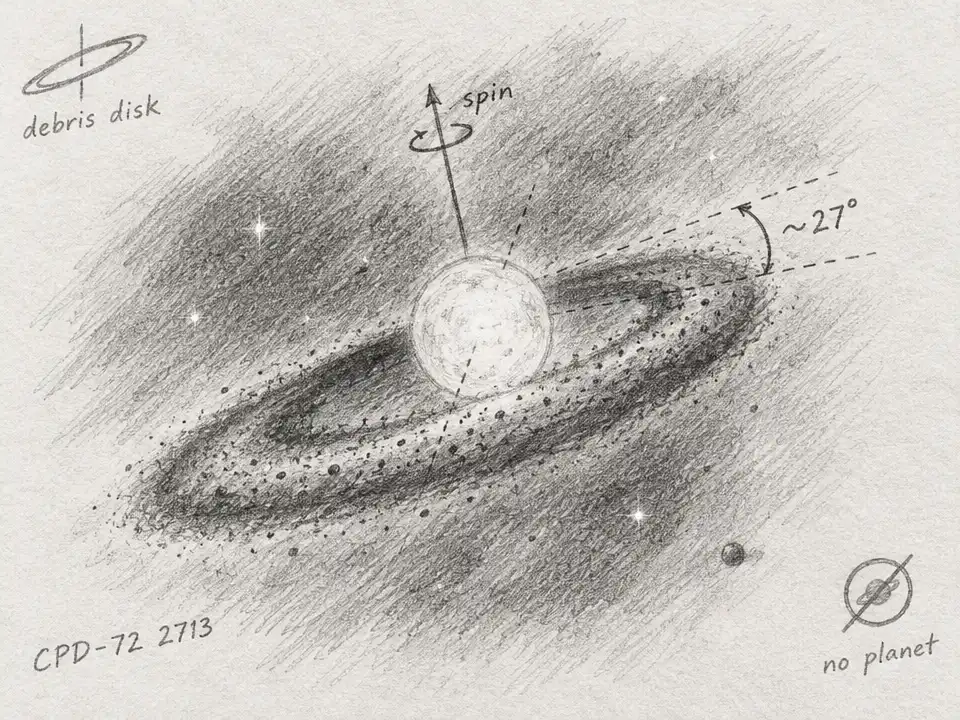
Picture a planetary system as a spinning top surrounded by a thin ring of rubble. The familiar expectation is that the ring and the star’s spin should share roughly the same axis: both emerged from the same rotating cloud, and planets grew from the disk around the young star. But a new view of a nearby star’s dusty leftovers has upset that tidy picture. Its disk appears tilted relative to the star—and the obvious suspect, a giant planet, has not turned up.
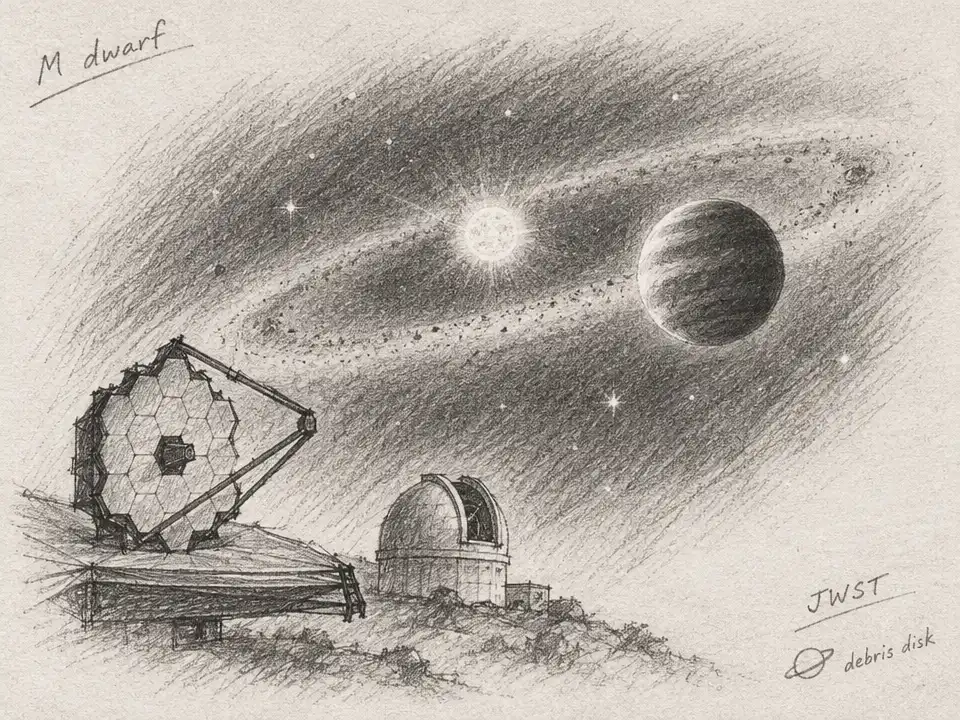
The star, CPD-72 2713, is about 24 million years old and belongs to the Beta Pictoris moving group. Its debris disk is not a young, gas-rich nursery. It is a more mature belt of small bodies and dust, with collisions among larger objects continually replenishing the fine grains. Until recently, astronomers had not seen this particular disk in scattered starlight: light from the star reflecting off its dust. The James Webb Space Telescope’s NIRCam instrument captured it at two near-infrared wavelengths, producing the first such images.
The disk looks nearly face-on from Earth, like a broad, faint ellipse around a hidden center. Turning that shape into an orientation takes careful modeling: astronomers account for how the telescope blurs the image and how the image-processing method affects the signal. The team found that the disk’s apparent radius depends on the wavelength. It reaches about 55 au in one filter and 39 au in the other, while observations of its thermal glow at longer wavelengths trace material out to roughly 100 au.
That difference is not necessarily a disagreement about where the disk ends. The instruments are sensitive to different grains. Webb sees small grains scattering starlight; longer-wavelength observations detect heat from colder dust spread farther out. It is a reminder that a “disk” is not one simple ring drawn in the sky, but a changing population of particles that different telescopes reveal in different ways.
The more startling comparison was between the disk’s orientation and the star’s rotation. A flattened disk image tells astronomers how much the disk is tilted toward or away from our line of sight. The star’s angle can be estimated by combining its measured rotation speed with its rotation period and size. For CPD-72 2713, the period—tracked through repeating changes in the star’s brightness—is about 4.47 days. Spectral lines broadened by the star’s rotation supply another clue to how much of that motion points toward us.
Putting those measurements together, the team estimated the star’s spin axis to be inclined about 47° to our line of sight. The disk’s axis is closer to 19°. Their difference gives a minimum mismatch of about 27°. “Minimum” matters: astronomers do not yet know how the two axes point across the plane of the sky, so they cannot reconstruct the complete three-dimensional angle. The true tilt could be larger. Still, estimates from both Webb filters indicate, at 95% confidence, that the mismatch exceeds 10°.
Why should the disk be out of step with its star? A planet on an inclined orbit can gravitationally tug on a disk and gradually warp or redirect it. That makes a planet a natural suspect—and gives astronomers a reason to look. Webb’s images rule out planets brighter than the instrument’s detection limit, down to about three-tenths the mass of Jupiter at distances of roughly 18 au from the star and farther out. But an image cannot exclude every planet: a smaller world or one closer to the star could remain hidden.
The researchers also tested whether a planet at the edge of what Webb could detect would have had enough time to tilt the distant belt. In their model, a planet of that mass at that distance would need about 57 million years to influence the disk’s outer edge—more than twice the system’s estimated age. A lower-mass planet, or one farther inward, would act more slowly in this scenario. That makes a large, distant planet an unlikely explanation, not an impossible one. The calculation depends on the model and the disk’s assumed structure; it does not establish that no planet is involved.
Other possibilities remain open. The star may have been tilted while it was young and gathering material. A close stellar flyby could have disturbed the debris, or interactions between a young star’s magnetic field and its disk could have shifted their orientations. The observations cannot pick a winner. The mystery is not simply that the axes differ; it is that a likely cause has not announced itself, even after a targeted search.
CPD-72 2713 is not the first hint that stellar spin and surrounding debris can diverge. A 2023 survey compared stars and resolved debris disks in 31 systems. Six showed minimum misalignments of roughly 30 to 60°, though most appeared more closely aligned and measurement uncertainties leave room for hidden tilts. That wider survey found no established explanation for the most striking cases. Webb’s new result adds a particularly useful system to the puzzle: the disk is imaged in scattered light, its star’s rotation is measured, and a giant-planet explanation faces a timing problem.
The result does not mean planetary systems are usually built crooked, or that their planets must follow the tilt of this outer debris. A debris belt is a later remnant, and its present-day orientation may not preserve the geometry of the earliest planet-forming disk. But the observation unsettles an easy assumption: a star’s spin is not always a reliable compass for the material orbiting it. In this system, the dust keeps circling at an angle, while astronomers search for the event that set it there.