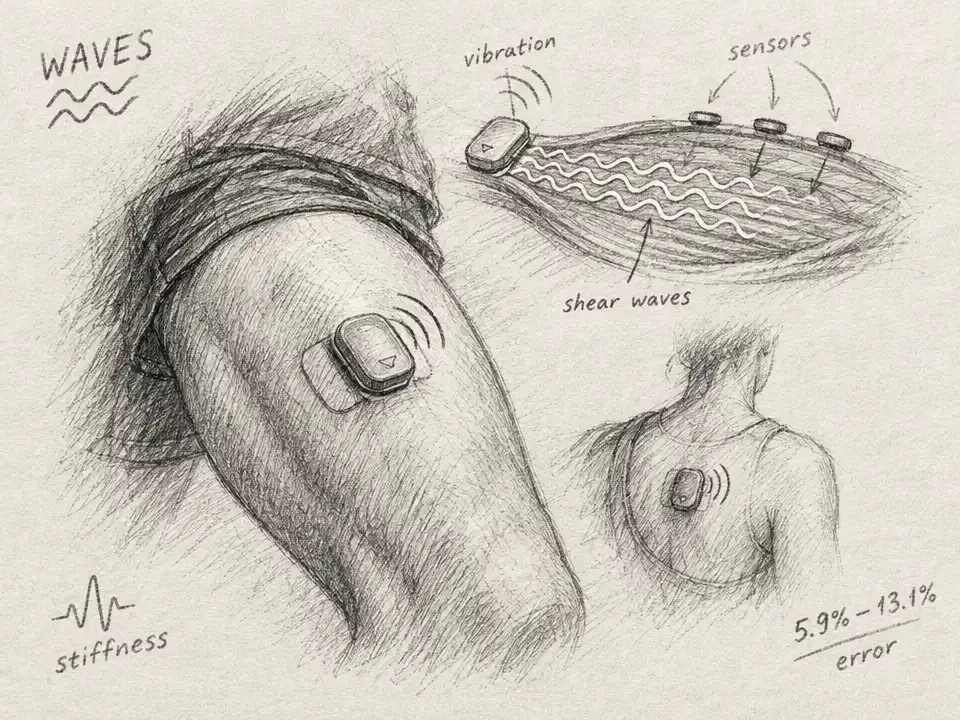
Imagine a small patch on your thigh giving a brief, almost imperceptible buzz. It is not trying to make the muscle move. Instead, the patch is listening for a ripple that slips through the tissue—and timing how quickly that ripple reaches tiny sensors nearby. From that travel time, a prototype system called WAVES estimates how stiff the muscle is while it rests.
That quiet measurement fills a gap in wearable sensing. Many familiar muscle monitors track electrical signals or vibrations produced when muscles contract. But resting stiffness is a different property: it describes how tissue resists being deformed even when you are not deliberately flexing. It can shift with physical condition, yet it is hard to monitor outside a clinic. Ultrasound-based shear-wave elastography can measure tissue stiffness, but it relies on specialized equipment and trained operation.
WAVES takes a more compact route. A bone-conduction transducer presses a controlled vibration into the skin. The vibration launches shear waves—sideways motions that travel through soft tissue, rather like a ripple crossing a flexible surface. Stiffer tissue generally carries these waves faster. The device does not make an image of the muscle. Instead, it places several motion sensors along the muscle and compares when each one detects the passing wave.
The key clue is a small difference in arrival time. If two sensors are a known distance apart, their timing difference helps estimate how fast the wave moved between them. WAVES uses that speed to estimate stiffness. The idea sounds simple; the tissue is not. Skin, fat, muscle fibers, and the sensor’s adhesive can all bend, damp, or redirect the vibration. A sensor may also pick up motion traveling through the patch itself rather than through the muscle.
So the researchers designed the system not just to collect signals, but to question them. Its processing checks whether the measured timings fit physiological and geometric expectations, whether multiple sensors tell a consistent story, and whether the signal looks like a useful shear wave. Measurements that fail those checks can be rejected. Repeated readings are then grouped to find a stable estimate rather than trusting one noisy pulse.
This is the prototype’s less obvious invention: a wearable that knows when its own evidence is shaky. In tissue-simulant gels, that filtering mattered. On three gels with measured stiffnesses of 393 N/m, 593.4 N/m, and 713 N/m, the system’s estimated errors were 1.42%, 8.46%, and 4.8%, respectively. In comparisons on those gels, the full WAVES method also outperformed simpler timing approaches. But a gel block is a controlled stand-in, not a living, moving body.
The on-body results are an important next step. The study enrolled 14 participants and tested the thigh, trapezius in the back, and brachioradialis in the forearm. For the 13 participants included in the reported cross-muscle analysis, average estimation error was 13.1% for the thigh, 7.4% for the forearm, and 5.9% for the back. The paper notes that errors stayed within 20% in these tests, a margin it describes as acceptable for non-clinical, everyday monitoring—not clinical diagnosis.
There is a practical price for that accuracy: patience and placement. A typical on-body estimate used about 100 measurement trials, taking approximately 1–2 minutes of data collection. Each trial involved 16 short pulses, and the sensors had to be aligned with the muscle fibers. A flexible, 3D-printed guide helped keep their spacing consistent. The study also found that good placement produced more usable measurements than poor placement. A future consumer patch would need to make that setup less fussy, and to cope with everyday motion and the diversity of real bodies.
The researchers also tested the system on one user during a workout session, a first look at use beyond still measurements. That is not yet proof of reliable round-the-clock monitoring. The participant group was small, and the paper’s authors frame applications such as tracking recovery or guiding rehabilitation as possibilities to explore—not outcomes already demonstrated. Stiffness is one clue about muscle condition, not a verdict about injury or health.
Still, the approach points toward an intriguing kind of wearable: one that briefly probes the body instead of merely waiting for the body to produce a signal. The same vibration hardware might someday combine sensing with haptic feedback, the authors suggest, or help track changes over time between clinical visits. Before that future arrives, the device must become easier to place, faster and more dependable in motion, and better tested across people and conditions. For now, WAVES shows how a small buzz—and careful attention to the wave’s path—could make an otherwise hidden mechanical property measurable.