Imagine flying through a wind that never stops streaming outward from the Sun. Your instruments register a steady rush of charged particles—and then, for a moment, the magnetic field threading that wind points the opposite way. The particles have not turned around. The field has folded.
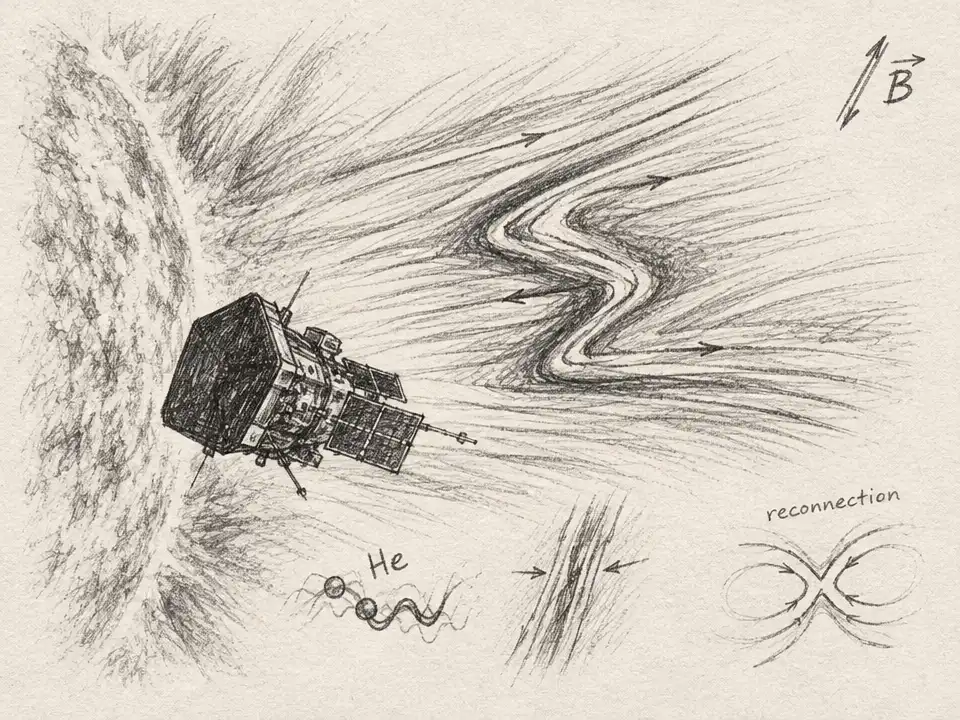
These brief reversals, called switchbacks, became a recurring surprise in measurements from NASA’s Parker Solar Probe. They can last seconds or much longer. In many, the magnetic field changes direction dramatically while keeping roughly the same strength. The puzzle is not just what makes a field bend so sharply. It is where the bend is made: near the Sun, or out in the wind itself.
That distinction matters. If switchbacks are launched from the Sun, they may preserve clues to how magnetic fields there reconnect and release energy. If they form as the solar wind travels, then the wind is not simply carrying a solar imprint outward. It is actively reshaping it along the way.
To separate those possibilities, researchers look beyond the field’s direction. Parker Solar Probe measures the surrounding plasma, too. A switchback often pairs the magnetic reversal with a change in the wind’s speed, while the field’s overall strength stays comparatively steady. That combination is a clue: the event may be a changing orientation of a magnetic structure, not a simple reversal of the whole flow.
One explanation begins with waves. Alfvén waves are disturbances that travel through magnetized plasma, moving magnetic field and particles together. In a study using computer simulations, researchers started with modest waves and let them travel through an expanding solar wind. As the wind spread outward, the waves grew relative to the background field. Their direction changes became large enough to produce sharp bends and, eventually, reversals.
The simulations offer a striking possibility: a switchback need not begin as a dramatic eruption on the Sun. Ordinary waves, carried outward and amplified by expansion, can develop switchback-like shapes in the wind. The simulated field also tended to keep nearly constant strength while changing direction, resembling an important feature of observations. But a simulation demonstrates that a mechanism can work under modeled conditions; it does not prove that every switchback forms that way.
A second theoretical study offers a different route to the same strange geometry. Picture an Alfvén wave moving outward, but not at exactly the same speed across its width. That uneven motion shears the wave: one side gets ahead of the other. The shear can tilt the magnetic field until its outward-pointing component flips. In this account, a wave does not need to grow through expansion alone; a sideways variation in how it propagates can twist it into a reversal.
Then come the spacecraft’s clues about origin. A separate analysis examined switchbacks across seven Parker Solar Probe encounters, looking not only at magnetic structure but also at small-scale current sheets and helium in the plasma. Helium can help distinguish different solar-wind populations. The researchers found both helium-rich and helium-poor material associated with switchbacks, a sign that these structures may be connected to more than one kind of magnetic region on the Sun.
That result complicates any single-origin story. The researchers argued that the evidence points toward magnetic reconnection—the rearrangement of magnetic connections—as an important formation process, while allowing that waves and turbulence may contribute. They also could not rule out switchbacks forming in interplanetary space. The evidence is suggestive, not a final verdict on which mechanism dominates.
So the field’s apparent about-face may have more than one maker. Some switchbacks could carry fingerprints of changing magnetic connections near the Sun. Others may be sculpted, or further altered, as waves travel through the expanding wind. A spacecraft passing through one brief structure can measure what it looks like at that instant; retracing where and how it formed is harder.
That is why the reversal is more than a magnetic oddity. It is a moving clue to the history of the solar wind—one that asks researchers to read direction, speed, composition and fine-scale structure together. Parker Solar Probe has made the puzzle visible up close. The answer may be that the wind does not have a single recipe for turning a field backward.