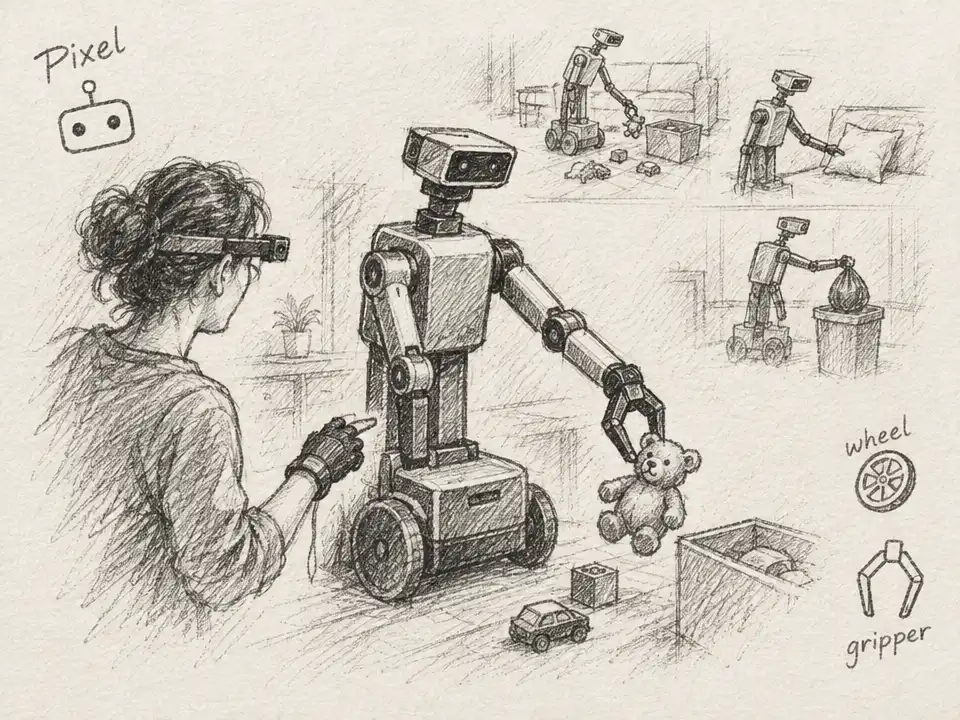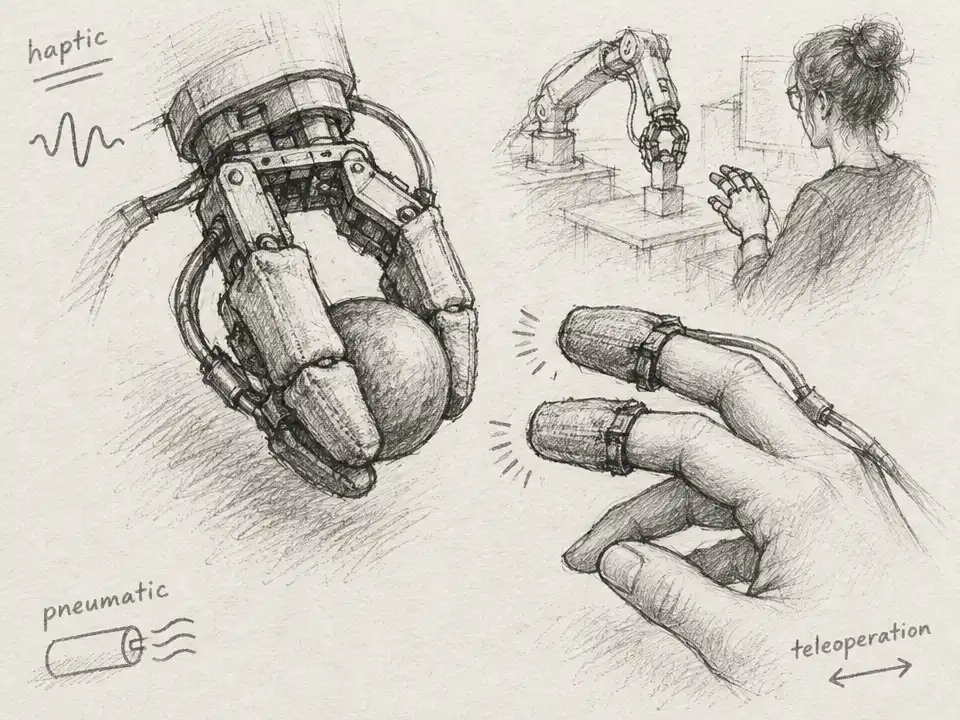
A robot’s gripper closes around a soft, sand-filled bag. From a camera, the operator can watch the fingers meet the object—but the image may not reveal whether the grip is gentle or crushing. Researchers have built a way to send another kind of information across that gap: the pressure of contact, delivered as a push against the operator’s own fingertips.
The device is made from small, air-filled textile pouches. One pouch sits inside each finger of a robot gripper; matching pouches press against a human operator’s fingers. When the robot touches something, pressure changes in its pouches are sensed and sent wirelessly to the human-side device. There, the pouches inflate or deflate to reproduce the changing pressure on the skin.
That may sound like a simple swap of one air signal for another. The important twist is that the same mechanism can do both jobs. A pouch can act as a sensor, an actuator, or both. Its internal pressure is the quantity the system measures—and the quantity it controls to create a touch cue. Instead of translating a robot’s contact into an unrelated vibration or beep, the system uses pressure to make pressure.
That directness addresses a stubborn design problem in remote manipulation. People naturally use touch to adjust how they hold an object: a slight shift in pressure can signal that a grip is too firm, or that a surface gives way. But many remote-control systems separate the two ends of that exchange. A robot records touch through one kind of sensor, then sends the operator a different kind of signal to interpret. Vibrations, for instance, can flag an event, but conveying a continuously changing force through them may require the operator to learn what each pattern means.
The researchers’ approach depends on a small control system built around each pouch. Every channel has a proportional valve, a pressure sensor, and its own microcontroller. That local feedback loop lets the device adjust pressure continuously rather than simply switch an air pulse on and off. The system can hold a pressure, change it quickly, and keep the signal from fading immediately.
In tests, the device’s force response reached 34.2 ± 1.2 Hz. When pressure was stepped from 1050 mbar to 2000 mbar, the average rise time was 29 ms and the settling time was 39 ms. Two paired devices sent a sensed pressure signal from one to the other with an average latency of 64 ms across 10 trials. Most of that delay came from wireless communication through the host computer. The device itself retained pressure for much longer than comparable compact pneumatic systems: after its external supply was disconnected, pressure remained above 1700 mbar after 16 min.
These measurements matter because a touch cue that arrives late or fades quickly is hard to use as the hand moves. The authors also designed the setup to be wearable, rather than tied to a benchtop compressor. A device has a base weight of 204 g, with 52 g added per channel; the two-channel version weighs 308 g. It can use wall air or an onboard reservoir. One device can contain up to twelve channels, though adding channels also adds weight.
To find out whether people could read the pressure cues, the team ran perception tasks with 25 participants. They tested whether participants could compare different force levels and distinguish objects with different stiffness. In the stiffness task, participants’ accuracy using robot-delivered fingertip feedback was 91.4% for two-object comparisons and 90.8% for three-object comparisons. Those results came close to direct hand-based performance: 90.1% and 96.7%, respectively. In other words, the mediated touch carried useful information about how much an object yielded when squeezed.
Weight proved more difficult. In a three-object comparison, participants identified weights with 100% accuracy by hand but 53.8% through teleoperation. They had to operate the robot while remembering and comparing fingertip sensations, adding demands that a simple force or stiffness comparison did not. The result is a reminder that transmitting touch is not the same as making every task feel exactly like direct handling.
The team also tested pick-and-place tasks with a soft bag, comparing performance with and without fingertip feedback. Nineteen participants’ teleoperation results were analyzed after device malfunctions led to exclusions. With feedback, participants applied less pressure in all three visual conditions: 19.2% less with a direct view, 23.1% less with an obstructed view, and 7.2% less when relying on the robot’s camera. They also finished two versions of the task faster—21.8% and 25.6%—though the obstructed-view task showed little overall improvement in time or path length.
Participants reported lower mental demand with feedback, from a mean score of 47.6 to 39.0, a reduction of 18.1%. The study was a demonstration, not a test of every kind of remote work: it involved a particular robot, interface, and set of tasks, and the authors note that the hardware could be smaller and its force resolution improved. Even so, it points to a useful change in design logic. A robot need not merely send a picture of contact, or encode touch as a signal the operator must decode. With a soft pouch, a pressure change at the machine can become a pressure change on the human hand—making remote control a little less like watching, and a little more like feeling.