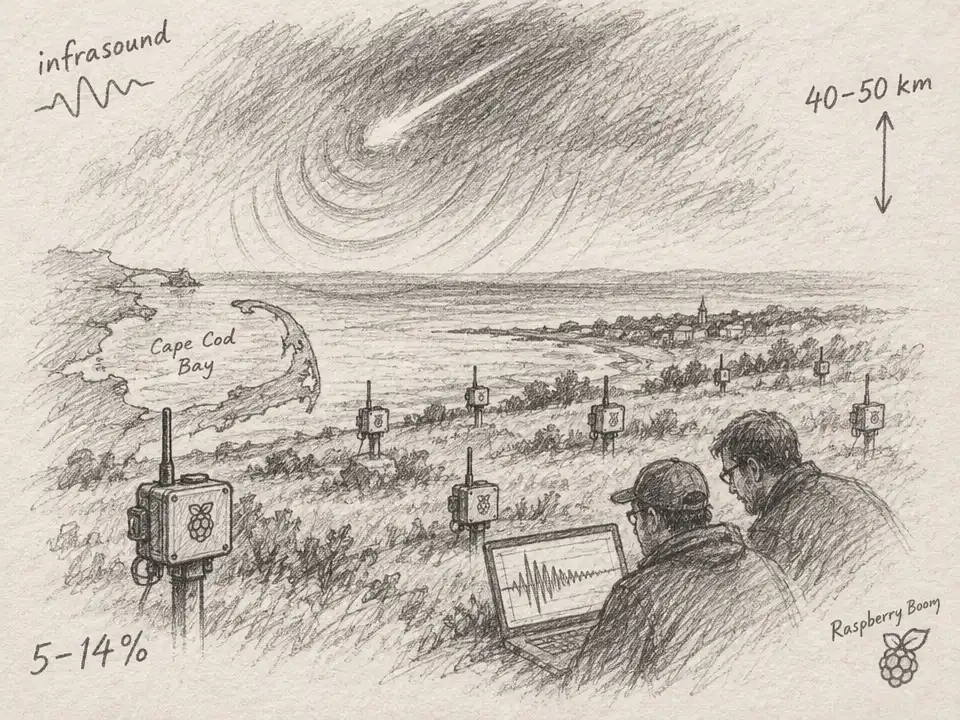
At 18:11:36 UTC on May 30, 2026, a sensor in Somerville, Massachusetts, recorded a strange, slow pressure pulse. It arrived several minutes after a meteor had blazed over Cape Cod Bay, roughly 80 kilometers southeast of Boston. The flash was gone. The sound, too low to hear, had traveled through the atmosphere and reached a scattered collection of sensors run by universities, schools, and hobbyists.
Steven Africk and Abraham Loeb turned those recordings into a kind of acoustic investigation. Instead of relying on a camera aimed at the sky, they asked what the wave itself could reveal: Which way had it come from? How high had the meteor exploded? And did the sound come from the fireball in the air, or fragments striking the water below?
The sensors were Raspberry Boom devices, part of a wider network that monitors very low-frequency pressure changes. Seven Boston-area stations captured the event. Their recordings showed a pulse lasting about one and a half cycles at 0.4 hertz. That is far below the frequencies our ears can hear, but a sensor can register it as a rise and fall in air pressure.
The first clue was timing. A pressure wave reaches one station before another because the two sites lie at different distances from its source. For each pair of sensors, the researchers compared the arrival-time difference with the distance between the stations. That gives a direction from which the wave could have arrived, much as two people timing a distant clap can tell which side of a room it came from.
One pair alone cannot pinpoint a source: the same timing difference can fit directions on either side of the line between the sensors. But compare several pairs, and the possible directions begin to narrow. Here, the resulting lines pointed toward Cape Cod Bay, in the direction of both the meteor’s atmospheric path and its estimated splash point.
They did not, however, cross cleanly enough to triangulate one exact location. The Boston sensors were relatively close together, and the fireball and splash sites lay nearly along the same direction from the city. That limitation is part of the story, not a footnote: a promising technique can point toward a source and still leave the central mystery unresolved.
So the researchers tried another test. They compared each sensor’s arrival time with its distance from different possible sources. If the assumed source is right, the distances and times should fit a plausible sound speed through the atmosphere and lead back to a plausible event time. Changing the assumed explosion height changes both the travel distance and the time the wave would need to arrive.
The best fits put the fireball blast between 40 and 50 kilometers above Earth. A 50-kilometer source gave an estimated event time close to the time inferred from optical observations; the 40-kilometer fit also gave a plausible sound speed. Fits for blasts at 0 or 75 kilometers did not match as well. This is a neat shift in perspective: the air itself becomes part of the measuring instrument, because sound’s journey through it carries clues about where and when it began.
But the splash remained a credible alternative in the timing test. A sea-level source also produced a good fit: its estimated sound speed was 346 meters per second, and its inferred event time came about a minute after the nominal fireball blast. On timing alone, the recordings could not settle the question.
The researchers then examined the pulse’s pressure. A stronger pressure wave generally carries more acoustic energy, though turning a sensor reading into the energy at the source requires assumptions about how the sound spread and how long it lasted. The measured amplitudes varied from station to station, possibly because of differences in sensor calibration and placement. The team therefore treated the resulting energy as an estimate, not a precision measurement.
Using their pressure readings and refining the estimated distance to the fireball, they calculated an acoustic energy of 2.3–6.5 × 10¹¹ joules. That is 5–14% of the meteor’s estimated total blast energy. The higher values are toward the upper end of historical estimates for how much fireball energy becomes sound. Even so, the inferred acoustic energy was far greater than the fragments could plausibly have carried into the bay. The authors conclude that the infrasound came from the atmospheric blast, not the splash.
The result shows how a network built for listening to pressure changes can double as a meteor-tracking tool. It does not replace optical observations, and this single event does not prove that every meteor can be located this way. The study also exposes what would make the approach stronger: more widely separated sensor pairs could cross in a useful pattern and improve triangulation; better calibration could tighten energy estimates.
A meteor’s visible streak lasts a moment. Its low-frequency wave can keep traveling after the light has vanished, carrying a delayed record of the event through the atmosphere. With enough sensors in the right places, that record may help researchers reconstruct fireballs that would otherwise leave only a brief flash and a distant boom.