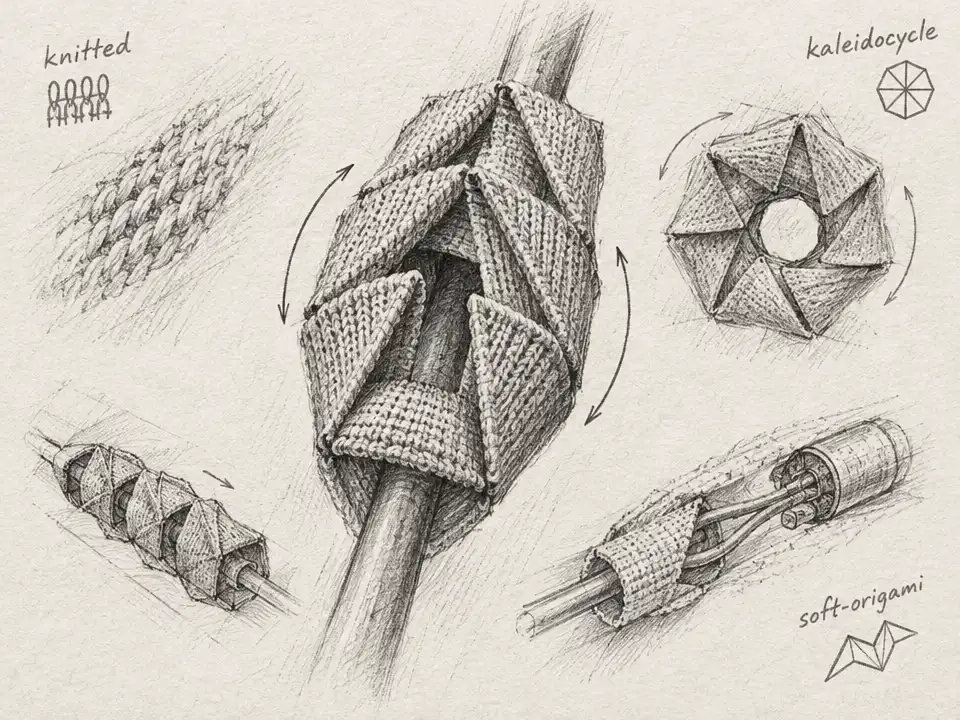
A sleeve is usually designed to follow the body. But what if the fabric could also guide a machine around it? In a recent soft-robotics demonstration, a knitted loop twists and changes its radius as it travels along a slender form. Its motion comes from a motor and tendons; the surprising part is how much of the machine’s behavior is built into the textile itself.
The key is to make the knit behave less like an ordinary piece of cloth and more like a carefully folded sheet. Origami works by joining relatively stiff panels with flexible creases. The researchers translated that arrangement into stitches: different stitch patterns encourage folds in chosen directions, while heat-fusible yarn helps selected regions hold their shape. The result is fabric with a mechanical map woven into it.
That map matters because cloth can deform in too many ways at once. A fold meant to close in one direction might instead curl, buckle, or twist somewhere else. The researchers tested how their stitch patterns bent, then used the measurements to improve the difference between a desired fold and an unwanted one. Heat-fusible yarn stiffened the panels, while the stitches helped define the creases. Together, those choices made the knitted structures fold more predictably.
The team used the method to make several familiar origami patterns in fabric, including designs that compress, expand, or twist as they move. Then they built a wearable soft robot shaped like a kaleidocycle: a closed chain of hinged sections that can rotate continuously around its center. Unlike a simple ring, this shape can keep an open channel through the middle as it turns.
That open center gives the robot a route around a narrow object, such as the mannequin arm used in the demonstration. One motor drives rotation; tendons adjust the loop’s radius by pulling selected parts of the structure. The knitted form can therefore travel while changing how tightly it fits. The textile is not supplying the energy, and the prototype is not a self-powered garment. Instead, its geometry helps turn a motor’s pull into a controlled sequence of folds and rotation.
Why build the moving structure from knit rather than cut plastic or paper? The researchers’ comparisons point to a trade-off. Thin plastic can be stiff, with edges that are less comfortable against a body; paper can be so compliant that the structure twists out of shape. Knitting offers a soft surface, while programmed stitches and selected stiffening yarn provide some of the structure needed for motion. The appeal is not that fabric solves every engineering problem. It is that softness and mechanical direction can coexist in one textile.
Other origami-inspired robots show how far the same design idea can travel. A separate project called GeoGami pairs an origami shell with a compliant 3D-printed skeleton. A single motor turns a gearbox that pulls cables around the body in sequence. Each pull changes the robot’s shape and shifts its balance; once its center of mass passes a tipping point, the structure rolls. Here, geometry helps a simple input produce a larger movement.
At a different scale, researchers have also tested soft origami actuators that use internal pressure to change shape. In one demonstration, sensors patterned onto an actuator let it estimate its own position and follow commanded movements without relying on a camera. In a separate, open-loop setup, three actuators supported a platform that could change its height and tilt under a person’s weight. These are distinct demonstrations, not a single finished robot, but they underline a central challenge: a soft machine needs not only to bend safely, but also to know where it is and bear the loads its task requires.
The knitted robot remains a proof of concept, not a ready-made wearable device. The demonstration does not establish how the structure would perform through long-term use, washing, or everyday movement. But it suggests a useful shift in how engineers think about fabric. Cloth need not be merely a cover for a mechanism. With the right pattern of stitches, yarns, and folds, it can become part of the mechanism—soft enough to conform, structured enough to move, and precise enough to steer motion in a chosen direction.