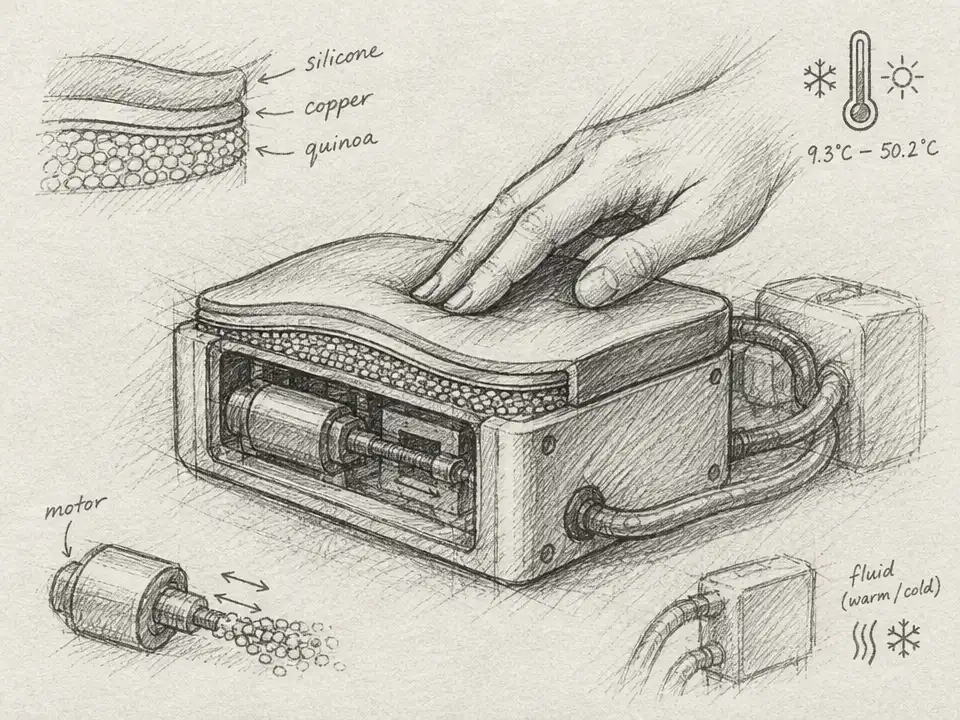
Press a fingertip into a virtual object and the illusion usually stops at the glass. The image may show a warm, yielding surface, but your finger meets the same hard screen. A new tabletop prototype tries to close that gap: its surface can change both how much it gives under pressure and how warm or cold it feels. The catch is tucked just below the touch.
The device is about the size of a small serving tray, with a circular touch surface 150 mm across. Beneath it sits a fabric pouch filled with quinoa seeds. In their loose state, the seeds shift around one another. Twist the pouch, and the grains press together, bracing against each other like a crowd packed into a narrow doorway. A motor controls that twist, changing how stiff the surface feels when pressed.
Changing temperature requires a different trick. The top layer is a thin silicone skin with channels carrying heated or chilled water. Copper powder mixed into part of the silicone helps spread warmth across the touch surface, while another silicone layer helps keep heat from leaking down into the seeds. That separation matters: the granular bed needs to remain free to change stiffness, rather than becoming a large sponge for heat.
It is an unusual pairing of mechanisms. The jamming pouch provides a changeable foundation; the water channels provide thermal feedback. A small pump circulates the water, while a thermoelectric module heats or cools it. The researchers’ engineering challenge was to let these systems share a surface without one spoiling the other. On the bench, they found that the display could change softness and temperature at the same time.
To measure the mechanical response, the team pressed a small, flat indenter into the surface with forces meant to resemble the start of a finger press. In its unjammed state, the surface had an initial contact stiffness of 0.63 N/mm. At 1 Nm of motor torque, stiffness reached 2.38 N/mm. The surface did not simply become uniformly rigid: the researchers also measured how its response differed as it was pressed and released. That hysteresis was high in the softest state, but fell to 2.1% at maximum torque.
The temperature range was broad enough to make the surface distinctly warm or cool. In tests at an ambient temperature of 20.7°C, it reached a maximum of 50.2°C after 20 minutes of heating and a minimum of 9.3°C when chilled. The copper-silicone layer helped keep the touch surface relatively even: during heating, the temperature difference between water channels was less than 0.3°C, though the area near the inlet was slightly warmer.
Temperature control was precise once the display arrived at its target. In one test, the system cooled from about 33°C to a 15°C setpoint in 12 minutes, then stayed within ±0.2°C of that target for 15 minutes. But the wait is central to the story, not a footnote. The researchers observed about a 30-second delay between issuing a command and seeing the expected temperature response, and the larger heating and cooling changes took minutes. This is not a surface that can instantly switch from a warm hand to a cold stone.
That slow shift points to the price of combining sensations in one device. Water, pumps, a thermoelectric module, a heatsink and fan, a motor, and a granular mechanism all have to fit into the system. The display’s broad surface takes time to heat or cool, and the water and hardware carry thermal mass that must change temperature too. The team suggests investigating smaller surfaces or separate hot and cold water supplies to improve response, but each choice brings its own trade-offs in size, complexity, or usable area.
If those delays can be reduced, the payoff could be more than a convincing virtual pebble. Temperature and softness together help people distinguish materials and interpret what they touch. A trainer might one day use such a display to explore how tissue feels under pressure and how warmth or coolness changes the impression. Researchers could use it to study how the brain combines touch and temperature. Those are possible uses, not outcomes this prototype has already demonstrated.
That distinction is important: the paper reports engineering tests, not a study showing that users can reliably identify virtual objects or that the device improves medical training. The prototype’s next frontier is therefore twofold. It must become quicker and more practical, but researchers also need to find out what combinations of softness and temperature people can actually perceive—and whether those sensations help them do anything better.
For now, the device offers a useful glimpse of what a richer interface might demand. A screen that can yield beneath a fingertip and carry warmth across its surface is no longer just an image with a clever vibration. It is a small, complicated machine that has to manage grains, fluid, heat, and pressure together. The surprising part is that it works at all. The price is measured in minutes.