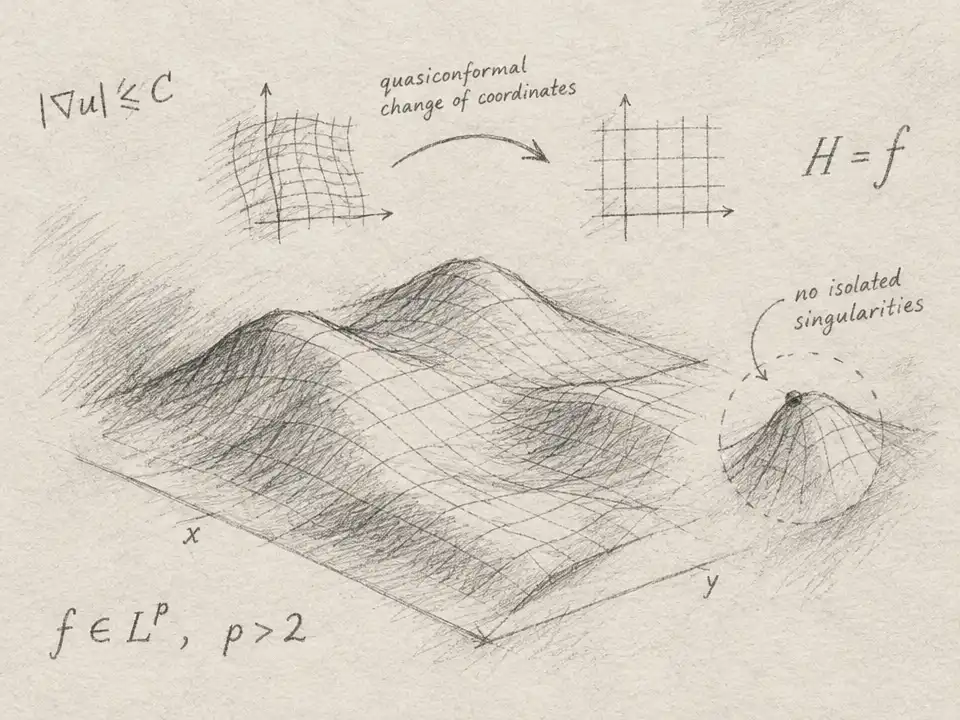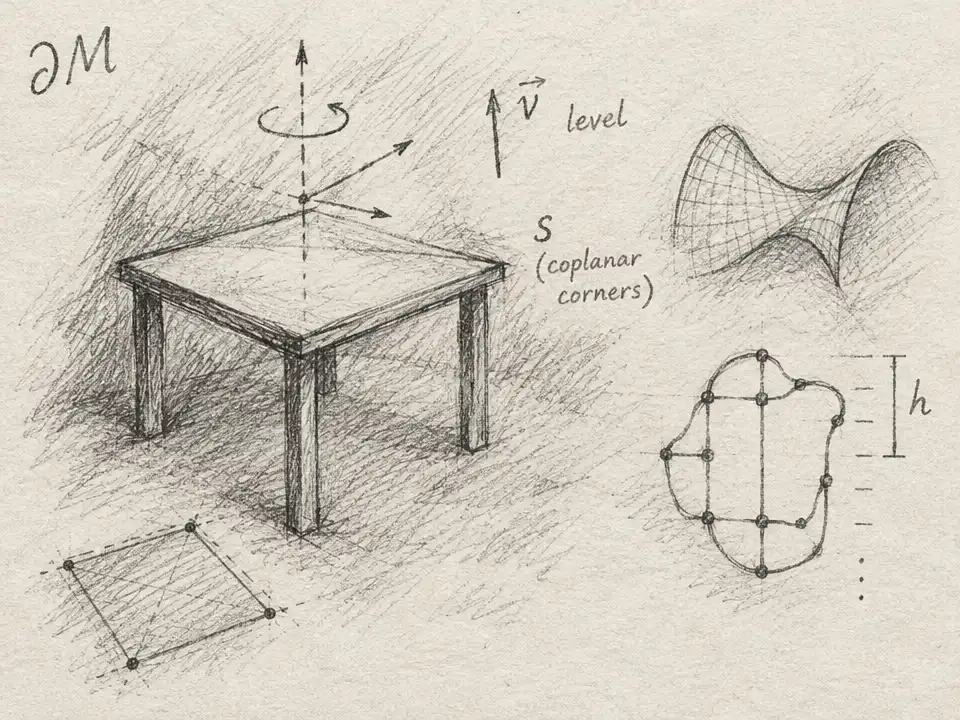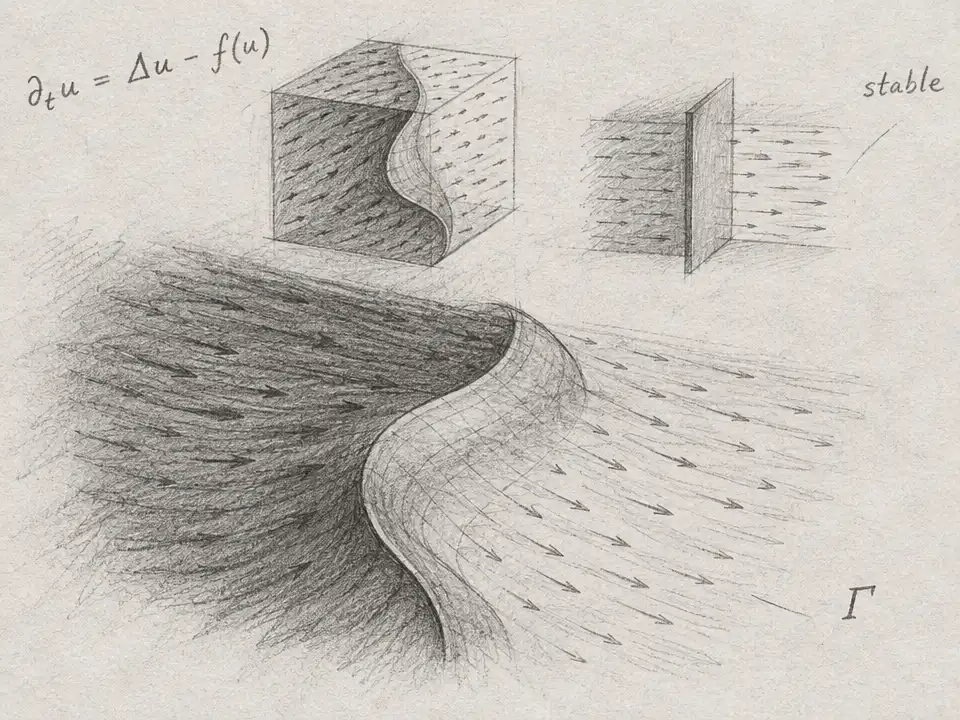
Imagine a mathematical field filling all of space, with each point carrying a value somewhere between two stable states. The boundary between those states is not drawn in the equation itself. It hides in the places where the field equals zero: a surface that might, at first glance, bend, split, or ripple without limit. A new mathematical result asks what happens when this hidden surface belongs to a particularly well-behaved field—one that is stable against small disturbances. In three dimensions, the answer is stark: stability leaves no room for a genuinely curved front.
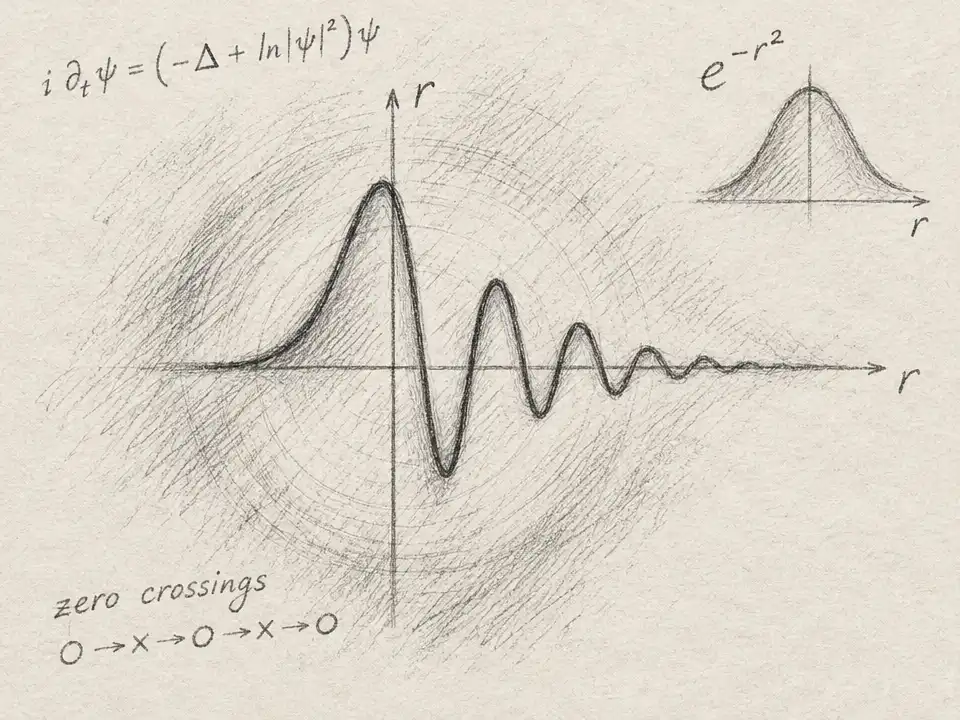
The field is governed by the Allen–Cahn equation, a model used to study transitions between phases. Its simplest nonconstant solution is a smooth one-dimensional change from one state to the other. The change happens across a plane, and the field’s value depends only on distance from that plane. But the equation has many other solutions; the challenge is to show that a stable one cannot hide a more complicated shape.
Stability here has a precise mathematical meaning. If researchers make a compactly supported perturbation—a change confined to a bounded region—the energy cannot decrease at second order. That sounds like a local rule. The surprise is that the authors use it to control the field everywhere, with no assumption that its energy grows at a convenient rate far from the origin. In a September 2026 arXiv preprint, Yong Liu, Tianci Luo, Kelei Wang, Juncheng Wei, Yong Wei, and Ke Wu prove that every bounded, stable solution throughout three-dimensional space is either one of the two constant states or a planar transition.
The proof starts by finding a hidden measure of how far the field departs from the ideal flat transition. The authors turn the field into a phase coordinate and define a nonnegative defect that registers departures from the one-dimensional profile. At a zero of the field, a vanishing defect is decisive: the mathematics forces the entire solution to be the flat profile. So any counterexample—a stable solution with a nonflat interface—must contain zeros where the defect is distinctly positive.
Stability puts a budget on those troublesome points. A weighted total of the defect inside a large ball grows more slowly than the ball’s radius. That estimate prevents nonflat zeros from forming an endless connected trail: such a trail would accumulate too much defect. The researchers can therefore isolate a bounded cluster of them, call it K, and cover it with a finite collection of disjoint unit-radius balls. Each ball carries a definite amount of the defect. The cluster is a compact, measurable source of trouble—not a vague irregularity disappearing into infinity.
Now comes the proof’s carefully designed test. Near the selected cluster, the researchers use a function built from the field itself, arranged to make a negative contribution to the stability calculation. Farther out, where the interface behaves more like a collection of separated flat fronts, they use the normal derivatives of one-dimensional transitions. These are not arbitrary patches: their shape follows the hidden surface. If the surface curves, the test detects that curvature.
Translating stability into a rule for the surface is delicate. A surface may have several nearby transition layers, and even when their zero surfaces do not touch, the layers’ tails can overlap. The authors track the interaction terms rather than pretending each front is alone. Once those contributions are controlled, stability yields an inequality on the regular part of the zero surface: squared curvature is penalized, while changes in the test function along the surface carry a cost of their own. In effect, bending has to be paid for by the variation of a cutoff.
The remaining question is whether the cutoff can be made cheap enough. Here the scale shifts again. The zero set in three-dimensional space is a two-dimensional surface, so the authors study its geometry intrinsically—measuring distances along the surface, not through the surrounding space. They cap and connect boundary loops with auxiliary pieces, then use geometric tools including the Gauss–Bonnet formula to establish area bounds. Those bounds let them build logarithmic cutoffs whose gradient cost can be made small as the cutoff is stretched outward.
This geometric detour is essential because the cluster K might be huge. The negative contribution near it and the error terms farther away are all controlled in proportion to the same number of covering balls. The authors choose the cutoff scales first, making the error per ball small, and only then let the cluster determine how many balls are needed. Its size cannot rescue a nonflat solution: both sides of the comparison scale together. Stability demands that the negative contribution be offset, but the carefully spread-out cutoff cannot provide enough compensation. The assumed nonflat zeros lead to a contradiction.
That closes the three-dimensional classification. It also unlocks a result in the next dimension: a bounded solution in four-dimensional space that increases strictly in one coordinate must depend on just one direction. That is the full De Giorgi conjecture in four dimensions, under its monotonicity condition. The paper also derives local curvature estimates for stable solutions, extending the geometric message beyond the all-space classification.
The striking idea is not that stability makes a surface look flat when viewed from far away. It is that stability can be translated, step by step, into a geometric constraint on a surface that was invisible in the original description. A field becomes a phase boundary; the boundary becomes a curvature inequality; and a cutoff, stretched across the hidden surface, turns an imagined bend into a contradiction. In this mathematical landscape, stability is not merely a label for a calm solution. It is a rule that forces the concealed interface to straighten.