A droplet dries on a warm surface. To the naked eye, the result is just a faint stain. Under an electron microscope, though, the deposit tells a more surprising story: slender clay particles have sorted themselves by length, gathering into layers and lining up like a crowd that has found a shared direction.
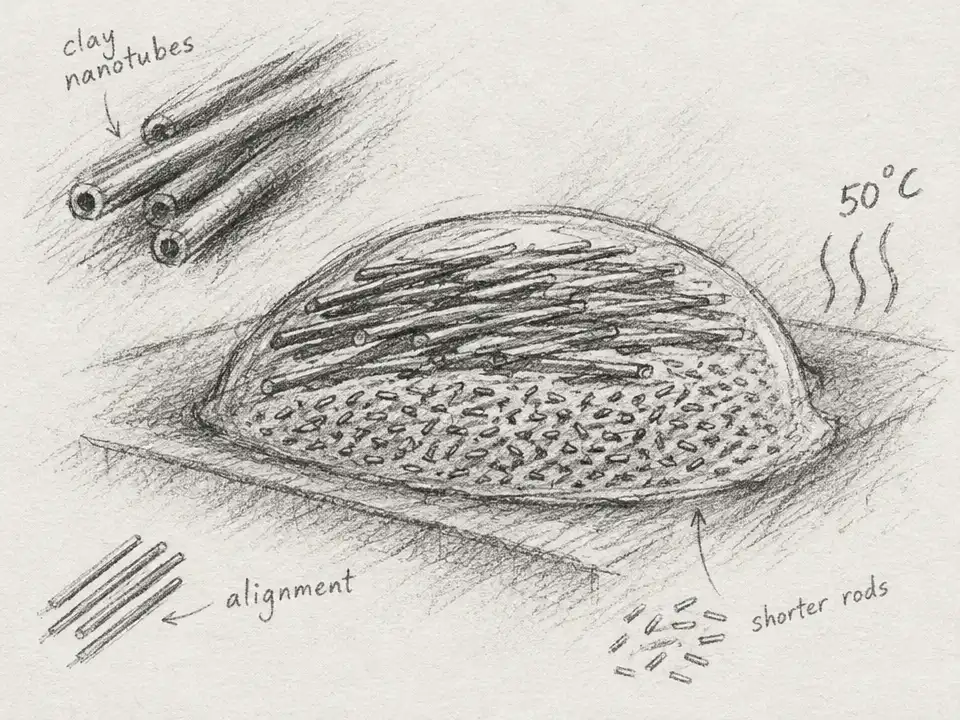
The particles are halloysite nanotubes, naturally occurring clay minerals shaped like tiny hollow rods. They vary in length, and that variation matters. When many rods point roughly the same way, the material enters a state called nematic order. Unlike a bundle of arrows, a nematic has no single forward direction: neighboring rods align, but either end can point first.
In a 2025 experiment, researchers placed a 4 μL droplet of water containing the nanotubes on a silicon surface heated to 50 °C. The suspension was deliberately polydisperse, meaning its rods came in a range of sizes. As the water evaporated, the researchers compared the dried deposit with one made on an unheated surface, then examined both from above and in cross-section using scanning electron microscopy.
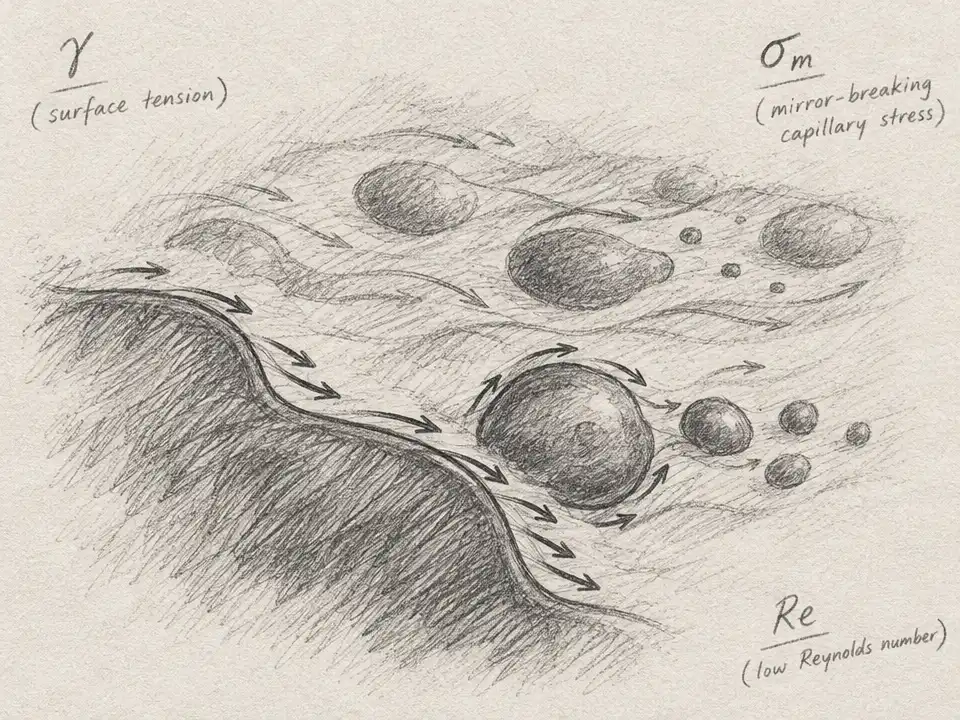
The warm surface changed the drying process in two ways. First, heating made the droplet’s surface recede about 11 times faster than in the unheated comparison. Second, temperature differences within the droplet stirred flows driven by surface-tension gradients. These Marangoni flows helped spread particles more evenly, reducing the familiar coffee-ring stain that often forms around a drying drop.
But the real surprise appeared in the deposit’s depth. In the heated sample, longer rods were concentrated near the top, where they formed an aligned layer; shorter rods were more common near the silicon. The unheated sample showed no comparable layering. And when the researchers prepared a sample with a narrower range of rod lengths and a lower average aspect ratio, they saw neither clear stratification nor strong alignment. That control suggests the particles’ size distribution is part of the story, not merely a side effect of warming.
The result builds on an earlier study of halloysite droplets dried without the same heated-substrate setup. There, the researchers found that alignment varied across the deposit: ordered patches appeared in some regions, surrounded by areas where the rods remained disorganized. These “nematic islands” appeared where the local rods were long enough relative to their width. The team estimated that strong ordering became possible around an aspect ratio of 6.5, with some uncertainty. In the later experiment, the sorting through the droplet’s depth appears to enrich the top layer in precisely the kind of long rods that can align.
That connection makes the drying drop look less like a passive puddle and more like a rough sorting device. Evaporation moves the interface; fluid flows redistribute particles; differences in rod length help determine where particles end up. Once enough long rods collect together, their shape favors alignment. The researchers did not watch every stage happen in real time, however. Their microscope images capture the final structure, not a movie of rods migrating through the liquid.
The unexpected part is that the observed layering is not an obvious prediction of a standard estimate. Using the full height of the droplet as the relevant distance, the researchers calculated that evaporation should dominate over particle diffusion so strongly that the conventional picture would not favor the stratification they saw. They suggest a possible resolution: in a dense suspension of rods, the important distance might be the space between neighboring particles, roughly comparable to a rod’s length, rather than the entire droplet height. On that smaller scale, their estimate moves into a range that could allow sorting. It is a plausible explanation, not a settled mechanism.
Temperature also has a limit. At 80 °C, evaporation was about three times faster than at 50 °C, but the aligned layer became less ordered. The microscope images showed defects—places where the rods’ local alignment breaks down. The researchers suggest that stronger flows might disrupt the pattern, or that rapid drying might freeze the rods before order has time to develop. They have not yet pinned down which explanation is right.
That uncertainty points to the next experiment: track the rods while the droplet is still drying, rather than infer their journey from the dried coating. For now, the findings show how a simple adjustment—warming the surface—can turn a broad mixture of natural clay nanotubes into a more uniform, aligned deposit. Such control could eventually help researchers design functional coatings from imperfect raw materials. The practical promise is still a possibility, not a demonstrated product. The immediate discovery is more basic: in a drying drop, shape, flow, and heat can conspire to make order emerge where a simple calculation said not to look for it.